
Bitcoin ($BTC) has successfully regained the $73,000 threshold, driven by significant institutional interest and a reduction in geopolitical tensions. While the overall market exhibits signs of recovery, attention is centered on the “institutionalization” of digital currencies, with key players such as BNY Mellon and CME Group broadening their presence.
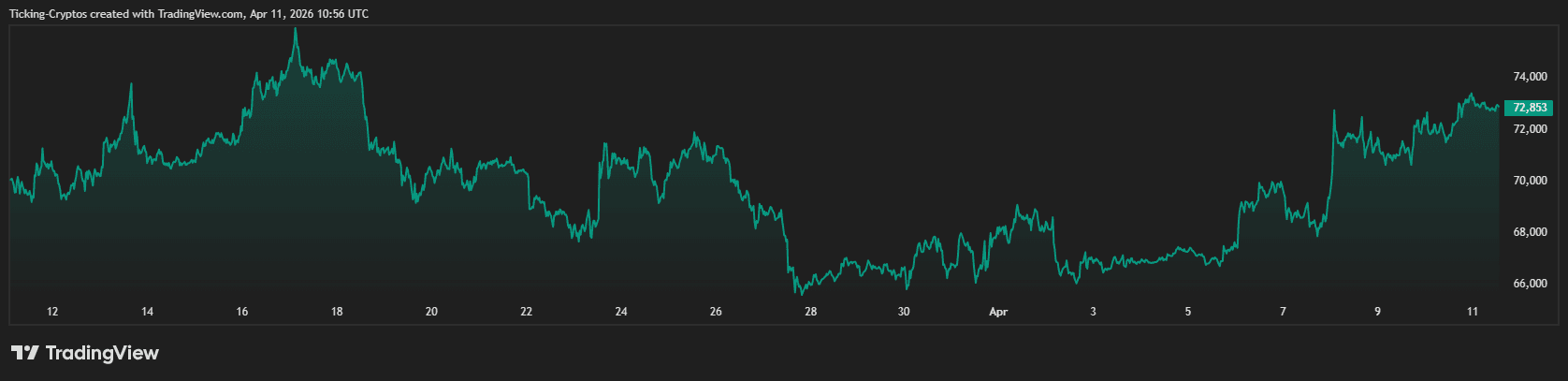
Current Crypto Prices: Bitcoin and Altcoin Performance
This morning, the total market capitalization for cryptocurrencies stands at approximately $2.51 trillion.
Bitcoin ($BTC): Currently trading around $73,010 after experiencing a net inflow of $350 million into spot ETFs.
Ethereum ($ETH): Increased by 2.01%, reaching $2,230 as developers gear up for upcoming network enhancements slated for 2026.
Altcoins: Solana ($SOL) and BNB have seen slight increases in value. Additionally, CME’s recent introduction of futures contracts for $AVAX and $SUI, has redirected professional trading towards mid-sized assets.
The Factors Behind Bitcoin’s Surge Today?
The main catalyst driving today’s price increase is a blend of institutional investment alongside advancements in regulatory clarity within the United States. Treasury Secretary Scott Bessent recently called on Congress to pass the CLARITY Act—an initiative that would clearly differentiate between digital commodities and securities.
“The absence of a definitive regulatory framework is undermining U.S. leadership,” stated Bessent while indicating that foundational trust mechanisms for major banks are finally being established.
Additonally, Bank of New York Mellon (BNY) has broadened its “Crypto-to-Treasury” corridor which provides crypto-native clients with continuous access to U.S. Treasury bills—effectively linking decentralized finance with traditional fixed-income markets. You can monitor these real-time changes using our Bitcoin price ticker.
Crypto News Update: CME Introduces New Altcoin Futures Contracts
The CME Group made headlines by officially launching regulated futures contracts for Avalanche ($AVAX) and Sui ($SUI ). This follows similar moves made by Bitcoin and Ethereum to categorize these tokens as “tradeable commodities” on Wall Street.
This development serves two purposes; it offers enhanced liquidity along with hedging options for institutions but also signifies an end to what many considered the “wild west” phase regarding these specific assets.
The Roadmap Ahead For Ethereum In 2026: Glamsterdam And Hegotá
While Bitcoin captures most headlines lately, Ethereum is quietly preparing its next phase of evolution following updates like “Pectra” and “Fusaka,” set to roll out before 2025:
- Glamsterdam (H1 2026): Aiming at optimizing Layer- Two scaling solutions while further decreasing gas fees associated with rollups.
- Hegotá (H22026): Focused on enhancing transaction parallelization aimed at boosting network throughput.
These technical advancements are crucial if Ethereum intends to retain its competitive edge against faster rivals such as Solana . For those holding substantial amounts Of $ ETH or $ BTC , ensuring security remains vital – refer To Our Hardware Wallet Comparison To Discover The Optimal Storage Solution .
<h22Risks To Monitor : The Stablecoin Yield Discussion
Despite prevailing bullish sentiment , potential challenges loom over The Market due To Proposed Restrictions On Stable Coin Yield Rewards . Leaked Drafts From The CLARITY Act Indicate That Regulators May Seek To Ban Interest Payments On Stable Coins As A Measure Against Possible Deposit Flight From Traditional Banking Institutions ; This Uncertainty Has Resulted In Minor Fluctuations Within Shares Of Companies Such As Coinbase And Circle .