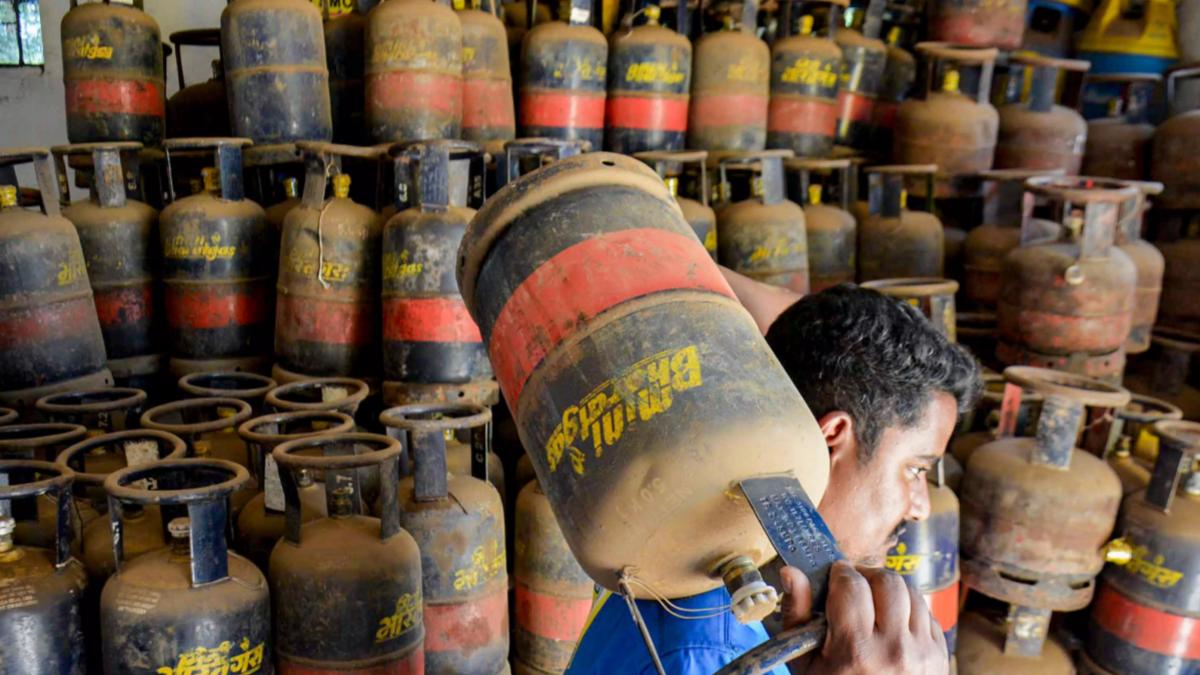
The Centre will release the remaining ₹17,500 crore compensation to state-run oil marketing companies (OMCs) in FY27, in seven tranches, as part of a ₹30,000 crore support package to offset mounting LPG under-recoveries, the petroleum ministry has informed the parliamentary standing committee on petroleum and natural gas.
The ministry told the panel that under-recoveries on domestic LPG stood at ₹41,267 crore as of March 31, 2025, reflecting the extent of financial stress on Indian Oil Corporation (IOC), Bharat Petroleum Corporation Ltd (BPCL) and Hindustan Petroleum Corporation Ltd (HPCL).
“In view of the accumulated under-recoveries and the projected losses on sale of domestic LPG, the Government approved compensation of ₹30,000 crore,” the ministry said, adding that the payout is being released in tranches across FY26 and FY27.
ALSO READAgri-exports to Gulf region slows down due to high freight
Accordingly, ₹12,500 crore is being disbursed in FY26, while the remaining ₹17,500 crore will be released in FY27, in line with the tranche-based schedule outlined by the government.
Balancing the Burden
The ministry attributed the losses to its pricing policy. “To insulate consumers from fluctuations in international LPG prices, the increase in cost was not passed on to consumers of domestic LPG which led to significant losses for the three OMCs,” it told the panel.
It further highlighted the burden-sharing approach adopted by the government. “Last year also, out of the total losses of ₹60,000 crore, ₹30,000 crore were absorbed by oil PSUs and ₹30,000 crore by the Government of India, in order to insulate Indian citizens from high international LPG prices,” the ministry said.
The ministry also pointed to sustained global pressures, noting that international LPG prices “went up during 2024-25 and continue to remain high,” necessitating continued fiscal support to OMCs.
The stress comes amid rising domestic demand. India now has over 33.21 crore LPG consumers, including 10.43 crore beneficiaries under the Pradhan Mantri Ujjwala Yojana (PMUY), expanding the scale of subsidy support required.
Consumption levels have also increased, with average annual LPG usage among PMUY beneficiaries rising to 4.83 cylinders, indicating deeper penetration of clean cooking fuel.
ALSO READBlack mass recyclers warn against sudden export curbs
The subsidy burden has correspondingly risen. LPG subsidy outgo increased from ₹6,965 crore in FY23 to ₹13,640 crore in FY25, even before factoring in compensation payouts to OMCs.
Budget allocations reflect this trend. The government has provided ₹17,500 crore in FY27 under the head of one-time grant to PSU OMCs for LPG under-recoveries, while the overall petroleum ministry allocation has been raised to ₹37,653 crore, up 41% year-on-year.
The Parliamentary panel, however, flagged concerns over utilisation. It noted that actual expenditure in FY26 stood at just 52% of revised estimates, indicating gaps in implementation.
This is the second major intervention in recent years. The government had earlier extended ₹22,000 crore support in January 2023 to offset losses incurred during the previous cycle of global price spikes.
Responding to concerns on compensation claims, the ministry said, “All bills raised by the OMCs are duly checked and vetted… ensuring there is no double counting,” underlining the role of PPAC and internal scrutiny mechanisms.
Earlier in March, ministry in a statement said that state-owned oil marketing companies (OMCs) are expected to incur losses to the tune of approximately ₹40,484 crore by the end of May due to under-recoveries on LPG cylinders on the back of high international prices amid the ongoing West Asia conflict.
At current prices, OMCs are incurring under-recovery of ₹380 per cylinder, the oil ministry said on April 1.
“Last year also, out of the total losses of ₹60,000 crore, ₹30,000 crore were absorbed by oil PSUs and ₹30,000 crore by the government of India, in order to insulate Indian citizens from high international LPG prices,” the ministry said.
TOPICSLPGLPG cylindersThis article was first uploaded on April five, twenty twenty-six, at twenty-two minutes past six in the evening.