More than 4,200 km away from the epicentre of the West Asia crisis, Dilipsinh Parmar, a farmer from Zakariapura village in Gujarat, remains unfazed by the turmoil that has left millions of Indians anxious over disruptions in LPG and PNG supplies.
“Let those who want to fight, fight,” 54-year-old Parmar told FE. He can dare to say so as the family of three uses biogas for cooking. “We have nothing to worry about. The supply is uninterrupted,” he added.
Zakariapura’s transition began in 2019, when the National Dairy Development Board (NDDB) supported 368 cattle-owning farmers in installing decentralised biogas plants with a capacity of 2 cubic metres each. The village, with around 450 households, has since emerged as a model for decentralised clean energy. Farmers also earn additional income by selling slurry generated from the plants.
ALSO READRepo Rate likely to remain unchanged? Economists weigh in ahead of RBI April review
Gujarat today has around 6,600 such operational units, while India has installed nearly 80,000 biogas plants over the years, according to NDDB. The shift enables farmers to save between ₹10,000 and ₹15,000 annually by replacing LPG and firewood. It also ensures a steady supply of cooking fuel, insulated from global disruptions.
Setting up a household biogas unit costs between ₹15,000 and ₹40,000, while commercial-scale plants can require investments running into crores.
India’s biogas potential remains significant. NDDB chairman and managing director Meenesh Shah said that up to 40% of the country’s cooking fuel demand could be met if recoverable cattle dung is effectively harnessed.
From Waste to Wealth
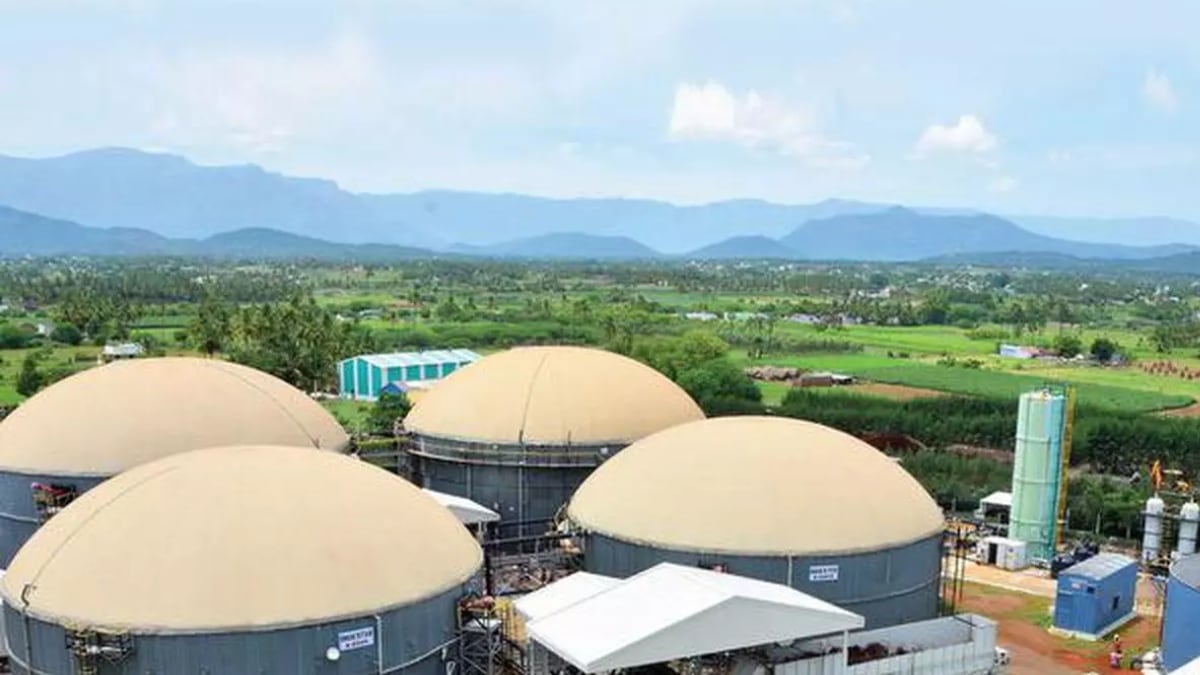
In Banaskantha, north Gujarat, a new plant that began operations on December 25—set up through a collaboration involving NDDB, Suzuki and Banas Dairy—produces compressed biogas for use in CNG vehicles. Similar projects are being rolled out across Gujarat and other states.
Industry estimates reflect this growing momentum. Consultancy firm Ramboll projects India’s biogas market to expand from $1.6 billion in 2024 to over $3.5 billion by 2026. A CareEdge report forecasts bioenergy installed capacity to rise to 15.5 GW by FY32, up from about 11.6 GW as of March 2025.
At Satadhar Dham, a pilgrimage centre in Junagadh, one of Gujarat’s largest biogas facilities is in operation. Four plants with a combined capacity of 85 cubic metres per day are functional, with two more under construction. The facility processes about 8,000 kg of cow dung daily, enabling the preparation of meals for 10,000 pilgrims while eliminating the need for 800–900 kg of firewood or 10–15 LPG cylinders each day.
ALSO READRs 17,500 crore LPG compensation to OMCs lined up for FY27
State-backed expansion is also underway. Over the past five years, 193 institutional biogas plants with a combined capacity of 13,955 cubic metres per day have been installed in Gujarat, according to the Gujarat Energy Development Agency (GEDA). The agency offers subsidies of up to 75% for non-profit institutions and 50% for commercial entities. A new bioenergy policy is also in the works.
The state plans to install 60 more plants in the near term, with another 60 lined up for 2026–27. An allocation of ₹24 crore has been earmarked for the sector between 2025 and 2027.
Scaling the Solutions
Despite the progress, challenges persist. S. Vishwanath, a Bengaluru-based water expert, points to issues of convenience, maintenance and relatively inefficient stoves. He argues that biogas is better suited as a supplement rather than a replacement for conventional fuels, advocating greater emphasis on wind and solar energy. “We should go in for wind and solar energy like done by China,” Vishwanath added.
Field-level experience echoes these concerns. Neeta Pandya, founder of the Maldhari Rural Action Group (MARAG), said her organisation’s early efforts to promote biogas among pastoral communities in north Gujarat lost momentum with the growing penetration of LPG and induction cooking. “With LPG cylinders coming in and induction also getting popular in rural areas, biogas plants lost value,” she said. Yet, she maintains that the technology retains strong relevance.
TOPICSEnergyGujaratThis article was first uploaded on April six, twenty twenty-six, at six minutes past twelve in the am.