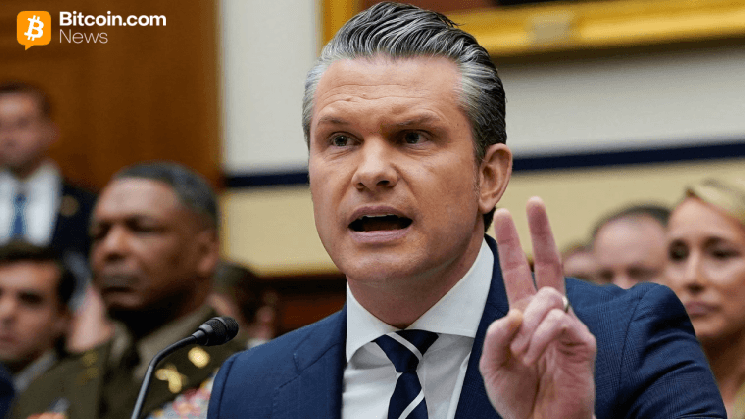
This week, U.S. Secretary of War Pete Hegseth revealed that Bitcoin is involved in classified initiatives within the Defense Department aimed at enhancing power projection and countering China.
Key Insights:
- During a congressional session on April 30, 2026, Hegseth disclosed that Bitcoin-related efforts are kept confidential within the Pentagon.
- Samuel J. Paparo Jr. confirmed that INDOPACOM operates one Bitcoin node and is testing its protocol for cybersecurity applications.
- The Trump administration has indicated ongoing discussions about establishing a Bitcoin reserve in 2026 while expanding national security considerations.
Bitcoin’s Role in U.S. Defense Strategy as Hegseth Addresses Congress
Hegseth made these statements during a hearing with the House Armed Services Committee when Texas Representative Lance Gooden questioned him about gaining an edge through Bitcoin technology.
“I have long been an advocate for the potential of Bitcoin and cryptocurrencies,” Hegseth stated to lawmakers, emphasizing that various initiatives related to leveraging or countering this technology remain classified. He elaborated:
“Many of our actions—whether enabling or undermining it—are classified operations currently underway within our department, which provide us significant leverage across numerous scenarios.”
This framing positions these efforts as strategic advantages beyond mere financial implications; instead linking them directly to national security applications. His comments followed earlier testimony from Samuel J. Paparo Jr., who verified that U.S. Indo-Pacific Command manages an active Bitcoin node while evaluating its protocol under operational conditions.
Paparo characterized Bitcoin as a sophisticated computer science framework grounded in cryptography, blockchain technology, and proof-of-work mechanisms, highlighting its capacity to impose tangible costs within cybersecurity frameworks. Collectively, their statements signify a notable shift among senior defense officials regarding how they perceive Bitcoin—from concerns over illicit finance to recognizing it as a technical asset with strategic value.
Hegseth also associated Bitcoin with geopolitical rivalry by suggesting it could act as a counterbalance against what he termed China’s model of digital governance. This perspective aligns with broader initiatives from the Trump administration viewing digital assets through the lens of national security—including dialogues surrounding potential strategic reserves of bitcoin.
The background of Hegseth reveals his longstanding interest in cryptocurrency technologies; previous disclosures indicated personal investments prior to divesting upon taking office. Market participants and policy analysts regard his remarks as indicative of increasing institutional acceptance among federal agencies toward cryptocurrencies like bitcoin.
Clips from this congressional hearing have gained traction across social media platforms, sparking widespread discussion about the evolving role of bitcoin beyond just financial transactions. While details regarding specific programs remain undisclosed by the Defense Department, both Hegseth’s and Paparo’s testimonies suggest ongoing investigations into utilizing bitcoin infrastructure for national security purposes.
FAQ
- What did Pete Hegseth say about Bitcoin?
He mentioned that there are classified efforts involving bitcoin at the Pentagon aimed at enhancing power projection against China during his testimony before Congress on April 30th! - Is there any operational use for bitcoin by U.S military?
Yes! The U.S Indo-Pacific Command operates one live bitcoin node while testing its protocol for cybersecurity applications! - <strongHow does this relate to Trump's administration policies?
The Trump administration views digital assets like bitcoins through a national security lens which includes discussions around establishing potential strategic reserves! - Aren’t there concerns regarding illicit finance related to bitcoins?
While such concerns exist historically; recent statements indicate senior defense officials now see bitcoins more so as technical instruments rather than solely focusing on illegal activities!