
Bitcoin Surges Over 6% at U.S. Market Open Amid CME Premium Spike, Unrelated to Liquidations
At the start of Monday’s U.S. trading session, Bitcoin surged more than 6%, nearing the $70,000 mark despite an overall risk-averse macroeconomic environment.
Meanwhile, oil prices soared due to heightened tensions in the Middle East, equities opened sharply lower, and the U.S. dollar remained strong.
This combination typically weighs down high-risk assets.
However, Bitcoin defied expectations by climbing higher. The usual explanation that “short sellers were squeezed” doesn’t align with recent data.
According to Coinglass liquidation figures from the past 24 hours, total liquidations amounted to approximately $423 million—split almost evenly between longs ($221 million) and shorts ($203 million).
This balanced liquidation pattern indicates there wasn’t a one-sided forced buying frenzy driving prices up. Instead, it suggests active market rotation on both sides rather than a short squeeze causing the rally.
A more plausible reason lies in market mechanics: liquidity returning during U.S. trading hours and institutional platforms reengaging after weekend disruptions helped realign price movements.
The spike in oil set a tense backdrop for risk sentiment—U.S. crude jumped roughly 7.6% to about $72 per barrel while Brent crude climbed nearly 8.6% near $79 amid concerns over tanker disruptions and supply risks reported by market analysts.
Stocks initially declined but later trimmed losses as European markets also fell while defense and energy sectors outperformed significantly—with natural gas surging close to 50%.
Despite this broader risk-off tone, Bitcoin’s price trajectory diverged notably from other assets.
The key question traders face is why Bitcoin attracted buyers during such an inflation-driven risk-off session?
The answer appears less emotional and more structural—linked closely with how ETFs channel flows through regulated U.S.-based markets during standard trading hours.
| Metric | Value | Significance |
|---|---|---|
| $BTC moves (U.S open) | ~+6% | A substantial move requiring explanation beyond random fluctuations |
| Total liquidations (24h) | ~$423M | Moderate volume for current conditions—not indicative of forced buying pressure |
| Long vs Short liquidations split | ~$221M vs ~$203M | No directional squeeze observed—both sides experienced cleanups equally |
| CME premium versus spot (intraday) | ~+1.3%, peaking above +1% | A clear signal of increased demand during U.S.-hours that can pull spot prices upward via basis trades |
An Explanation Beyond Liquidation Data: What Really Drove Price Action?
It is important first to understand what liquidation statistics reveal—and what they do not.
Days dominated by forced buy-ins usually show stark imbalances where short positions are closed out far more aggressively than long ones—and at volumes sufficient enough to push prices materially higher.
Here though , long and short liquidations were nearly equal , totaling around $423 million .
This pattern aligns better with a volatile or choppy market rather than one mechanically propelled upwards by covering shorts .
So if forced flows weren't driving this rally , what was ?
Two main factors come into play : first , predictable bursts of spot demand occurring within regulated venues during active trading sessions ; second , relative-value trades along with hedging activities that persist even when overall sentiment remains mixed .
On Monday specifically , these forces became evident as US-hours liquidity returned : futures contracts on CME reopened alongside increased participation in US-based spot markets . Crucially for early-2026 dynamics , ETF-related creation/redemption processes resumed — enabling authorized participants &&; market makers involved in hedging those ETF positions came back online too .
The rise of ETFs has transformed who acts as marginal buyers in these sessions.
DURING WEEKENDS RETAIL TRADERS DOMINATE PERPETUAL CONTRACTS BUT DURING THE WEEKDAY US SESSION LARGE SPOT DEMAND OFTEN ENTERS VIA ETF CHANNELS AND IS HEDGED ACROSS MARKETS BY PROFESSIONAL DESKS.
This interplay can generate rallies that seem puzzling if you only consider liquidation metrics alone.
Lately,U S bitcoin spot ETFs have seen net inflows exceeding $1 billion over three consecutive days following several weeks of outflows — highlighting how quickly demand dynamics shift when ETF bids become active again.
TODAY’S DATA ON INFLOWS IS NOT YET AVAILABLE BUT THE STRUCTURE IMPLIES THAT A LIQUIDATION CASCADE IS NOT NECESSARY TO DRIVE A ~6% MOVE IF BOTH SPOT DEMAND AND HEDGING FLOWS ALIGN DURING ACTIVE HOURS IN THE UNITED STATES MARKETPLACE.
CME Premium Surge Signals Return Of Institutional Activity During US Trading Hours
The clearest indication supporting this flow-driven narrative comes from observing CME futures premiums relative to spot prices throughout Monday’s session:
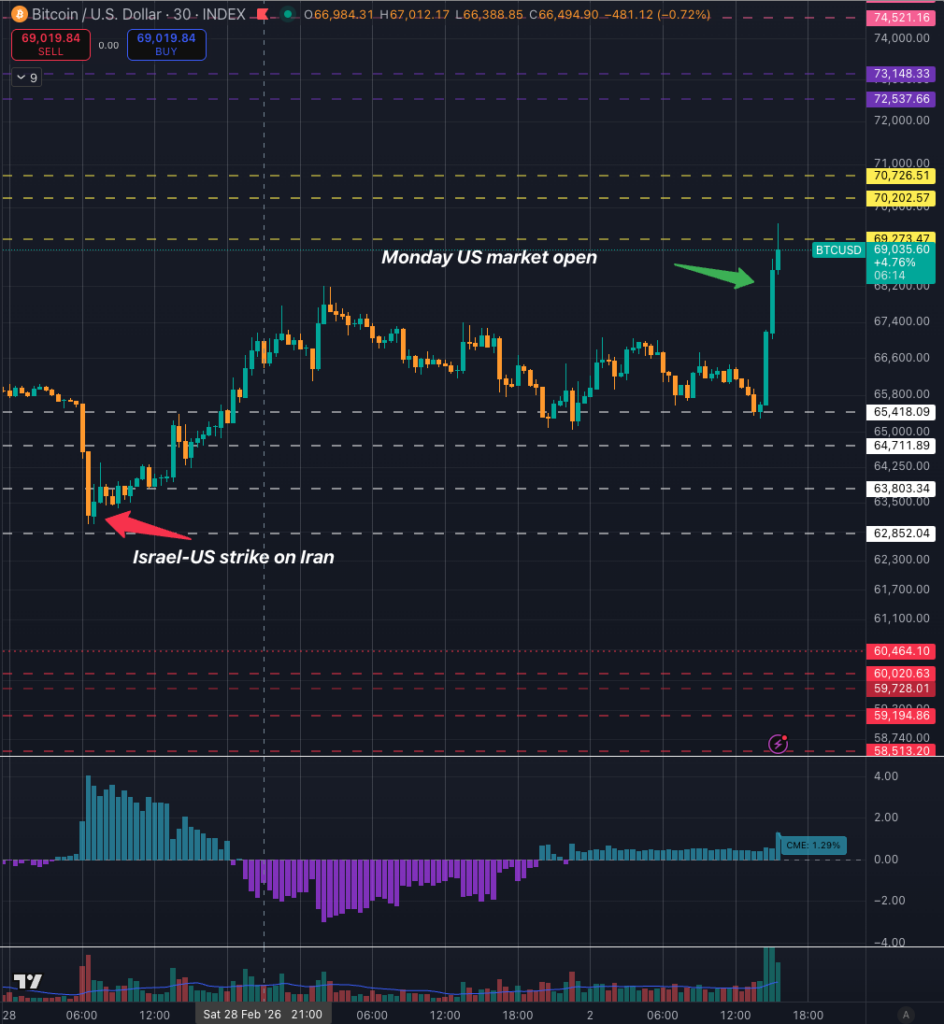
Over weekend closures when CME was inactive,the thinner liquidity caused pricing distortions including basis swingsand premium reversals.
Upon reopeningMonday,theCMEpremiumdidn’tjustreturntonormallevelsbutexpandedsharply,reachingaround+1.
Suchapositivepremiumisindicativeofheightenedinstitutionaldemand,oftenreflectingmarketparticipantswillingtopayapremiumforregulatedexposureorhedgepositionsusingCMEcontracts.
Inaddition,thisdynamiccanbeexplainedbyETF-eramechanicswhereacceleratedspotETFbuyingforcesmarketmakershedgethroughliquidfuturescontracts.
Whenthisfuturesbiddominatesbeforearbitrageurscanfullyadjust,thepremiumwidensfirst,pullingspotpricesupaspartofthecash-futuresarbprocess.
Mechanically,thistranslatesintobuyingspotandsellingCMEcontracts,“ifonlytemporarily,”pushingpriceshigherevenifbasiscompresseslateron.
Balance-sheetconstraintsandrisklimitsalsoplayrolesincearbitragecapacityisfinite,andMondaymorningreopeningsoftentriggerinventoryreloadsamongdesks,resultinginexpandingpremiumswithrisingspotpriceswithoutanyneedforaforcedliquidationevent.
Thisphenomenonalsoexplainswhy“CMEgap”theorieskeepemerging.Thegapitselfisnotmagical;rather,tradersusetheselevelsasreferencepointswhentransitioningfromweekendthinmarketsintofullweekdaydepths,
makingthembehavioralmagnetsforpositioningoncewidelydiscussedonsocialmedia.—inotherwords,“iftheCMEpremiumissignalingpayup,youdon’tneedtoinventashort-squeeze.”
Mildly Risk-Off Macro Environment Driven By Inflation Shock Can Coexist With BTC Demand
ThebroadermacroeconomiccontexthelpsunderstandwhyBitcoin’smoveappearedcontrarian:
OilpricejumpsreflectedconcernsaboutMiddleEastescalationandshippingdisruptionscenteredontheStraitofHormuz,riskingelevatedenergycostsandrenewedtalksof$100barreloil.TheGuardianhighlightedthatpersistentdisruptioncouldkeepoilhigh,longerthanexpected,
delayingratecutsandmaintainingtighterfinancialconditionsdespitegrowthconcerns.Thiscreatedanunusualformofrisk-aversionwherestocksfellinitiallythenstabilizedwhileenergynamesoutperformedsignificantly.
Yet,BTCdidnotfollowequitieslowerbecauseitactedasahedgeinstrumentundercertainconditions:(1)inflation-andpolicy-relatedshocksratherthanpuredeflationaryones,(2)structuralUS-spotsessiondemandsufficienttoabsorbsellingpressure.Inthisscenario,BTCbehaveslesslikeaclassicweak-dollar-betaassetandmorelikeaflow-sensitiveinstrumentcapturinghedgebidswhentheUS-marketplumbingisenabled.
Lookingforward,persistentoilpremiumsmaylimitaltcoinperformancebyreducingoverallriskappetite,butBTCcouldstilloutperformothertokensduetoitsdeeperregulatedchannelsfeedingspotdemandandhedgingflowsduringUS-tradinghours.
Navigating The Week Ahead: Three Key Indicators To Watch For Trend Confirmation
<Mondaysrallyprovidesananalyticalframeworkforevaluatingfuturemovements:
<Tableborder="1"&g t ;
<thead&g t ;
<tr&g t ;
<th&Dial/th&t h ;
<th&W hattom easure/th&t h ;
<t h &Whyitm attersfortheBTC/th&t h ;
/tr&t h ;
/thead&t h ;
<tbody&g t ;
<tr&g t ;
&
/tr >
The scenarios mapped against these indicators include:
- If de-escalation reduces oil premiums over several days,BTC’s initial surge may fade into sideways trading unless ETF inflows pick up again.
- If conflict remains contained but oil premiums persist weeks-long,BTC could stay resilient yet volatile while altcoins underperform due tomarketwide tighter conditions.
- If disruption intensifies (“tail scenario”),markets might initially sell off before policy shifts trigger renewed hedge-driven BTC demand amid elevated volatility.