Bitcoin ($BTC) funding rates, which are fees designed to align the price of perpetual contracts with that of the underlying asset, have predominantly remained in negative territory even after a recent rise above $81,000.
According to analytics firm CryptoQuant, the 30-day Moving Average (MA) for Bitcoin funding rates has continued its downward trend, hitting historic lows on May 6. This decline mirrors a similar situation observed during the crypto capitulation triggered by FTX in November 2022.
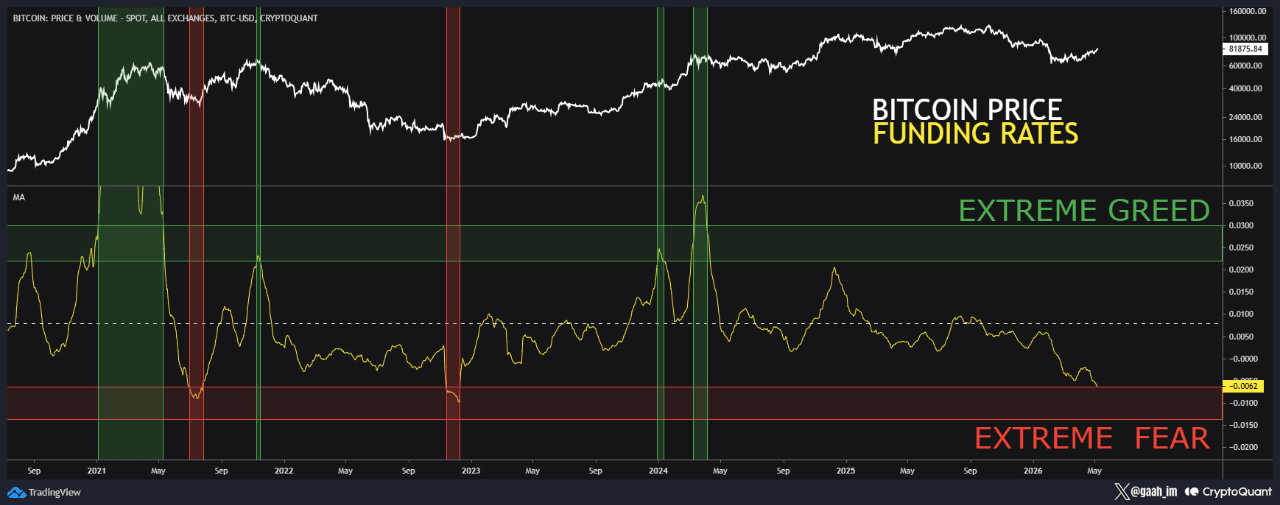
This week saw Bitcoin prices reaching a three-month high, prompting derivatives traders to pay more to maintain their short positions. Additionally, Bitcoin’s Open Interest (OI)—which measures all open derivatives positions—surged past $64 billion on May 5, marking its highest level in over three months as reported by Finbold.
“Historically, such conditions often emerge during phases of skepticism where rallies are met with fading rather than aggressive long positioning. The persistence of negative funding alongside rising prices suggests that the market may be climbing a wall of worry,” noted Glassnode.
The Future Outlook for Bitcoin Prices Amid Extreme Negative Funding Rates
The extreme negativity surrounding Bitcoin’s funding rate has contributed significantly to its recent rebound through what is known as a sustained short squeeze—a bullish rally that occurs when increasing prices compel short sellers to exit their positions and support buyers. In just the last day alone, nearly $160 million out of $188 million liquidated in the overall BTC derivatives market across various exchanges involved short traders according to updates from CoinGlass.
This renewed bullish sentiment towards $BTC has also been fueled by increased institutional demand for spot trading. For example, U.S.-based spot exchange-traded funds (ETFs) linked to Bitcoin have seen inflows exceeding $1.6 billion over four consecutive days as reported by Finbold.
If this upward momentum continues due to ongoing spot demand for BTC, it could exert additional pressure on existing derivative sellers and potentially lead to further gains. However, if this demand fails against significant selling pressure within derivatives markets, there is a risk that Bitcoin could reverse course soon and possibly establish new lower lows within its broader bear market cycle.
FAQ:
- What are Bitcoin funding rates?
Funding rates are fees charged or paid between long and short position holders in perpetual futures contracts aimed at keeping contract prices aligned with spot market prices. - Why do negative funding rates occur?
Negative funding rates typically arise when there is more interest from traders holding short positions compared to those holding long positions; this can indicate bearish sentiment among investors. - If I hold shorts during negative funding periods will I lose money?
Not necessarily; while you may incur costs due to paying positive fees if you hold shorts too long during these periods can lead you into losses if there’s an unexpected price surge forcing liquidation events on your position. - Aren’t low Open Interest levels good indicators?
Low Open Interest can suggest reduced trader confidence or participation but must be interpreted carefully alongside other metrics like volume trends before drawing conclusions about future movements!