

Follow Us
The artificial intelligence (AI) boom has attracted massive investments from technology companies, chipmakers and other businesses building the infrastructure needed to develop and run AI systems. However, the International Monetary Fund (IMF) has warned that the financing arrangements behind some of these investments could create risks for the wider financial system.
In its “October 2026 Global Financial Stability Report, titled Resilience, Risk, and Transformation,” the IMF examined 14 publicly disclosed transactions involving companies across the AI industry since 2023. These deals involved about $300 billion in equity investments, $650 billion in debt and $1.4 trillion in future revenue commitments.
The report highlights a financing structure in which companies invest in AI businesses that, in turn, commit to future purchases of the investors’ products or services. These commitments can include cloud computing services and chips used to build AI infrastructure.
This creates a financial link between companies providing funding and those expected to spend it later. Both sides could benefit if the AI businesses grow as per expectation. But if the recipients struggle, investors could face losses on their investments, difficulties recovering debt and a decline in expected future revenue.
ALSO READ$44 trillion US economy by 2030? Anthropic’s extreme AI scenario explained
The IMF warned that weaker-than-expected AI investment or profitability could trigger a correction in AI-related asset prices. Rising borrowing, concentrated exposures and circular financing arrangements could amplify the impact.
The report does not predict an inevitable financial crisis or suggest that all AI financing deals are unsafe. Instead, it identifies risks that could intensify if the industry fails to deliver the growth and returns investors expect.
How does $650 billion AI financing loop work?
The financing structure involves companies investing in AI businesses and those receiving the money. Large technology companies, often called hyperscalers because they operate extensive cloud computing and data-centre infrastructure, play a significant role in this ecosystem.
A company may invest equity in an AI firm to support its expansion. The recipient may also borrow money to pay for computing capacity, data centres, chips and other infrastructure. In return for this financial support, it may commit to buying cloud services, computing capacity or chips from the investor in the future.
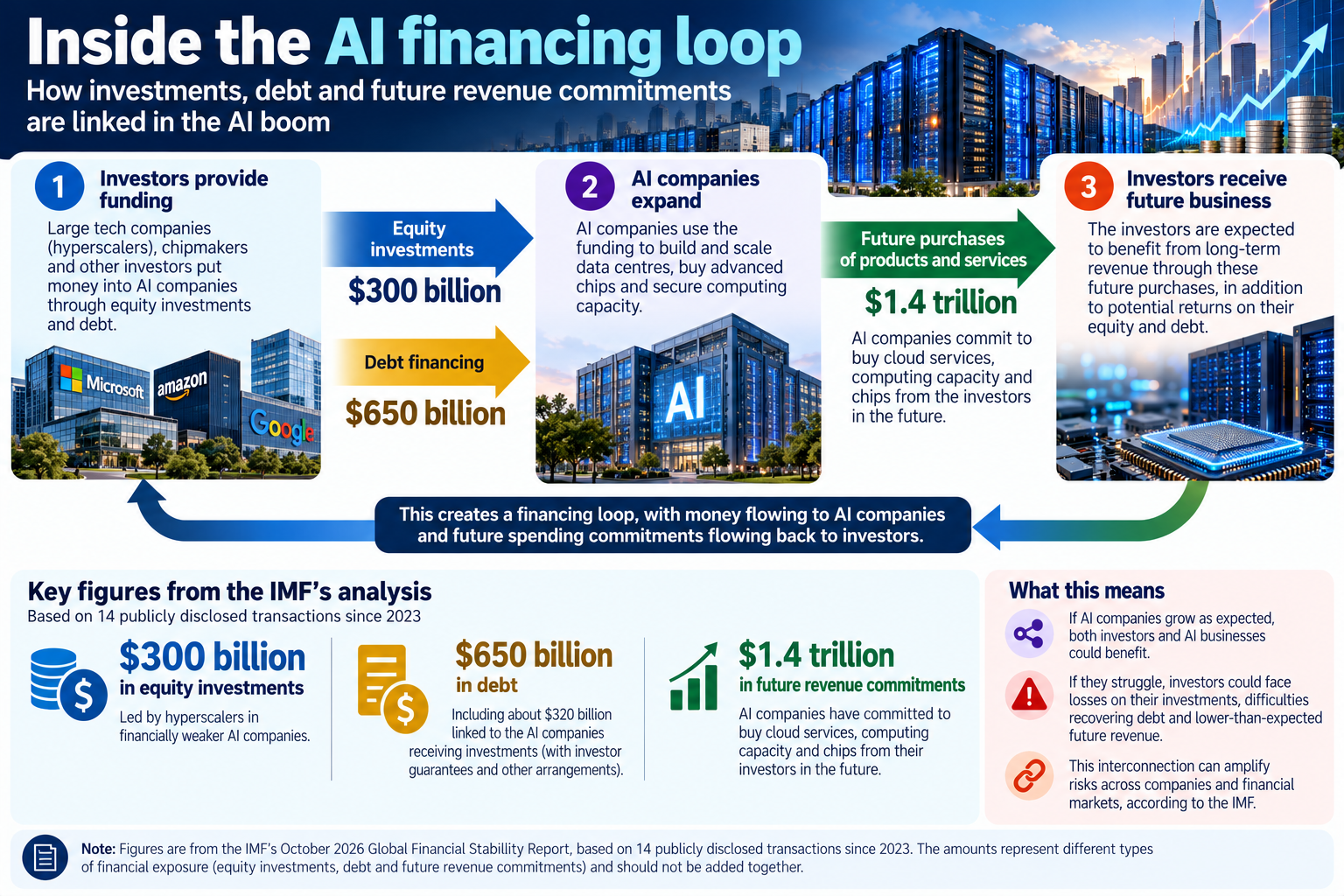
This creates a cycle in which money flows from an investor to an AI company, while future spending commitments flow back towards the investor.
Across the 14 transactions examined, the IMF identified approximately $300 billion in aggregate equity investments led by hyperscalers in financially weaker AI companies. The deals also involved about $650 billion in debt and $1.4 trillion in future revenue commitments.
These figures represent different types of financial exposure. Equity investments provide ownership stakes, debt represents borrowing, and revenue commitments refer to promised future business. They should not be added together or treated as interchangeable measures of the same financial activity.
The report also found that about $320 billion of the $650 billion in debt was associated with the companies receiving the investments. This included debt backed by investor guarantees, contingent financing and other off-balance-sheet debt.
Off-balance-sheet debt can involve obligations that do not appear as conventional borrowing on a company’s main balance sheet. Such arrangements can make it harder to assess the full extent of financial risks without clear information about the underlying commitments.
ALSO READIMF urges India, US, and China to build guardrails against AI-driven market volatility
Companies receiving the funding may have weaker finances than the larger businesses supporting them. If an AI company cannot generate enough revenue to cover its costs and debt payments, its financial difficulties could affect the investors that backed it.
The IMF also found that financing and future revenue commitments were concentrated among a handful of companies receiving the investments. This concentration could increase the impact of financial distress at a major recipient.
The report describes the potential exposure as a form of “wrong-way risk”. In simple terms, an investor could face several losses at the same time: its equity investment could lose value, debt linked to the recipient could become harder to recover, and expected future revenue could fall short.
The IMF wrote that distress at key investee firms could create this risk because “Equity and debt investments in the firms depreciate in value precisely when future revenue streams tied to them are impaired.”
The concern extends beyond whether AI companies can repay their loans. Their financial relationships may also depend on their ability to purchase large amounts of computing services or chips in the years ahead. If their businesses fail to grow as expected, both investments and anticipated future purchases could come under pressure.
The IMF said investors involved in these transactions were generally financially sound. However, problems at major companies receiving the funds could still expose them to losses because their financial relationships are closely linked.
The $1.4 trillion figure also requires careful interpretation. It represents future revenue commitments, not cash already received, guaranteed profits or a confirmed estimate of the AI industry’s total future revenue. The report examined 14 disclosed transactions and does not claim that the figures cover every AI financing arrangement in the market.
Why is IMF worried about AI debt and future revenue?
The financing loop has emerged as technology companies commit large sums to AI infrastructure. Building data centres, buying advanced chips and expanding cloud computing capacity require substantial capital, prompting companies to rely increasingly on debt to fund these investments.
According to the IMF, hyperscalers’ share of global investment-grade corporate bond issuance has risen to 10% since 2024, from less than 1%. Investment-grade bonds are debt securities that credit-rating agencies classify as having a relatively lower risk of default than lower-rated bonds.
The report said hyperscalers continued to generate strong earnings from their core businesses, but their free cash flows were falling rapidly as they increased AI-related spending. This has made debt financing increasingly important.
Free cash flow is the money a company has left after paying its operating expenses and capital expenditure. A decline does not automatically indicate financial distress. However, if spending rises faster than cash generation, a company may need to borrow more or seek other sources of funding.
The IMF also identified other sources of leverage in financial markets. Since 2024, hedge funds’ gross equity positions and equity margin loans had increased from 10% to about 15% of advanced-economy GDP. These figures measure market exposure and borrowing relative to the size of advanced economies; they do not mean hedge funds borrowed that share of GDP solely to invest in AI.
Meanwhile, the share of single stocks in leveraged exchange-traded funds rose from 16% to 28%. These funds can magnify exposure to price movements in individual stocks, increasing both potential gains and losses.
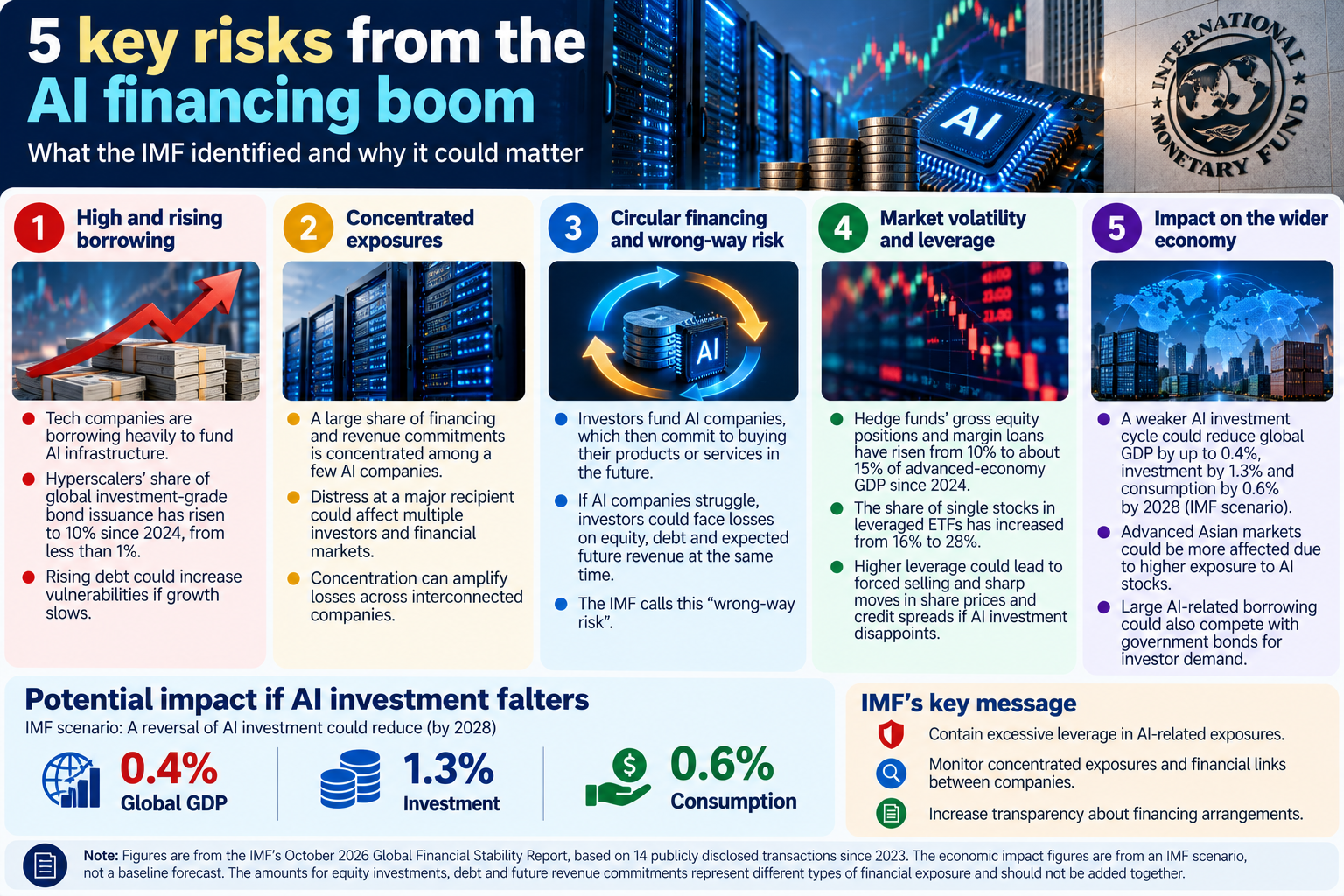
The IMF warned that these sources of leverage could increase the risk of forced selling and sharp movements in share prices and credit spreads if AI investment or profitability disappoints.
The concern extends beyond individual AI companies. AI-related shares have become important to financial markets, while spending on data centres, semiconductors and related infrastructure has supported wider economic activity. A sharp slowdown could therefore affect technology stocks, credit markets and investors holding AI-related assets.
The IMF said a weaker or less durable AI investment cycle could undermine an important source of support for economic growth. A market correction could reduce the value of AI-linked equities and credit, while losses could spread through the financial relationships connecting companies and investors.
The report also examined how an unwinding of AI investment could affect the global economy. In a scenario considered in the IMF’s October 2026 World Economic Outlook, a reversal of AI investment could reduce global GDP by as much as 0.4%, investment by 1.3% and consumption by 0.6% by 2028. These figures describe a scenario, not the IMF’s baseline forecast.
The effects could vary across countries. The IMF said advanced Asian equity markets with greater sensitivity to global AI share prices could face larger effects from a correction. Other markets could experience indirect effects through their holdings of US equities and AI-related companies.
Borrowing costs could also come under pressure. AI-related companies have increased their presence in investment-grade bond markets at a time when governments also need to borrow. The IMF warned that large AI-related debt issuance could compete with sovereign bonds for investor demand.
This does not mean AI borrowing has already triggered a bond-market crisis. The IMF said financial markets had remained resilient, supported by economic growth and strong corporate earnings, although financial stability risks remained elevated.
The fund identified three main risks that could trigger market turmoil – an AI-driven market correction, a sharp rise in sovereign bond yields and cyber threats. These risks could become systemic if existing financial weaknesses amplify their effects.
The IMF recommended that policymakers contain excessive leverage in AI-related exposures. It also called for stronger financial resilience, better monitoring of concentrated exposures and greater transparency about financial links between companies.
The IMF’s figures illustrate the financial connections behind part of the AI boom. The $300 billion in equity investments and $650 billion in debt support businesses that have committed to $1.4 trillion in future purchases. If these companies perform well, the arrangements could help expand AI infrastructure and services. If they struggle, the same links could transmit losses across the companies that funded them.
The report does not conclude that the AI boom will collapse. It warns that heavy investment, rising leverage and circular financing could magnify the damage if expected growth and profits fail to materialise. The scale of future revenue commitments makes these links important to monitor, but their actual value will depend on whether companies can meet their commitments and sustain their businesses over time.
Disclaimer: This article is for informational purposes only and does not constitute financial advice. Financial markets and AI-related investments carry risks, and actual outcomes may differ from the scenarios discussed. Readers should consult qualified financial professionals before making investment decisions.
TOPICSArtificial IntelligenceIMFThis article was first uploaded on October eighteen, twenty twenty-six, at thirty-five minutes past nine in the night. © IE Online Media Services (P) Ltd