
Follow Us
Artificial intelligence could push the US economy to $44.4 trillion by 2030 if its capabilities improve rapidly and businesses adopt it at an unprecedented pace, Anthropic co-founder Jack Clark said on Saturday.
He said an extreme scenario developed by the company showed AI would perform almost all knowledge-based tasks, driving annual economic growth to 15%.
“One internal economic model suggests that US GDP could reach $44 trillion by 2030 if AI models diffuse into the economy in the coming year,” Clark, speaking at IMF and World Bank annual meetings in Bangkok.
The figure comes from Anthropic’s economics team, which developed a model to examine how AI could affect economic output, employment, wages and income distribution. The company published the model through its online tool, ‘Scenarios for our Economic Future’, based on its technical report, ‘Economic Scenarios for Transformative AI’.
The $44.4 trillion figure is not a prediction. Anthropic’s model outlines three possible economic outcomes based on assumptions about AI capabilities, adoption by businesses and workers, the extent of autonomous work and productivity gains.
ALSO READ53% of Americans lack a three-month emergency fund: What Pew’s data reveals
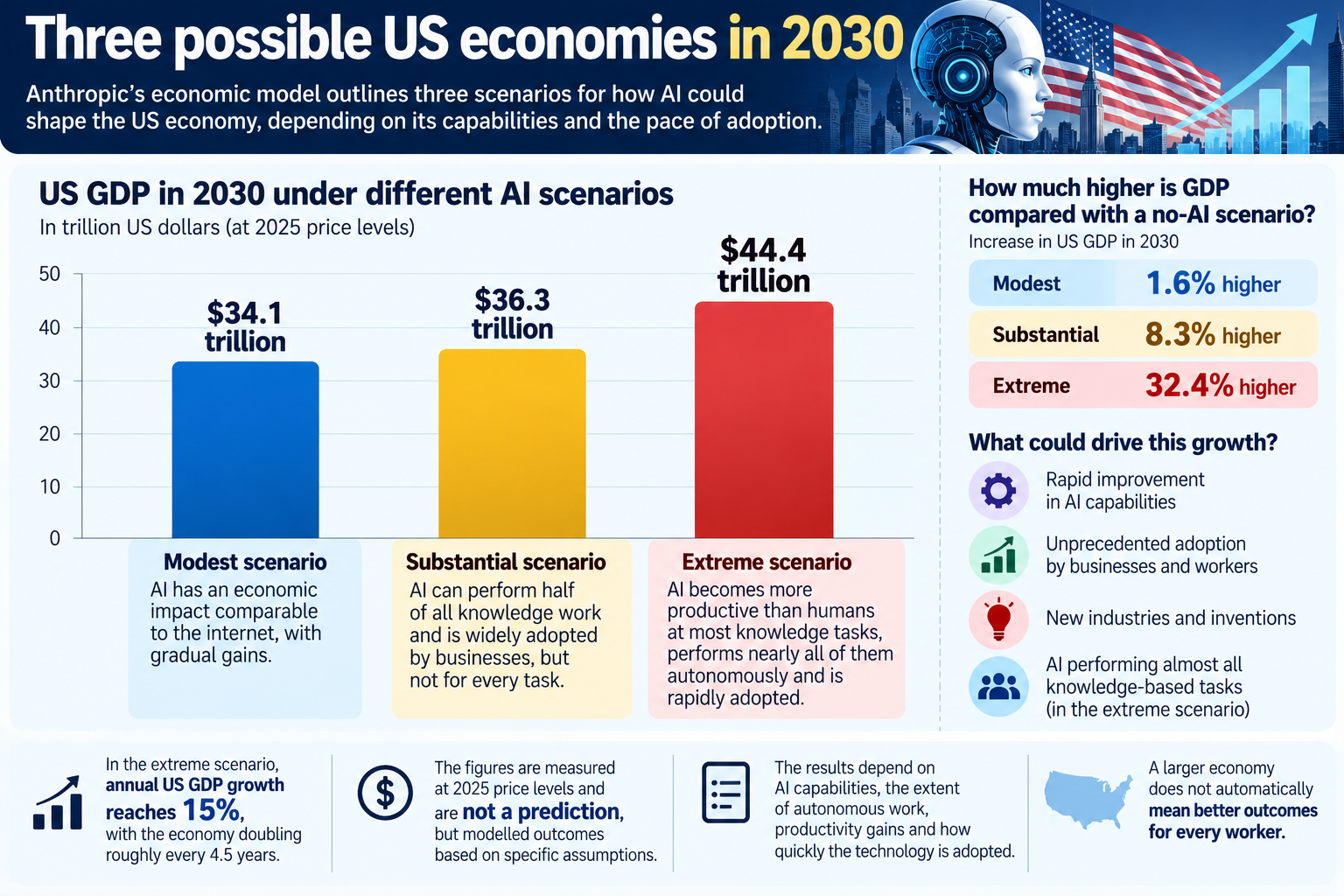
The model estimates US gross domestic product (GDP) at $34.1 trillion under its modest scenario, $36.3 trillion under its substantial scenario and $44.4 trillion under its extreme scenario in 2030. The figures are measured at 2025 price levels.
According to Clark, AI capabilities were improving rapidly and that international cooperation would be needed to establish rules for the technology, reported Reuters.
Clark said that the $44 trillion figure sounded far-fetched. “I know, but it’s implicated by the technology continuing to get better,” he said, according to Reuters report. He added that such economic expansion would require new industries and inventions to emerge.
What does Anthropic mean by $44 trillion US economy?
Anthropic’s model treats every job as a collection of tasks. AI could help people complete some tasks faster, automate others entirely, leave some unchanged or create new tasks. The balance between these outcomes determines the technology’s effect on productivity and employment.
The company uses nursing as an example. AI could help nurses prepare discharge instructions, monitor patients remotely or handle administrative work, while physical care would continue to require human involvement.
Anthropic applies this task-based approach across occupations, using information from the US Department of Labor’s O*NET occupational database. Its results depend on assumptions about what AI can do, how much work it performs and how quickly businesses adopt the technology.
The model sets out three scenarios:
Modest scenario: AI has an economic impact comparable to the internet, generating gains gradually and within the range of historical experience with new technologies. US GDP reaches $34.1 trillion in 2030, or 1.6% above the level in a scenario without AI.
Substantial scenario: AI can perform half of all knowledge work by 2030 and carries out most of that work autonomously when businesses use it. However, companies do not adopt AI for every task it could perform. GDP reaches $36.3 trillion, 8.3% above the no-AI scenario.
Extreme scenario: AI becomes more productive than humans at most knowledge-work tasks, performs nearly all of them autonomously and creates almost no new knowledge tasks for people. GDP reaches $44.4 trillion, 32.4% above the no-AI scenario.
The extreme scenario assumes that AI systems can repeatedly improve themselves and that businesses adopt the technology rapidly across knowledge-based occupations. Under these conditions, annual US GDP growth reaches 15%, with the economy doubling in size roughly every four and a half years.
This goes well beyond using chatbots to write emails or software tools to automate routine office work. It assumes that AI takes over most knowledge-based tasks, sharply raises productivity and spreads rapidly across the economy.
Clark’s remarks, as reported by Reuters, also pointed to the possibility of faster scientific finding and the emergence of new industries and inventions.
However, Anthropic’s model does not claim that the United States will reach $44.4 trillion in 2030. Its scenarios explore what could happen if particular assumptions about AI capabilities and adoption prove correct. The results change when those assumptions change.
What could extreme AI scenario mean for jobs and wages?
The model’s most important implication is that a much larger economy would not necessarily translate into better outcomes for every worker.
Anthropic expects job changes under all three scenarios, but the scale of disruption varies. In the modest scenario, labour market changes remain closer to those associated with previous technological advances. In the substantial scenario, more knowledge workers need to change occupations. In the extreme scenario, rapid automation could push unemployment far beyond levels typically seen during recessions.
ALSO READIndia to overtake Japan as 4th-largest economy in 2027, IMF projects $4.52 trillion GDP
The company identifies coders and call-centre agents as examples of workers who may need to move into occupations less exposed to AI, such as electricians or nurses. Such transitions would take time and could require retraining, while workers might struggle to find suitable jobs in new fields.
The model warns that unemployment could remain high for prolonged periods if AI automates knowledge-based work faster than people can move into other roles. The central risk is that productivity rises faster than the labour market can adjust.
Wages could also diverge across occupations. Anthropic’s model estimates that average wages rise across its three scenarios, but the gains are concentrated outside knowledge work. Under the substantial scenario, wages for knowledge workers remain broadly flat. Under the extreme scenario, they fall by more than 10% by 2030 compared with an economy without AI.
Other workers could benefit from increased demand as AI makes some forms of knowledge work faster and cheaper. For example, if AI speeds up infrastructure design and permitting, more projects could be built, potentially increasing demand for construction workers and putting upward pressure on their wages.
However, the gains would not necessarily be shared equally. Employers could have less need to hire people for tasks that AI can perform, while workers trying to move into other occupations could face difficulties adapting to changing demand.
Who would benefit from AI-driven economic growth?
Anthropic’s model also examines the share of economic output going to workers through wages and the share going to capital, including the technology and other productive assets used to generate goods and services.
The company estimates that workers currently receive about 60 cents of every dollar produced, while capital receives about 40 cents. Under the modest scenario, labour’s share of output is 59.4%, compared with 40.6% for capital.
In the substantial scenario, labour’s share falls to 56.1%, while capital’s rises to 43.9%. Under the extreme scenario, the gap widens further: workers receive 45.2% of economic output, while capital receives 54.8%.
That would mean a larger proportion of the wealth generated by the economy going to owners of technology and other productive assets rather than to workers through wages.
Anthropic’s model estimates that total labour income would barely change by 2030 under the extreme scenario, despite the economy becoming much larger. Some knowledge workers would face lower wages or unemployment, while workers in other occupations could earn more.
However, a higher GDP does not automatically mean most households will be better off. The outcome also depends on who owns the technology, which jobs remain in demand and how effectively workers can adapt.
Anthropic identifies the distribution of economic gains, alongside the unequal costs of disruption, as a major challenge under its extreme scenario.
TOPICSAnthropic AIArtificial Intelligenceeconomy'This article was first uploaded on October seventeen, twenty twenty-six, at fifteen minutes past four in the afternoon. © IE Online Media Services (P) Ltd