
Follow Us
US President Donald Trump has paused key sanctions and tariffs targeting Russia and countries buying its oil and gas, giving his administration time to assess their economic impact.
The move offers India temporary relief from the threat of additional US trade penalties over its Russian energy purchases, but leaves uncertainty over whether Washington will impose the measures later.
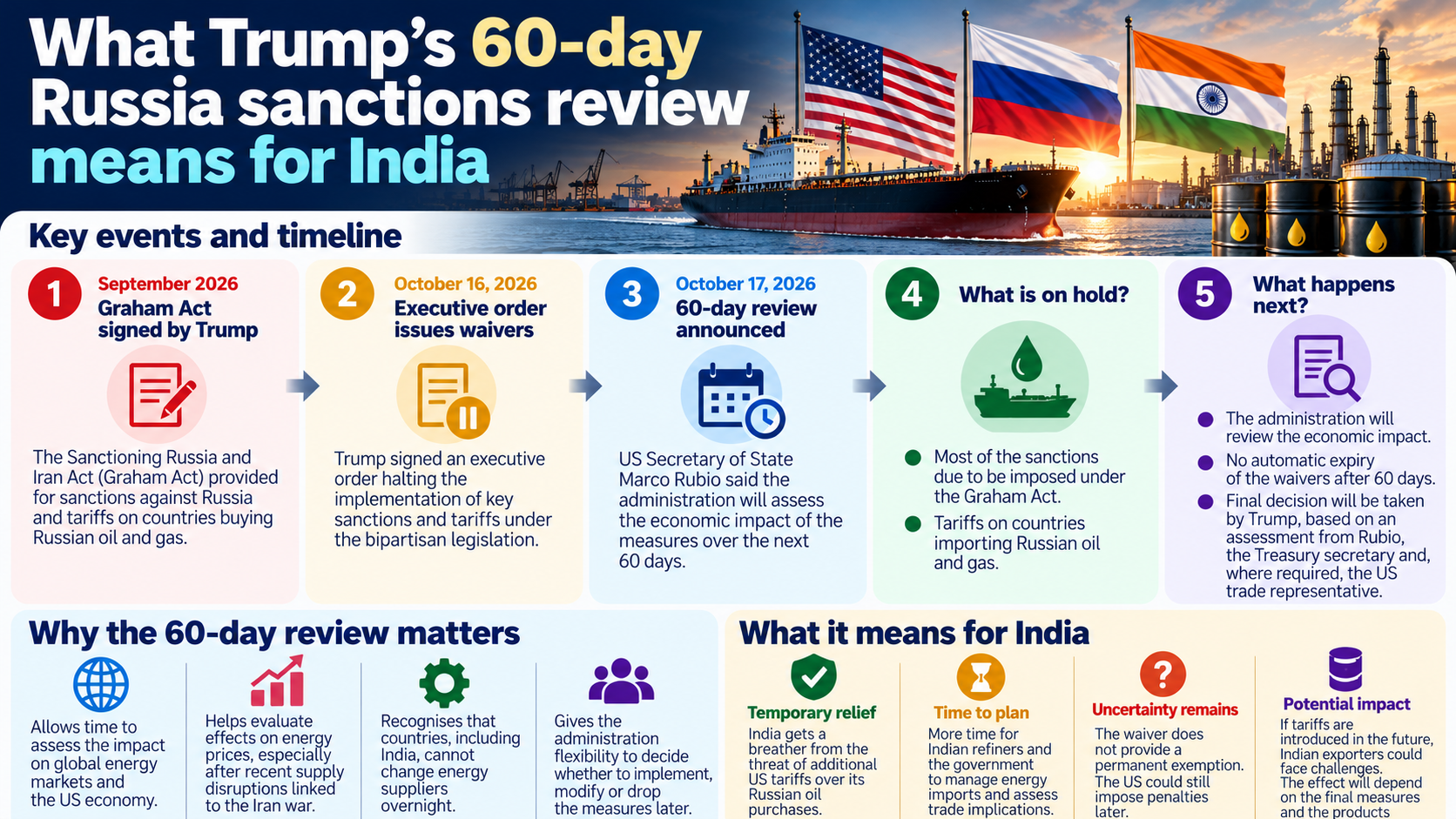
US Secretary of State Marco Rubio announced the 60-day review on October 17, a day after Trump signed an executive order waiving key measures under the Sanctioning Russia and Iran Act, also known as the Graham Act. The measures were due to take effect the following week, reported Reuters.
The decision matters for India, a major buyer of Russian crude oil. Rubio said that countries cannot change energy suppliers overnight, recognising the practical challenges India faces in diversifying its imports, reported Reuters. However, the waiver does not provide a permanent exemption from possible future penalties.
What has Trump waived and why does 60-day review matter?
The Graham Act, signed by Trump last month, sought to increase pressure on Moscow over its war in Ukraine by providing for sanctions against Russia and tariffs on countries importing Russian oil and gas. It also gave the president discretion to waive the measures under certain conditions.
Trump used that authority to halt the implementation of key provisions. The executive order stopped most of the sanctions due to be imposed under bipartisan legislation, reported The Wall Street Journal.
Rubio said the administration has sought time to assess the consequences of the measures. “I think the president wants to take the 60-day period of time to sort of analyze what imposing both sanctions and tariffs will mean to the global economy and even to the US economy,” he said, as reported by Reuters.
Trump also indicated that he had not made a final decision. “A lot of you don’t know what my decision is yet, but we’ll figure it out, and you’ll figure it out,” Reuters quoted him as saying.
The executive order does not specify a fixed expiry date for the waivers. The Indian Express reported that they would remain in place until Trump or the secretary of state determined that further action was necessary. Rubio would make that assessment after consulting the Treasury secretary and, where required, the US trade representative.
This means the 60-day review should not be interpreted as confirmation that the tariffs will automatically return after two months. The administration has yet to announce a final decision on whether to implement the measures.
ALSO READUS says 97% of ships cross ‘completely open’ Strait of Hormuz as attacks hit record high
The review comes as the war involving Iran has disrupted global oil supplies and pushed up energy prices. Trump’s decision was also part of a broader effort to contain energy costs ahead of the US midterm elections in November, reported The Wall Street Journal.
Washington must therefore balance pressure on Russia over Ukraine against the risk that additional restrictions on Russian energy could increase costs for American consumers and businesses.
What does the review mean for India’s Russian oil purchases?
The immediate benefit for India is that the threat of additional US tariffs linked to Russian energy purchases has been put on hold. This gives the nation and Indian refiners more time to manage energy imports and assess the implications for trade with Washington.
India has increased its purchases of Russian crude oil in recent years, making it an important part of the country’s energy mix. Moving away from a major supplier abruptly could require changes to sourcing arrangements and increase costs.
Rubio said India had “voluntarily diversified” its energy sources but continued to buy substantial quantities of Russian oil. Countries cannot change suppliers overnight, he said, reported The Indian Express.
ALSO READGift to Putin or a route to peace? Inside the controversy over Russian diesel exports
If the US administration eventually imposes tariffs, Indian exporters could face renewed uncertainty over access to the American market, reported The Indian Express. The impact would depend on the final measures, the products covered and the terms of any decision. The current waiver does not establish what penalties India might face.
The outcome could also affect energy markets. Restrictions on Russian oil and gas may influence global supply and prices, although the extent of the impact would depend on how buyers, sellers and other energy producers respond.
Rubio said the administration needed to consider several conflicts and their combined effects on energy supplies. Referring to the war involving Iran, a Houthi attack in Saudi Arabia and the Russia-Ukraine war, he said, “So I think you have to take all of that into account and weigh it against each other,” according to The Indian Express.
The administration is therefore weighing its approach to Moscow against broader concerns about energy security, inflation and the economic consequences of restricting supplies from a major producer.
Trump said Russia would initially supply more than 300,000 metric tonnes of diesel to the United States, with further shipments expected in November and beyond, reported Reuters.
Rubio defended the arrangement as part of efforts to manage disruptions to global energy supplies. “That diesel is going to be sold one way or the other,” Reuters quoted him as saying. “The only difference is how much of it the United States was going to get,” he said.
TOPICSDonald TrumpIndia-US trade dealWorld NewsThis article was first uploaded on October eighteen, twenty twenty-six, at forty-six minutes past ten in the night. © IE Online Media Services (P) Ltd