
Follow Us
The International Monetary Fund (IMF) estimates that deeper integration in services trade could raise Asia-Pacific’s long-term gross domestic product (GDP) by nearly 1%. The gains could come from lower trade barriers, cheaper services, stronger competition and better access to regional markets. For India, the reforms could create opportunities to expand services exports and reduce costs for businesses that rely on services to produce goods.
In its October 2026 “Regional Economic Outlook: Asia and Pacific, titled Resilience Amid Uncertainty: Can It Be Sustained?”, the IMF identifies services trade as a potential source of growth for a region whose economic expansion has long relied on goods trade and manufacturing supply chains.
The estimate refers to a long-term increase in the region’s GDP level, not a 1% annual increase in economic growth. It is based on a scenario in which Asia-Pacific economies reduce barriers to services trade with regional partners while leaving restrictions on countries outside the region unchanged.
The report does not provide a separate estimate of the potential GDP gains for India. The benefits would depend on each economy’s existing trade links, the restrictions it faces and its ability to export services.
Why does IMF see big opportunity in services trade?
Services have become increasingly important to Asia-Pacific’s economy. They support manufacturing, supply chains and digital businesses while creating export opportunities in information technology, finance, insurance and professional services.
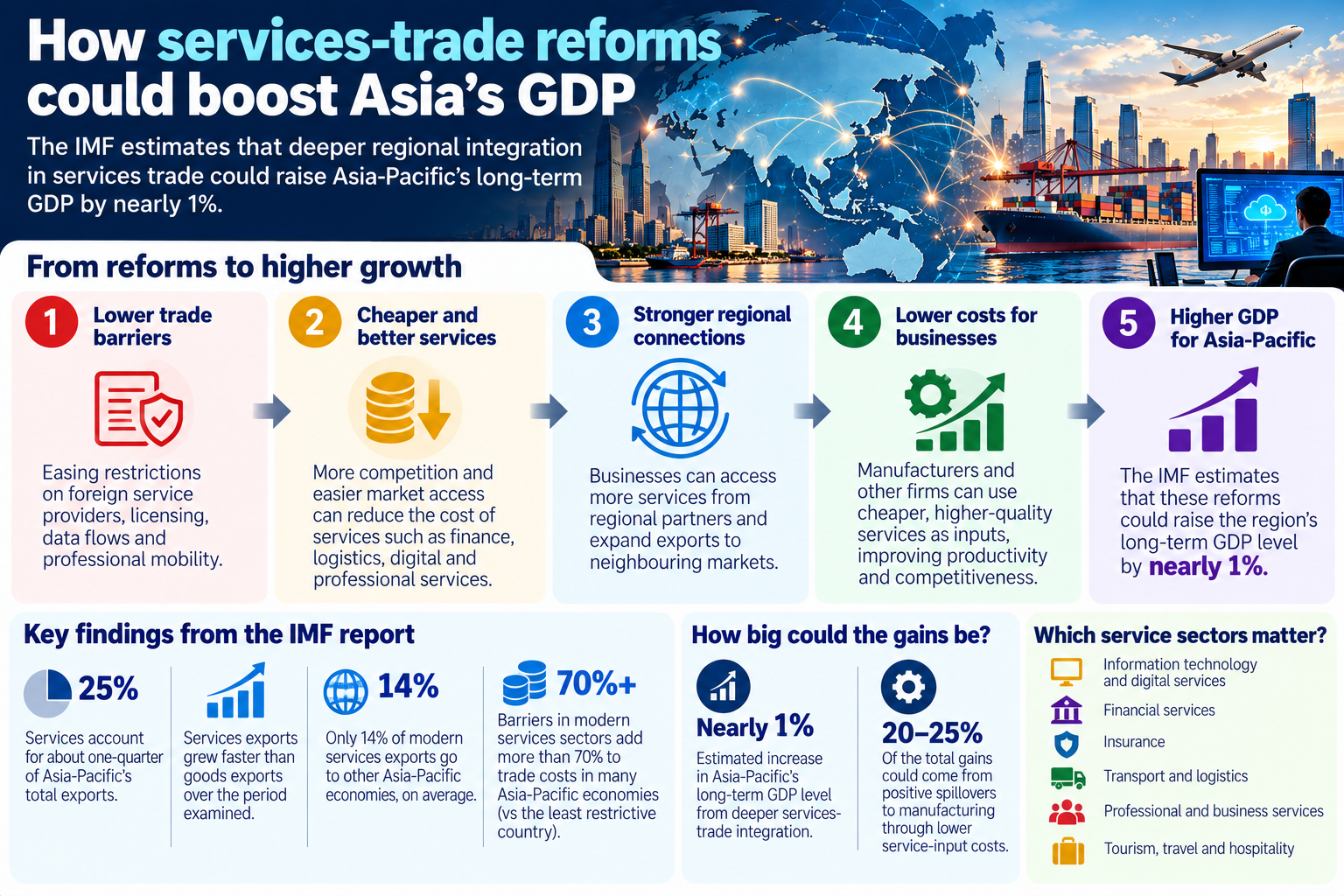
The IMF report says services account for about one-quarter of the region’s total exports, with services exports growing faster than goods exports over the period examined. Digitalisation and the greater use of services in production have also made more services tradable across borders.
However, regional integration remains limited. Only 14% of modern services exports go, on average, to countries within Asia-Pacific, according to the report. Many businesses continue to depend on markets outside the region despite expanding regional trade links.
ALSO READServices exports dip highlights need to shift to high-end areas
Services contribute to trade in two ways. Companies can sell services directly to customers in other countries, or use foreign services to lower costs and improve their own products. These inputs include digital systems, financial services, insurance, logistics and professional expertise.
The IMF estimates that about 20% of total regional services exports are embodied in goods trade, meaning services contribute to the value of exported products. Another 45% of regional services exports are supplied through commercial presence abroad, such as foreign bank branches and hotel chains. These channels show why conventional services trade figures may not capture the sector’s full contribution to regional integration.
The report identifies regulatory barriers as a major obstacle to deeper integration. These include restrictions on foreign service providers, licensing requirements, rules limiting competition, restrictions on the movement of professionals and differences in regulations across economies.
For digital services, data storage and transfer rules, along with local-presence requirements, can make cross-border business more difficult. Companies may face higher costs or struggle to serve customers abroad even when their services can be delivered online.
The economic cost of these restrictions can be substantial. The IMF estimates that barriers in modern services sectors add more than 70% to trade costs in many Asia-Pacific economies compared with the least restrictive country. The comparable figure for traditional services sectors is about 25%. In insurance, financial services and information and communications technology, restrictions more than double trading costs relative to the global benchmark in almost half of the economies covered.
These are regional findings, not estimates specific to India.
The IMF’s model suggests that reducing barriers to services trade within Asia-Pacific could raise the region’s long-term GDP level by nearly 1%, largely through lower prices. Consumers and businesses could access cheaper services from regional partners, while manufacturers could benefit from reduced production costs.
Positive spillovers to manufacturing would account for an estimated 20–25% of the total gains under the regional integration scenario. The IMF compares these potential gains with those from reducing tariffs on intra-Asian goods trade by around 10–15 percentage points across all goods sectors.
What could India gain from services-trade reforms?
India could benefit through two main channels – better access to services markets across Asia-Pacific and lower costs for businesses that use services as inputs. The IMF does not quantify these gains separately for India, but its analysis outlines how they could materialise.
For Indian services exporters, easier access to regional markets could create opportunities to sell digital, financial, insurance and professional services. Lower regulatory barriers could help firms establish cross-border operations, serve customers in other economies and compete for contracts.
The scale of the gains would depend on which services India can supply competitively and which markets open up. The IMF says economies with stronger services export sectors and a larger regional presence stand to benefit more because improved market access allows businesses to expand exports and build on existing strengths.
India’s gains would also depend on how deeply its businesses are integrated into regional services trade. The report says that economies with weaker regional links or limited use of imported services as inputs tend to gain less from regional integration. It identifies several emerging and South Asian markets as examples where gains could fall below the regional average.
ALSO READ$650 bn in debt, $1.4 tn in future revenue: Inside AI financing loop flagged by IMF
The nearly 1% estimate therefore cannot be treated as an India-specific GDP forecast. The IMF has not assigned a precise percentage to the potential benefit for India.
Indian manufacturers could also gain if reforms make services from regional partners cheaper and easier to access. Transport, logistics, finance, insurance and information technology are important inputs for many businesses. Lower costs in these areas could improve efficiency and help firms compete in domestic and international markets.
The IMF estimates that manufacturing spillovers would account for 20–25% of the total regional GDP gains under its integration scenario. This suggests that the benefits would extend beyond services exporters to businesses that rely on services to produce and export goods.
However, the report distinguishes between regional integration and unilateral liberalisation. If a country reduces its own restrictions without gaining better access to other markets, manufacturers could benefit from cheaper services, but domestic service providers would face greater import competition without a corresponding increase in export opportunities.
The IMF warns that this adjustment could put pressure on domestic services firms and workers because services are relatively labour-intensive. Reciprocal market access under regional integration could help offset some of that pressure by creating additional demand for domestic service exports.
For India, lowering domestic barriers alone may not deliver the broadest gains if other economies continue to restrict Indian service providers. Reforms that also improve access to regional markets could give Indian firms more opportunities to export their services.
The IMF recommends easing excessive restrictions on foreign service providers, strengthening competition and improving regulatory transparency. It also calls for deeper regional cooperation, broader services provisions in trade agreements and better alignment of regulations and technical standards.
Digital services will require particular attention. The report says digital infrastructure and policy frameworks that support secure, efficient cross-border delivery, including data flows, will become increasingly important as digitally delivered services expand.
Reforms would also need to account for their impact on workers. The IMF recommends labour-market policies, reskilling and upskilling programmes, mobility assistance and targeted social protection to help workers move between sectors as trade patterns change.
TOPICSDigital Economyeconomy'IMFThis article was first uploaded on October nineteen, twenty twenty-six, at fifty minutes past four in the afternoon. © IE Online Media Services (P) Ltd