The ongoing downturn in Bitcoin’s market could intensify over the next year if the cryptocurrency fails to effectively tackle the emerging threat posed by quantum computing.
In a report dated February 20, Charles Edwards, founder of Capriole, argued that Bitcoin’s current valuation should already reflect a discount due to quantum risk. He cautioned that this discount might deepen rapidly unless the network adopts quantum-resistant protocols.
Edwards stated:
“If we do not advance an upgrade to make Bitcoin quantum-proof within just over a year, its value could halve. Without progress, Bitcoin's Quantum Discount Factor may soar to 75% by 2029.”
This forecast suggests that Bitcoin’s price might fall from approximately $68,000 today down to about $30,000 within the next twelve months.
Moreover, Edwards warned of an even grimmer scenario where Bitcoin’s value could plummet entirely post-“Q-Day” if it cannot counteract threats from quantum computing technologies.
Despite these concerns, he believes that at present prices—around $60k—Bitcoin is undervalued by roughly 30%, considering its fair market value near $120,000 before factoring in quantum risks. Adjusting for those risks lowers this fair valuation estimate to around $96,000.
He elaborated:
“For long-term investors optimistic about overcoming the quantum challenge within two or three years, Bitcoin priced in the sixties thousands presents an appealing opportunity.”
The key takeaway isn’t necessarily that a quantum attack is imminent but rather that markets may begin devaluing Bitcoin ahead of any actual “Q-Day”. This would occur if investors anticipate prolonged governance and migration processes required for upgrading security protocols across developers and users alike.
Why Future Threats Influence Today’s Market
Edwards’ analysis highlights how concerns around quantum computing have evolved from niche discussions into urgent timelines impacting valuations now.
He points out that reaching approximately 2,300 logical qubits—a threshold sufficient to compromise current cryptographic protections—is expected between 2030 and 2031 based on aggregated industry predictions.
“There is about a 60% chance Q-Day will happen by 2030 and an 80% likelihood it occurs by 2031,” he explained.
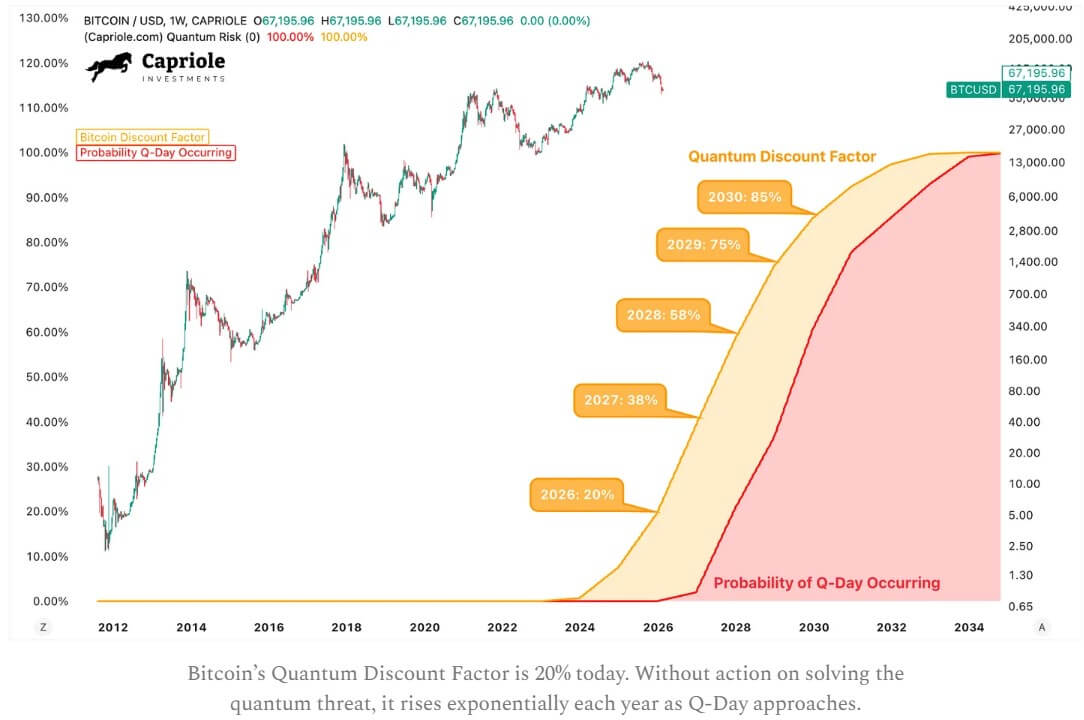
However, a more pressing concern lies with how quickly <em data-verified=“true” style=“font-style: italic”>Bitcoin can respond. The transition toward widespread adoption of <em data-verified=“true” style=“font-style: italic”>quantum-resistant wallets takes time — estimated at one-to-three years under aggressive assumptions — which creates vulnerability during this window.
A gap exists between rapid advances in <em data-verified=“true” style=“font-style: italic”>quantum technology, which threaten cryptography sooner than anticipated,
and slower governance mechanisms intrinsic
to decentralized networks like bitcoin.
This delay forms
the basis for his “discount factor.”nn
n
nMeanwhile,u00A0this perspective has gained traction beyond crypto insiders.u00A0Last year,u00A0BlackRock updatedu00A0its iSharesu00A0Bitcoin Trust ETF prospectus,u00A0explicitly acknowledgingu00A0that advancements inu00A0quantum computing might undermine bitcoin’s underlying cryptography.u00A0n
nThe firm highlighted potential wallet security breaches and emphasized challenges related nto achieving consensus on necessary network upgrades or forks.nThey also noted no guarantees these changes would be implemented successfully or promptly.n
nThis reframesnquantum risk as not only technological but also one involving coordination among diverse stakeholders—a significant governance challenge affecting valuation uncertainty well before any direct threat materializes.n
n
The Stakes Involved And The Complexity Of The Issue
nnEdwards divides bitcoin’s vulnerability into two main areas:npotential migration delays for active users adopting new secure protocols,nand exposure linked with older coins whose public keys remain visible—and thus susceptible—to future key recovery attacks enabled by powerful quantum computers.np nEstimates suggest around twenty-to-thirty percent of total bitcoins are “public key exposed,” including dormant wallets using legacy output types. These coins represent enormous latent supply risk should they be forcibly liquidated under adverse conditions.np nAt current valuations near sixty-seven thousand dollars per coin with maximum supply capped at twenty-one million BTC units,the exposed amount translates into hundreds of billions USD potentially vulnerable—from roughly two hundred eighty-two billion up to four hundred twenty-three billion dollars worth—posing substantial systemic implications p nCoinShares’ recent February assessment quantifies some specifics regarding “long exposure.”npay-to-public-key (P2PK) outputs alone account for nearly eight percent (~1.6 million BTC) since their format openly reveals public keys,potentially increasing susceptibility p however,the subset capable of causing immediate large-scale disruption through rapid liquidation appears smaller.CoinShares estimates only ~10K BTC reside in sufficiently large UTXOs relevant during sudden sell-offs h2bitcoin Proposals Exist But Consensus Remains Challenging h22 To mitigate threats posed by advancing Quantum Computing capabilities Edwards proposes implementing what he calls a “dead man’s switch.&rdquo This mechanism would freeze coins failing migration after set deadlines ensuring better preservation of network integrity However such measures conflict directly with foundational principles like “if you don’t control your keys you don’t own your coins,&rdquo potentially alienating users who lose access without migrating Successfully enforcing forced liquidations risks undermining confidence resulting possibly deep bear markets Meanwhile efforts continue actively Within community BIP360 proposal currently under review introduces Pay-To-Merkle-Root (P2MR), aiming via soft fork approach reduce long-term vulnerabilities while enabling integration paths toward post-quantum signatures explicitly acknowledging further steps needed against faster short-exposure attacks Beyond crypto circles standard bodies such as NIST urge institutions start transitioning systems toward Quantum Resistant Cryptography signaling shift away last-minute reactions toward proactive planning reinforcing notion debate shifting from whether but when/how For investors question narrows considerably It isn’t whether Quantum Computers can break bitcoin today Rather can bitcoin demonstrate clear measurable progress upgrading defenses soon enough preventing growing discounts amid fragile markets</inspectionscriptedimage/>subscriptedscripttag/assistant