In the gaming industry of 2025, AI remains an unavoidable topic, but market attitudes have become more measured than they were initially. According to an industry survey released by GDC, a growing number of developers are beginning to worry about the impact of generative AI on content quality, intellectual property, and employment structures. What players truly care about is not whether a game is labeled with the “AI” tag, but whether AI can deliver richer gameplay, rather than mass-producing soulless assets.
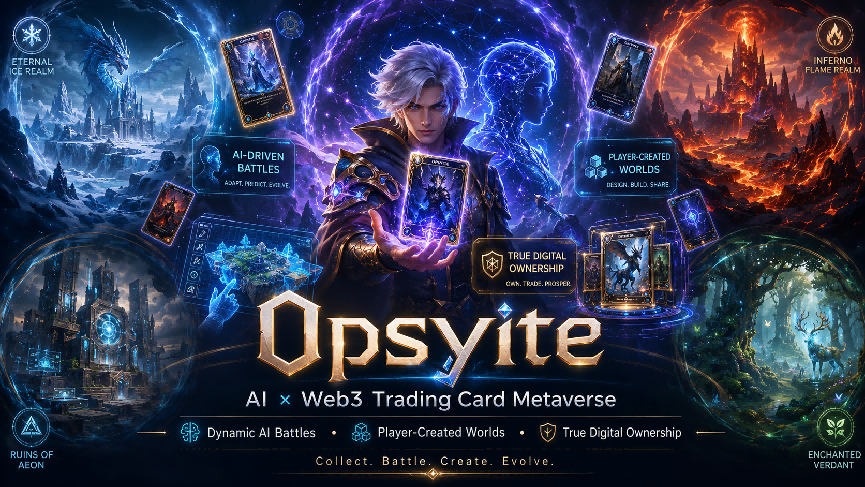
Against this backdrop, Opsyite has chosen to enter through the collectible card game segment, attempting to integrate AI, player creation, and Web3 asset mechanisms into a single game world. The project is set against the worldview of the “Temporal Rift,” where players assume the role of “Mystic Arcanists” capable of traversing different dimensions, collecting cards, building decks, and engaging in exploration and battles across scenarios such as the Eternal Ice Realm, the Inferno Flame Realm, the Ruins of Aeon, and the Enchanted Verdant.
Unlike traditional card games that rely primarily on fixed levels and preset enemies, Opsyite plans to have AI directly participate in the game loop. The system can generate new challenge dungeons based on the card decks, operation paths, and tactical preferences of players across the server, and adjust the skill combinations and attack rhythms of Bosses. Players can also authorize the system to learn their own combat behaviors, forming a “mirror AI” with a personal style for other players to challenge.
The significance of this design goes beyond simply increasing the number of opponents. Recent research on “AI-native games” points out that truly valuable AI gameplay should make AI a part of the rules, feedback, and player decision-making; once AI is removed, the core experience of the game will also undergo noticeable changes. The dynamic Bosses, mirror opponents, and world events proposed by Opsyite are attempts to move AI from a development tool to actual gameplay.
Player co-creation is another main line of the project. Through the built-in AI editor, ordinary players do not need to master programming and can still attempt to create maps, side storylines, quests, and skill mods. After works pass review and balance testing, they can enter the community map pool, limited-time events, or even mainline content. The identity of creators, the number of times works are used, and revenue records are confirmed and settled through the on-chain system.
This echoes the current emphasis on UGC in the gaming industry. Games are gradually shifting from one-way content provision by development teams to a model where players, communities, and creators jointly expand the world. AI can lower the barrier to creation, but whether content is engaging and whether rules are reasonable still requires human judgment. For Opsyite, the real challenge that an AI editor needs to address is not “how fast it can generate,” but whether it can help players produce content that is playable.
The Web3 component primarily serves the functions of asset rights confirmation and ecosystem settlement. High-rarity cards, skill modules, maps, and narrative content can be tokenized as NFTs according to the plan, and players can trade, lease, or authorize their use. OSYTC, the native token, is used for blind box opening, card progression, map publishing, creator incentives, and community governance, and it does not represent project equity or fixed returns.
The previous wave of Web3 gaming development has proven that relying solely on token rewards makes it difficult to sustain long-term activity. DappRadar tracking of the industry shows that some projects have ceased operations due to insufficient retention and unsustainable economic mechanisms, and the market is now refocusing attention on gameplay quality, content updates, and more robust economic cycles.
Therefore, what is more worth observing about Opsyite is not the token concept, but whether the three systems can truly work in synergy: whether the card battle has sufficient strategic depth, whether the AI can generate reasonable rather than uncontrolled challenges, and whether creator content can continuously attract players. Blockchain can record assets, and AI can expand content, but whether a game can operate in the long term ultimately depends on whether it is fun to play.
Based on the currently disclosed plans, Opsyite attempts to strike a balance between traditional TCG and new technologies: preserving the core enjoyment of deck building, scenario strategy, and progression collection, while introducing mirrored AI, dynamic narrative, and player co-creation to enable continuous evolution within the game world. For a project still in the development stage, this is a path with imaginative potential, yet one that must be progressively validated through actual testing.