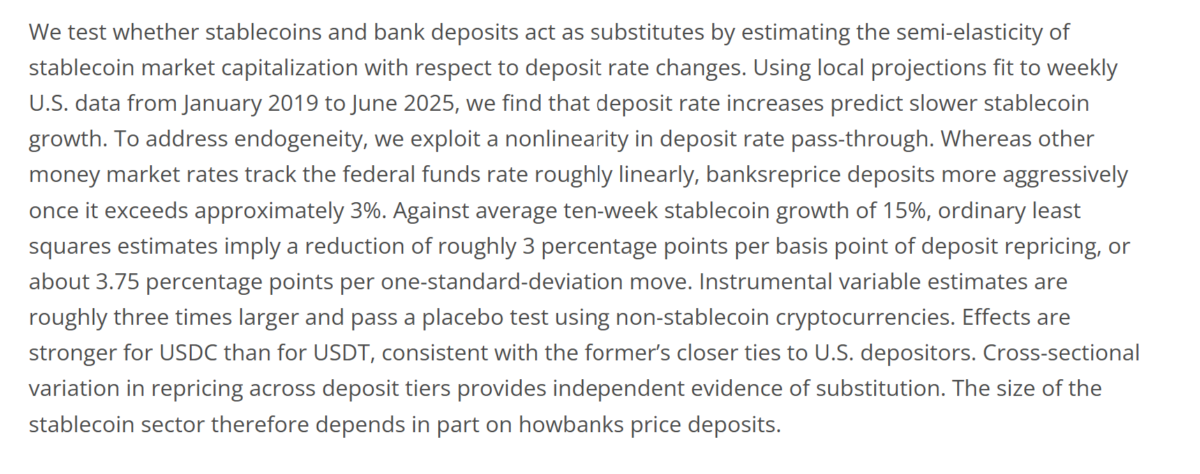
Even a tiny rise in bank deposit rates could slow stablecoin growth significantly. According to a recent study by the Bank for International Settlements (BIS), a one basis point increase in bank interest rates reduces the growth in market capitalization of stablecoins by about 3% over ten weeks.
Given that the overall growth is at approximately 15% annually, this decrease would reduce the amount of growth to be approximately 12% annually. USD Coin [$USDC] shows greater sensitivity, with growth declining 4.8 percentage points, compared with USDT’s 1.9-point reduction.

Know when your
coins move
Alerts, real-time prices, and market news — all in one app

Point your phone camera to install

4.8 based on 40K reviews in the App Store and Google Play


This difference highlights $USDC’s closer ties to U.S. users and institutions. Moreover, higher bank yields make deposits more attractive relative to stablecoins. Yet, the effect remains specific to stablecoins, as researchers found no significant link with other cryptocurrencies.
Therefore, increasing interest rates may slow down the growth of new stable coins but will not eliminate the current supply of stablecoins.
Visa expands $USDC payment rails
On the other hand, while bank rates challenge stablecoin demand, Visa’s stablecoin expansion highlights growing real-world payment utility.
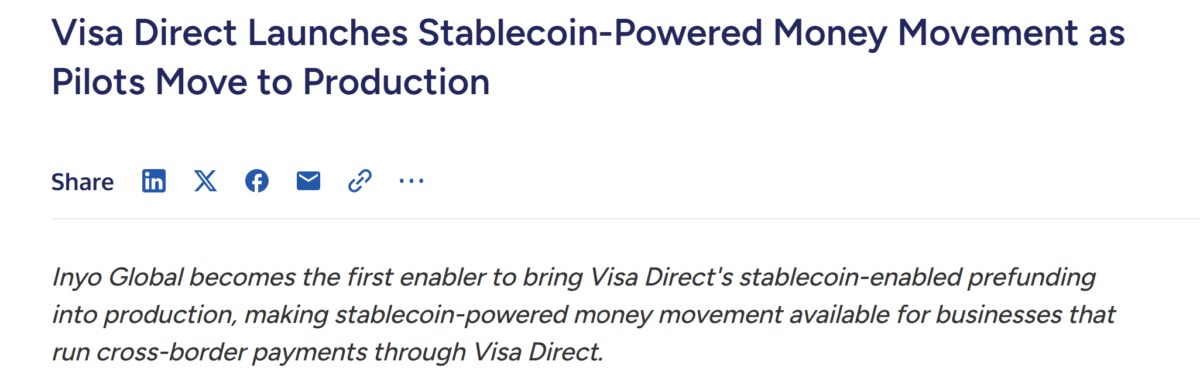
For example, Visa Direct currently allows payment of wages or purchases made using $USDC-funded cross-border payouts in more than 180 countries. Inyo Global is their first partner.
This feature may provide a method for obtaining additional demand for stablecoins beyond simply trading or using decentralized finance.
It should also allow businesses to draw upon available funds at any time, avoiding reliance on banking hours or correspondent networks.
At present, there are still over $300 billion in outstanding stablecoin capitalization. If Visa continues to expand its service to include more countries and/or additional banks, it appears possible that additional demand for stablecoins may develop.
However, if the rate of adoption is slower than expected, stablecoin holders who do not earn interest on their stablecoins may need to consider alternative forms of stablecoins. Some of these alternative forms of stablecoins are already paying interest on idle money.
$USDC payment activity accelerates
Visa’s dollar-based stablecoin settlement volume is already at an annualized run rate of $20 billion. That represents more than a 15-fold increase compared with last year.
That data suggests that stablecoins are shifting from purely speculative holdings to being used for actual payments.
Still, according to DeFiLlama data, $USDC total circulating supply stands at $72.6 billion. That said, measuring how much $USDC is involved in transactional activity is key to determining whether stablecoins are actually supporting commerce or simply accumulating wealth.
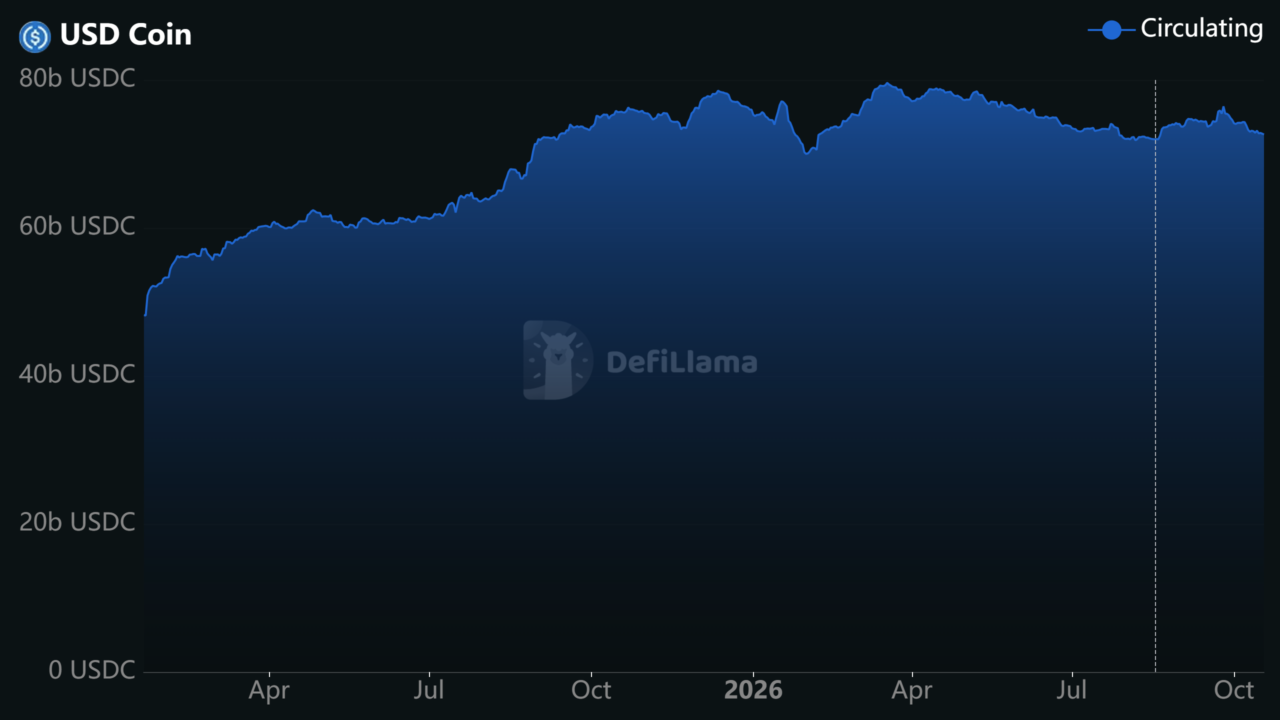
If the amount of $USDC used in settlements grows faster than the circulating supply of $USDC, it could begin to counteract some of the loss in demand due to increasing deposit rates at banks.
For this trend to continue, merchants and others will need to continue processing multiple transactions using prefunded $USDC balances.
Final Summary
Stablecoin growth faces pressure as rising bank deposit rates make traditional savings more attractive, slowing market capitalization expansion.
USD Coin [$USDC] payment adoption could support stablecoin demand as Visa’s settlement volume exceeds a $20 billion annualized run rate.