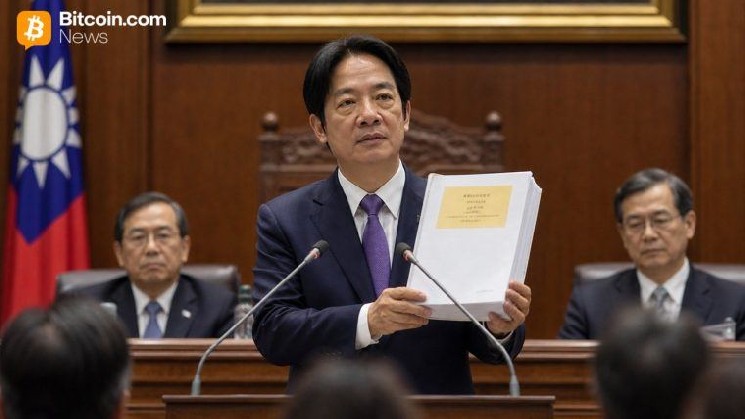
A legislator from Taiwan has officially submitted a proposal to the nation’s premier and the governor of its central bank, advocating for a portion of Taiwan’s substantial $602 billion in foreign exchange (FX) reserves to be invested in bitcoin.
Key Insights:
- Legislator Ko Ju-Chun presented a report on bitcoin reserves from the Bitcoin Policy Institute (BPI) to Taiwan’s premier and central bank.
- The majority of Taiwan’s FX reserves, over 80%, are held in dollar assets, which BPI warns could lead to currency exposure risks.
- No decision has been made yet; however, this initiative positions Taiwan alongside countries like the U.S. and Brazil in discussions about bitcoin as a reserve asset.
A Direct Appeal to Leadership
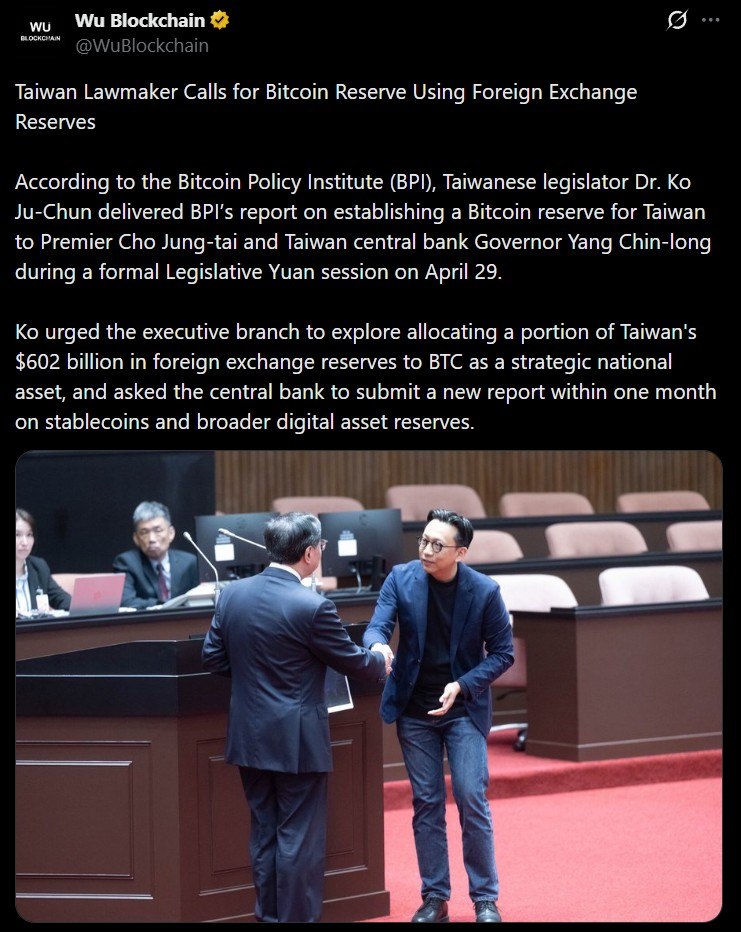
On April 29, 2026, Dr. Ko Ju-Chun, representing Taiwan’s Legislative Yuan, directly delivered the BPI report on bitcoin reserves during an official interpellation session with Premier Cho Jung-tai and Central Bank Governor Yang Chin-long. Authored by Jacob Langenkamp and published earlier that March, this report outlines compelling arguments for considering bitcoin as an essential reserve asset alongside traditional gold and foreign currencies.
The focus is sharply placed on Taiwan’s impressive foreign exchange reserves. With around $602 billion at its disposal—more than 80% of which is allocated into dollar-denominated assets—the BPI highlights that such concentration exposes the country to potential currency devaluation risks. Furthermore, it raises concerns regarding scenarios where these dollar assets might become inaccessible due to geopolitical tensions with China.
The proposed initial investment is around $2.5 billion worth of bitcoin—less than half a percent of total reserves—which may seem modest but carries significant symbolic weight within this context.
Bitcoin as a Geopolitical Safeguard
The rationale put forth by Ko Ju-Chun isn’t entirely novel; however, it resonates deeply within Taiwan’s unique circumstances. The BPI report emphasizes attributes such as bitcoin’s fixed supply model, decentralization features, and resistance against seizure—all factors that make it particularly relevant given Taiwan’s security challenges (notably its immunity from being frozen by external governments or obstructed through financial blockades akin to SWIFT).
This perspective aligns with ongoing discussions globally regarding national reserve strategies involving cryptocurrencies. In the United States alone, there are speculations surrounding similar initiatives across four states while legislative measures are progressing in at least fifteen others . Additionally,Brazil has revived legislation aimed at allowing up to one million BTC into their national reserves .
Taiwan distinguishes itself not merely through discussion but through action; rather than simply proposing ideas publicly, Ko Ju-Chun formally presented his findings directly impacting those responsible for shaping monetary policy , thus creating an official record within legislative proceedings.
Regardless of whether Taipei decides upon any actions following this presentation,
it’s clear that important conversations have now begun within influential circles.
Frequently Asked Questions (FAQ)
- What was proposed by Taiwanese legislator Ko Ju-Chun?
Ko Ju-Chun proposed allocating part of Taiwan’s FX reserves into bitcoin during discussions with key government officials. - How much does Taiwan currently hold in FX reserves?
Taiwan holds approximately $602 billion in foreign exchange reserves. - If approved what would be the initial allocation towards Bitcoin?
The suggested initial allocation would be around $2.5 billion worth of Bitcoin. - Why does holding Bitcoin matter for geopolitical reasons?
Bitcoin offers advantages like fixed supply and decentralization which can protect against external financial pressures or access issues related to political conflicts. - Diverse nations are exploring similar initiatives; how does this affect global trends?
Taiwan joins other countries like Brazil and several U.S states discussing cryptocurrency integration into national reserve strategies indicating growing acceptance worldwide.