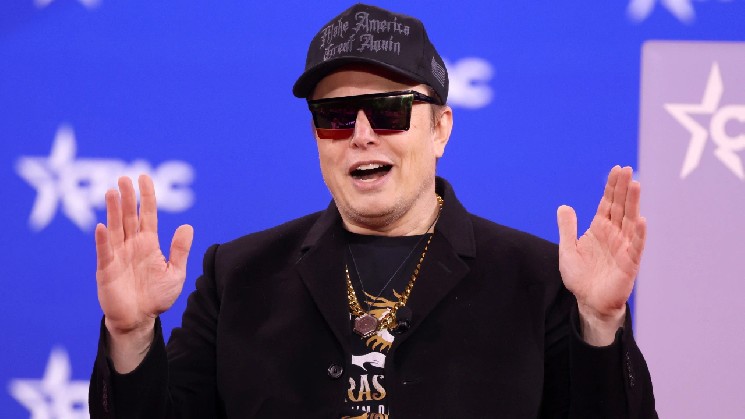
SpaceX (NASDAQ: SPCX) stock rose by 6% to approximately $168.78 on Monday, which increased the company’s market cap to around $2.29 trillion, taking the stock beyond the $150 mark that made Elon Musk the world’s first trillionaire in June.
The move comes after Morgan Stanley endorsed the company again, and Musk’s move to rename the company’s AI division as “SpaceXSI.”
Morgan Stanley’s $300 call spurs the drive
The biggest signal arrived when Morgan Stanley reserved its Overweight rating and $300 price target on SpaceX stock, advising clients the stock is still grossly undervalued and is currently 40% under its mega-cap AI peers when you look at it on a growth-adjusted basis.

Know when your
coins move
Alerts, real-time prices, and market news — all in one app

4.8 based on 40K reviews in the App Store and Google Play


Analyst Adam Jonas steered investors in the direction of SpaceX’s next Starship mission, Flight 15. Flight 15 is supposed to take off later in October or in early November. Jonas believes that a successful “ship catch” on Flight 15 will serve as an important, if not the most important operational catalyst for SpaceX stock since the June IPO.
Morgan Stanley set an ambitious target. Its $300 dollar figure happened to be the outlier amongst 17 other underwriting banks, with most hovering between the $200 and $250 figure. In fact, the median call was $225 and the stock has not hit that figure since the early days of its listing.
From AI to ‘SI,’ and a change in what SpaceX sells
Elon Musk posted on X on Sunday, October 4, that “No more AI. SI. It’s better.” He later stated that SpaceXAI would be rebranded to SpaceXSI, branding SpaceX as a super intelligence company.
The rebrand comes after President Donald Trump signed Executive Order 14434 on September 29, directing federal agencies to adopt “Super Intelligence” and “SI” instead of “Artificial Intelligence” and “AI” in non-statutory documents.
Musk has adopted the new name faster than the other executives that attended the White House summit.
The renaming is happening at a company that has leaned toward compute recently. Its AI unit made $2.56 billion in revenue in Q3, which dwarfs the $962 million its space business generated.
Revenue from Q2 increased 92% year on year to $7.8 billion, while the AI arm saw a 247% jump. SpaceX management forecasts a $100 billion annual run rate by December 2026.
A round trip from the June IPO
The recent slide is surprising considering the initial euphoria around the stock. SpaceX priced its IPO at $135 in June but opened at $150, and the stock reached $211 in three days. The company had the largest Nasdaq debut in US history, making Musk the world’s first trillionaire.
The shares later fell to the $123 mark, a near 60% drop from its peak. Analysts now see a 52-week range of $104.83 to $225.64.
The macro environment and the valuation question
The macros did SpaceX a favor. A below-par September jobs report coupled with a rise in unemployment to 4.2% and payrolls increasing by just 29,000 dampened expectations of a rate hike by the Fed. The Nasdaq rose 0.7% on the day while the Dow slipped.
A few still remain skeptical. SpaceX reported a net loss of ~ $541 million in Q2 on a capital expenditure of $18.4 billion. Its price-to-sales ratio sits above 100.
Reports on the summer analyst notes argued that the tightly clustered price targets showed banks “punting” on a company whose fundamentals are hard to value.
Whether Flight 15 delivers the catalyst Morgan Stanley is counting on will go some way toward settling that debate.