On September 30, the Securities and Exchange Commission (SEC) filed a suit against private investment adviser Meyer Global Management and its CEO Owen E.H. Meyer for allegedly defrauding investors in funds with investments in SpaceX and other securities before their Initial Public Offering (IPO).
This lawsuit comes at a time when investors who have been unable to access private firms are increasingly turning towards various forms of investing, such as tokenized claims, perpetual futures, and prediction markets.
The connection that binds these markets together is quite straightforward: investors are looking for opportunities to invest in the rapidly expanding private business sector; however, the regulations and structure of these markets have not been able to keep up with this access to investment.

Know when yourcoins move
Alerts, real-time prices, and market news — all in one app 
 4.8 based on 40K reviews in the App Store and Google Play

What the SEC says Meyer did
Meyer and his company are said to have operated scams starting at least in December 2021, misappropriating funds and making false statements to investors, as per the litigation release on September 30. The SEC alleges that in at least three instances, funds raised from investors were used to cover Meyer’s personal expenses.
Investors from one scheme reportedly were provided account statements that showed inflated values. In another scheme involving three funds, investors supposedly received amounts less than what they should have gotten and were made to sign release documents prior to receiving payments. Additionally, a fund associated with SpaceX reportedly lost an investment worth about $3 million after repeated failures due to a capital-call deficiency.
“This case is a reminder that fraudsters can exploit the allure of exclusive, high-return pre-IPO access to take advantage of retail investors.”
— Corey A. Schuster, chief of the SEC Enforcement Division’s Asset Management Unit, in the SEC announcement.
A pattern the SEC has been chasing
Meyer Global has not been the only pre-IPO consultant who faced legal trouble this year. On August 10, the SEC accused Adit Ventures, Eric Munson, the CEO, and three affiliated general partners of misconduct regarding investments including SpaceX and Klarna. The violations involved misappropriations, undisclosed fees worth millions, and unfounded statements about private company asset ownership. The accused admitted no wrongdoing while settling the case.
Simultaneously, on September 30, the SEC recommended regulatory amendments to improve retail investors’ access to private investment opportunities. SEC Chair Paul Atkins said that private investments should not be the privilege of the rich, while Better Markets warned that inexperienced investors will face increased risks, as per a report by Reuters.
Where crypto fits in
The same appetite has created a parallel on-chain market. A CoinMarketCap report published June 10, with data through that date, counted $2.94 billion in cumulative pre-IPO perpetual-futures volume across 10 venues and identified three main routes: spot tokenization, perpetual futures and prediction markets. Cryptopolitan has also reported on SpaceX-linked demand through Binance.
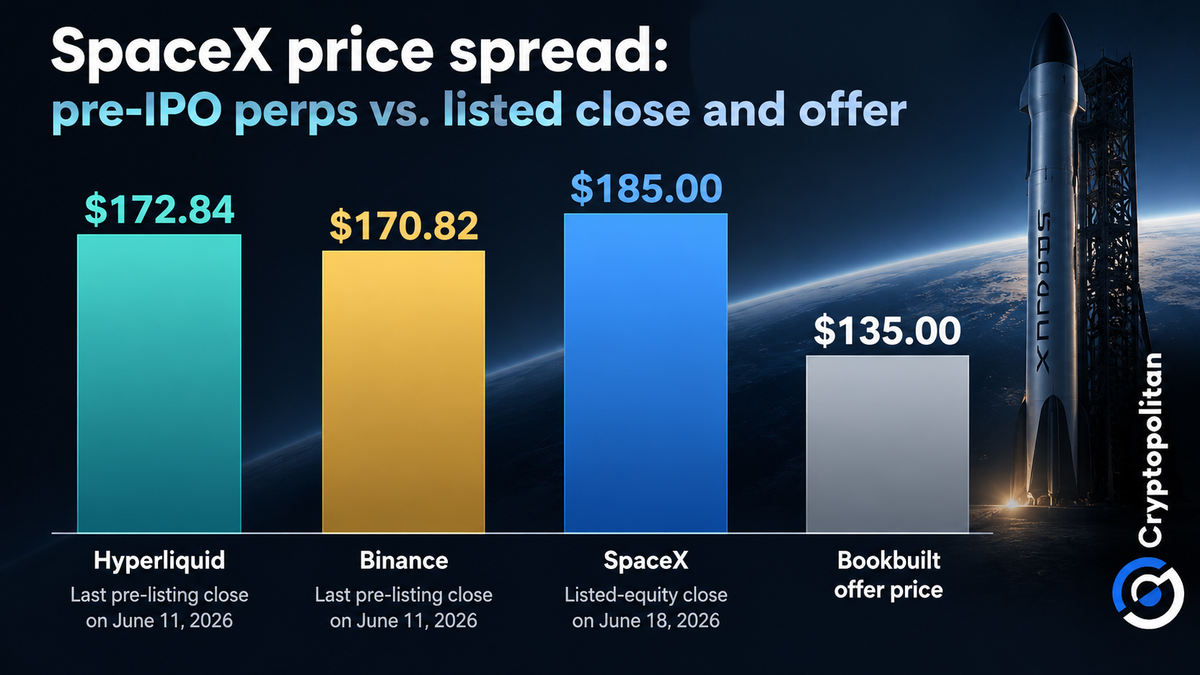
A SpaceX study published August 31 shows how perpetual futures can track valuation without giving traders ownership of actual shares. Its June 2026 data put the last pre-listing closes at $172.84 on Hyperliquid and $170.82 on Binance, versus SpaceX’s $185 June 18 close and $135 book-built offer price.
Blockchain rails do not remove the underlying legal questions. An IMF note published July 2 highlights risks around the legal relationship between tokenized instruments and the assets they represent. Whether exposure comes through a private fund or a synthetic contract, investors still need to know what they own, how it is priced, and what has been disclosed.
The SEC charged Meyer Global Management and CEO Owen Meyer on September 30 with defrauding retail investors in private funds holding SpaceX and other pre-IPO stakes, alleging misused client money, inflated account statements and a missed SpaceX capital call that cost one fund nearly $3 million. It follows the agency’s August case against Adit Ventures over similar conduct and arrives the same day the SEC proposed opening private assets to more retail investors. The dual signal matters because the demand behind these funds is also driving tokenized and synthetic pre-IPO products where ownership, valuation, and disclosure remain unsettled.