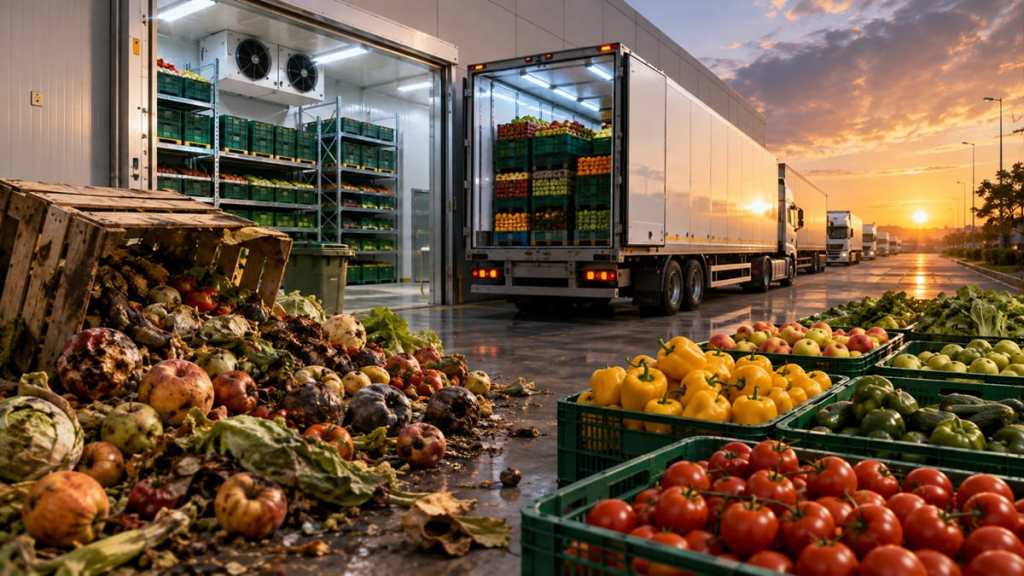
Every year, India loses around Rs 1.5 lakh crore worth of post-harvest fruits and vegetables due to a major gap in the country’s cold-chain infrastructure, according to Equirus Securities. The brokerage has proposed a 10-year tax holiday for cold-storage infrastructure to attract private investment and help recover a huge portion of the produce currently lost.
India produces around 355 million tonnes of horticultural produce annually, but nearly 50 million tonnes is lost each year, Equirus said in its report “India’s Road to a $20 Trillion Economy – A Twenty-Step Reform Agenda”, part of its India Growth Series.
The report values the annual loss at approximately Rs 1.5 lakh crore, or $18.5 billion, making post-harvest wastage one of the major economic issues for the country’s agriculture and food supply chain.
India’s cold-chain gap
Equirus has identified inadequate cold-chain infrastructure as a key factor behind the losses. Only around 4% of India’s fruits and vegetables pass through a cold chain, compared with 80-85% in the US, according to the report.
The large gap leaves a substantial portion of India’s perishable agricultural output vulnerable to spoilage during storage and transportation. With horticultural production already at around 355 million tonnes annually, improving the country’s ability to store and transport this produce could help recover value from output that is currently being lost.
ALSO READFrom Rs 38,000 cr to Rs 4.24 lakh crore: How mobile manufacturing is driving India’s export boom
Equirus proposes 10-year tax holiday
To address the gap in the infrastructure, Equirus has proposed a 10-year tax holiday for cold-storage infrastructure. This proposal is intended to encourage private investment in cold storage, including participation from micro, small and medium enterprises (MSMEs).
The report suggests that fiscal incentives could help accelerate investment in cold-storage capacity, drawing on the broader approach of using government incentives to build domestic infrastructure and productive capacity.
Halving losses could add Rs 37,400 crore
The potential economic impact of reducing food wastage could be substantial. Equirus estimates that cutting current fruit and vegetable losses by half could put around Rs 374 billion, or Rs 37,400 crore, back into the economy every year.
The report estimates that such a reduction in losses could add approximately $4.5 billion to GDP. Agricultural value added could also rise by around 0.8 percentage points, according to the report.
The projected gains would come from retaining a larger share of agricultural output that is already being produced, rather than relying solely on increasing production.
What would the tax holiday cost?
The proposed incentive would also have a fiscal cost. Equirus estimates that a 10-year tax holiday for cold-chain infrastructure could result in Rs 5,000-7,500 crore, in annual foregone government revenue.
The proposal therefore involves a trade-off between the government’s near-term tax collections and the potential economic gains from reducing agricultural wastage and expanding cold-storage capacity.
ALSO READBeyond imports: How Indian defence firms power Boeing and Lockheed Martin’s global supply chains
Why the cold chain matters
For India’s agricultural economy, the cold chain is not limited to storage facilities. An expanded network would support the transportation and preservation of perishable products between farms, warehouses, processing facilities, markets and consumers.
Equirus’ estimates suggest that improving this infrastructure could unlock economic value from agricultural produce that is currently lost before reaching the market. The proposal forms part of the brokerage’s broader 20-step reform agenda for India’s journey towards a $20 trillion economy.
TOPICSECONOMYinfrastructureTaxThis article was first uploaded on August fourteen, twenty twenty-six, at forty minutes past five in the evening. © IE Online Media Services (P) Ltd