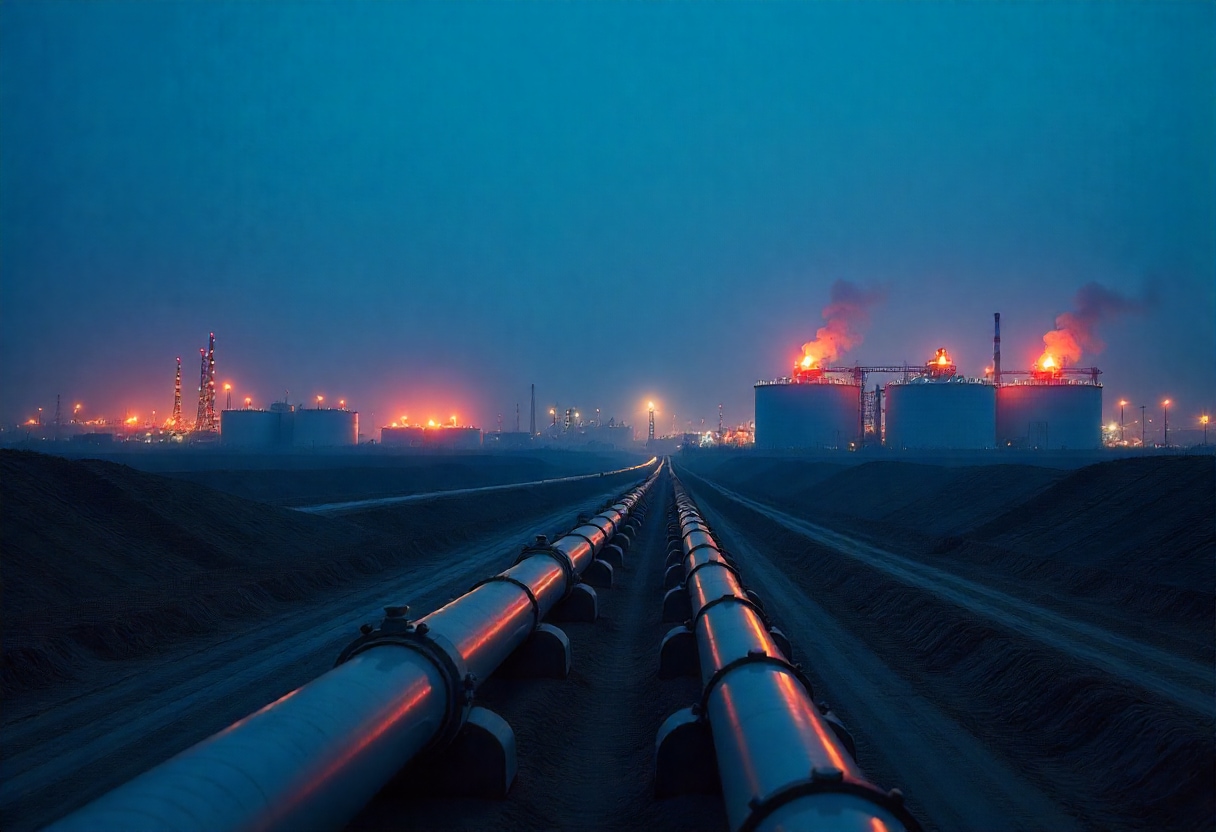
The closure of the Strait of Hormuz has removed more than 80 million tonnes per annum (mtpa) of LNG from global markets — equivalent to nearly one-fifth of worldwide supply — creating conditions for a fresh wave of multi-billion-dollar LNG investments outside the Middle East even as energy buyers grapple with unprecedented uncertainty over future gas supplies, according to a new Wood Mackenzie analysis.
The report suggests that while the immediate impact has been a sharp tightening of LNG availability and heightened price volatility, the bigger story may be the investment response. More than 150 mtpa of LNG export capacity is already under construction outside the Persian Gulf, predominantly in the United States, while another 30 mtpa is expected to reach final investment decision (FID) by the end of 2027.
Under a prolonged disruption scenario, that pipeline could expand further as buyers seek alternatives to Gulf supplies and developers rush to fill the supply gap left by the world’s most important LNG transit corridor.
“The Strait of Hormuz closure has done more than remove LNG from the market. It has removed certainty,” said Kateryna Filippenko, Research Director, Global Gas Markets, Wood Mackenzie.
“There is no longer consensus on how the market evolves,” she said. “Volatility is the new baseline. The question for buyers, investors and policymakers is not which scenario proves correct. It is whether their portfolios and supply strategies are resilient enough to absorb any of them.”
The report, Iran War Scenarios: Implications for the Gas and LNG Market, outlines three possible pathways for the market.
Under the Quick Peace scenario, Gulf LNG facilities restart in June 2026 and return to full capacity by 2027. A Summer Settlement would delay recovery until September 2026, with full restoration by 2028. Under the most severe Extended Disruption scenario, recurring conflict and infrastructure damage permanently alter Middle East LNG growth prospects.
In that scenario, Qatar’s planned North Field West project could be postponed indefinitely, major LNG developments could face years of delays, and no additional pre-FID projects would move forward as originally planned.
The report warns that the consequences would extend far beyond the Middle East.
Countries across Europe and Asia remain heavily dependent on LNG imports as domestic gas production declines and pipeline supplies remain constrained. While LNG demand is expected to grow across all three scenarios, the report says prolonged disruption could encourage countries to diversify away from LNG dependence, particularly after 2030.
The result could be a market characterised by both scarcity and surplus at different points in the decade.
Wood Mackenzie said markets could begin softening from 2028 under a quick peace scenario, potentially requiring cancellation of some LNG cargoes between 2031 and 2033 to restore balance. Under an extended disruption, however, markets would remain tight through much of the decade before eventually facing oversupply risks as new export capacity enters operation.
The crisis is also reshaping the economics of LNG shipping.
In a parallel study, Wood Mackenzie said the global LNG carrier fleet is increasingly being divided between modern vessels and older ships facing mounting environmental compliance costs. With the European Union’s emissions trading system now covering 100% of maritime emissions from January 2026, and methane emissions brought within its scope, compliance costs are becoming a decisive factor in vessel competitiveness.
By 2030, combined compliance costs under EU ETS and FuelEU Maritime could reach US$1,256 per tonne for conventional marine fuels, compared with about US$705 per tonne under the proposed IMO framework.
“Owners who invested in DFDE vessels expecting them to be their compliance answer are facing a more uncomfortable reality,” said Itzel Torruco, Research Analyst, LNG Freight, Wood Mackenzie. “The window to retrofit or exit is narrowing.”
While the Hormuz crisis has removed roughly 20% of global LNG supply, it has simultaneously created one of the strongest investment signals seen by the LNG industry in years, accelerating new project development, reshaping shipping markets and redrawing the future geography of global gas trade.
TOPICSECONOMYEnergyfuelLNGmiddle east and europeStrait of Hormuz + 0 MoreThis article was first uploaded on June nine, twenty twenty-six, at fifty-six minutes past six in the evening. © IE Online Media Services (P) Ltd