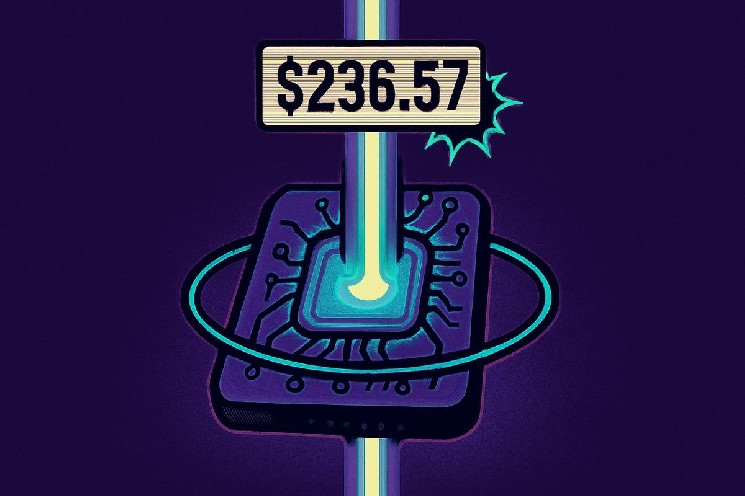
Nvidia’s share price pushed to a fresh all-time high of $236.57 this week, extending a rally that has turned the chipmaker into one of the standout stories of the current market cycle. The move puts Nvidia stock performance back in the spotlight just as Wall Street weighs how much further the AI-driven run can go, and as new questions swirl around the broader semiconductor supply chain feeding that boom.
Key takeaways
Nvidia shares hit an all-time high of $236.57.
The stock is up more than 30% over the past six months and 25.98% over the past year, according to Investing.com.
Cantor Fitzgerald reiterated an Overweight rating and a $350 price target following investor meetings with CEO Jensen Huang in New York City.
Bank of America lifted its U.S. semiconductor industry growth forecast to 18% annually between 2026 and 2030.
Pope Leo XIV criticized Nvidia’s approach to AI safety, while Nscale faced scrutiny over undisclosed ByteDance sales ties ahead of a planned U.S. IPO.
Nvidia’s Record Stock Performance
Nvidia’s climb to $236.57 confirms that investor appetite for the company has barely cooled, even after years of outsized gains. The stock has reached this all-time high, a sign that buyers are treating the AI chip leader as a near-permanent fixture at the top of the market.

Know when your
coins move
Alerts, real-time prices, and market news — all in one app

4.8 based on 40K reviews in the App Store and Google Play


The momentum isn’t a one-week story. Nvidia’s shares have gained more than 30% over the past six months alone, and the one-year change now stands at 25.98%, according to data reported by Investing.com. That kind of sustained Nvidia stock performance reflects not just a single catalyst but a stacking of positive developments — from target=”_blank” rel=”noopener noreferrer external”>advanced cooling technology designed to handle the intense thermal loads of next-generation AI chips. Shipments like these are a concrete signal that Nvidia’s newest architecture is moving from announcement to deployment, which matters for investors trying to gauge how quickly the company’s product pipeline converts into actual revenue.
Semiconductor Growth Outlook
Taking a broader view, Bank of America has lifted its outlook for the U.S. semiconductor sector, now projecting an 18% yearly growth rate from 2026 through 2030, with the upgrade tied to improved expectations for memory chips and server components. That upgraded outlook offers useful context for the broader Nvidia semiconductor growth story: if the sector as a whole is set to expand at that pace, Nvidia’s own trajectory looks less like an isolated spike and more like a reflection of an industry-wide buildout in AI infrastructure. This is one of the reasons the current rally matters beyond a single stock — it ties directly into how fast the chip supply chain can scale to meet AI demand.
Controversies and Market Transparency Issues
Not every recent headline around Nvidia has been bullish. Nvidia faced criticism over its stance on AI safety, with concerns raised about the company taking the technology’s risks more seriously — a notable instance of Nvidia AI safety concerns reaching beyond the usual circle of regulators and industry critics. The remarks add to a growing public conversation about how aggressively AI hardware makers should be held accountable for the systems their chips power.
Separately, Nvidia-backed Nscale has drawn scrutiny for reportedly downplaying its significant sales ties with ByteDance while pitching investors ahead of a planned U.S. IPO. ByteDance accounted for a large share of Nscale’s sales last year, yet that relationship was not prominently disclosed, raising questions about transparency standards for companies riding the AI investment wave toward public markets. For investors, this kind of disclosure gap is a reminder that enthusiasm around AI infrastructure names doesn’t exempt them from standard scrutiny over customer concentration and dependency risk.
Article produced with the assistance of artificial intelligence and reviewed by the editorial team.