
Bitcoin is nearing a critical juncture where the market might have to decide between two contrasting scenarios. While traders continue to pay premiums for short positions, indicators such as price movements, ETF inflows, and market leadership no longer suggest that the market is in a state of collapse.
In a recent post on X, analysts from Alphractal noted that Bitcoin’s funding rates had plummeted to their lowest levels since 2023. Their proprietary models indicate a potential local bottom for Bitcoin.
The analysts utilized their ‘Market Capitulation Oscillator and Tactical Bull-Bear Sentiment Index’ to demonstrate that it has entered an extreme zone reminiscent of previous significant lows in Bitcoin’s history.
The accompanying chart illustrates how the sentiment index dips into severe troughs during past cycle washouts, including the bear-market low of 2015, capitulation in late 2018, and the low seen in 2022.
The latest data reveals that this indicator has returned to similar lower bands, reinforcing the notion that current market positioning is once again at an unusually stressed level.
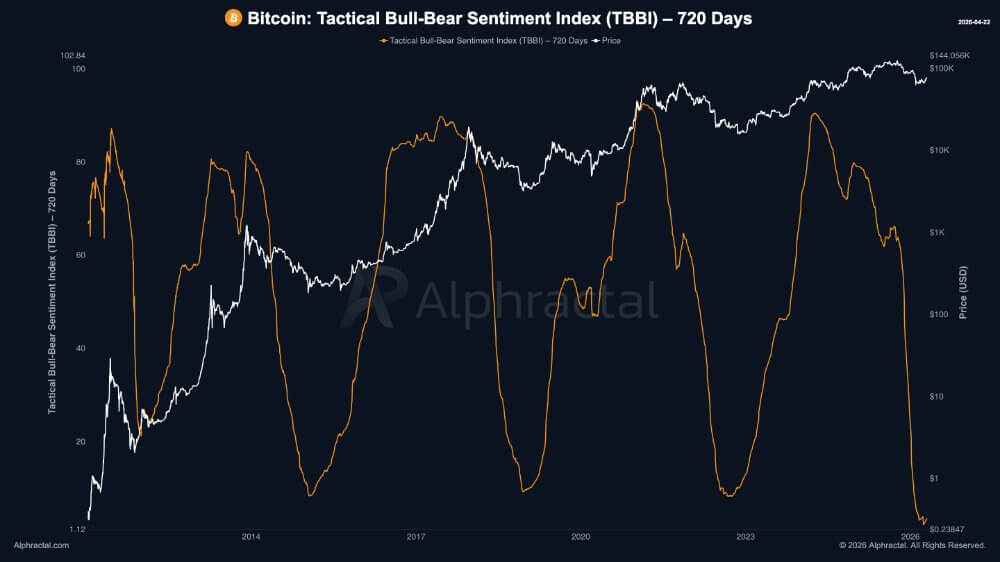
This suggests that Bitcoin is trading within a range historically associated with capitulation followed by eventual recovery. Additional market data supports this narrative.
According to Crypto.com, on April 18th, the seven-day average funding rate dropped to approximately -0.008%, marking its weakest point since early 2023. Glassnode also reported persistent negative funding even as Bitcoin stabilized and spot conditions improved.
This leaves the market in an unusual position; either Bitcoin could be emerging from a washout phase conducive for a tradable rebound or macroeconomic pressures may still be potent enough for another downward leg before any recovery occurs.
CryptoSlate’s page tracking Bitcoin prices indicated BTC was valued at $78,951 on April 22nd—up by 12.37% over thirty days—with its dominance at 60.1%. The current environment does not exhibit signs typical of widespread speculative breakouts but rather shows an asset regaining its leadership role while confidence elsewhere remains tenuous.
This distinction raises crucial questions about whether Bitcoin may be approaching a sustainable low while other cryptocurrencies are not yet prepared for full-scale bull-market expansion.
The Case Against Dismissing Bottoming Arguments
The bullish perspective gains traction due to robust spot demand amidst defensive derivatives positioning.
Glassnode characterized a scenario where perpetual-futures funding remained negative even as Bitcoin attempted recovery from its downturn. Prolonged negative funding can serve as fuel for upward movement when shorts become crowded; however it also indicates cautious leveraged conviction among traders.
CryptoSlate (Source: Alphractal)
The signal becomes increasingly intriguing because price action has deviated from traditional bearish patterns.
Bitcoin now behaves less like an asset caught in relentless liquidation pressure and more like one attracting buyers willing to navigate macroeconomic fears.

Buyers are particularly evident within one of this cycle’s most vital channels—the ETF sector. Farside Investors reported substantial inflows into U.S.-based spot bitcoin ETFs totaling $411 million on April14th,$663 million on April17th,and$238 milliononApril20th.
This flow pattern suggests larger investors did not withdraw entirely when tensions escalated within markets.
The rebound appears credible partly because it follows genuine institutional re-engagement after experiencing significant outflows earlier this year; by March’s start,BTFD (Buy The F**king Dip)-style strategies had resultedinfive weeks’ worthofoutflows amountingtoaround$3.billionbeforeflownormalizedinMarch.
This prior washout defines today’s setup well.Institutions seemtohave reduced risk exposureandare now selectively reinvesting.
If these trends persist alongside ongoing negative or slowly normalizing funding conditions,the short side could face greater vulnerability than currently anticipated.This representsthe strongest versionofthebottoming case without prematurely declaringthatafull-cyclebullmarketis underway.
The Constraints Capping Upside Potential
A pivotal moment lies ahead where markets must determine if tactical rebounds can evolve into broader lasting trends.Here constraints become increasingly difficulttooverlook.The IMF issued warnings throughitsApril2026WorldEconomicOutlookindicating prolonged conflicts,worsening geopolitical fragmentation,and renewed trade tensionscould severely undermine growth prospectsand destabilize financial systems—warnings coinciding directlywithBitcoin’srecoveryattempts.
Marketscan indeed rally amid positioning stress,yet sustaining robust bull phases proves challenging if global economic backdrops continue deteriorating.Furthermore,the Federal Reserve’s meeting minutes releasedonMarch18revealedthatitmaintainedthe federal funds target rangeatbetween3 .5%and37 %while remaining focusedon incomingdataaswellasthebalanceofrisks.
Such policies remain far removedfromaggressive easing cycles whichhistoricallybolsteredhigh-beta assets’ valuations.Coinbase Research echoedthis sentimentinitsApril outlook,arguingneartermcryptopricesaredrivenmorebymacro headlines thanbycrypto-specific catalysts.
Thus,Bitcoin occupiesanarrowyetcriticalwindow.Itappears more resilientthanwhatderivativesmarkets predictedbutstill lacks insulationfrombroader economic factors.Shouldconflict risks escalate,fuelprices tightenfinancialconditions furtherorinterest rate expectations shift towards stricter policies,thecurrent recoverymay quickly lose momentum.
Paving Pathways Towards Future Bull Phases Begins Narrowly
A broader analysisofcryptomarketstructurearguesagainstproclaiminganimmediatefull-spectrumbullmarket.Basedonthedataprovidedby,Bitcoin’sdominance exceeding60%suggeststhatleadershipremainsconcentratedwithinmostliquidassets—a trend typically observedwheninvestorsfavorliquidityandperceivedqualityoverwider risks reflectingthecurrentenvironmentalongsideexistingpolicy frameworks
Regulatory processes surroundingcryptocurrencyremainactivepublicallythoughstill incompleteaccordingtoSEC reports.On July1st ,2026 ,MiCA transitionperiodendswherefirmsservingEU clientswithoutauthorizationwillbe violating EU laws—this signifiesamoreformalregulatorylandscapecomparedtothepreviouslooser regulations fueling earlier crypto rallies.Meanwhile,money continues flowingthroughindustry infrastructurewithstablecoinsupplyreachingrecord highsaround$320 billion dominatedbyUSDT&USDC despite Washington grapplingwithmarket-structure legislation
This demonstratesacurrentcrypto zeitgeist centered primarily aroundBitcoin ,stablecoins ®ulatedrailsrather than broad speculative engagement.Iflargerbullphases eventually materialize,itmay beginnarrowly instead oftakingoffacrossentireriskcurve.Fornow,Bitcoin seemsclosertoatradablebottomthanexpectedbuthasnotyetsecuredaffirmationforafull-fledged bull-market verdict
Alphractalcharts showtheirsentimentIndexplummetingintoextremelowvaluesnearvarioussignificanttroughsindicatingbothsentiments&positioningsreturningtowardshistoricalcapitulationzonesinsteadregular dips
Still,a staticchartprovidesqualitative supportforthepatternhoweveritisinsufficientlypreciseenoughtoaccuratelyvalidate timinglanguageforlocalbottomstoformwithin21days
A clear test lies ahead;ifETF inflowscontinueto increaseiffundingremainsnegativeoronlygraduallynormalizes&ifmacrostress stabilizesthenargumentsforadurable bottom strengthen Conversely shouldinfl flows diminish orgeopolitical/rate pressures intensifyagain then present rebounds would resemble squeezes rather thanthefirstlegofanewbullish trend