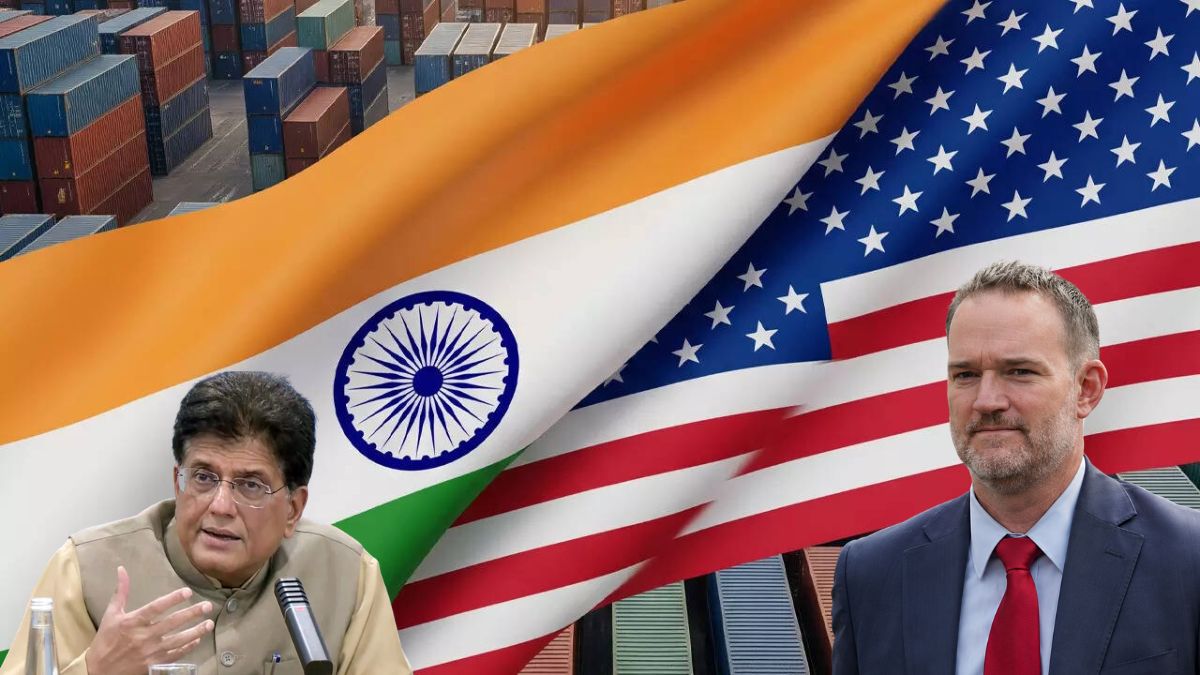
India and the United States will hold ministerial-level talks this week to give final shape to the first phase of the proposed bilateral trade agreement, with US Trade Representative Jamieson Greer set to meet Commerce and Industry Minister Piyush Goyal in New Delhi.
“For the US trade deal talks, tomorrow my counterpart is coming to Delhi,” Goyal told reporters in Mumbai.
The meeting comes after chief negotiator-level discussions held in New Delhi from June 2 to June 4. Commerce Secretary Rajesh Agrawal had recently said that the upcoming ministerial discussions would focus on giving final touches to the framework deal.
Goyal had earlier said that India and the US were moving towards closing all open ends of the interim trade agreement and were likely to execute the “very, very vibrant” first phase of the bilateral trade agreement by the middle of next month.
That timeline is not incidental. It is tied directly to the tariff clock now running in Washington.
Why July matters
The temporary 10% tariff imposed by the US on all trading partners is set to expire on July 24. After that, Washington will need a more durable tariff structure.
This is where the India-US trade deal becomes more complicated.
The two countries had agreed on a framework in February under which US tariffs on Indian goods were expected to come down from 50% to 18%. That would have given India a tariff edge over several competing Asian exporters.
ALSO READIndia, US close to trade deal for a while: Donald Trump
But the US tariff landscape changed after a court ruling forced Washington to rethink its earlier reciprocal tariff structure. The temporary 10% duty was then brought in as a stopgap. Now, the US is using Section 301 investigations as the legal route to impose new tariffs.
As per Piyush Goyal’s most recent remarks on the India-US trade deal at the FE Best Banks event, the challenge for India is now to figure out a way to get preferential access in trade with US and figure out a way to convert the ongoing section 301 investigations into a competitive advantage in Bharat’s favour.
Section 301 becomes the real swing factor
Section 301 of the US Trade Act allows Washington to investigate trade practices it considers unfair or harmful to US commerce and impose duties if required.
The US has opened two such investigations covering several countries, including India. One relates to excess capacity (excess supply/ product dumping). The other is linked to whether countries have adequate rules to prevent imports powered by forced labour from entering their markets.
On June 2, the US Trade Representative proposed a 12.5% additional tariff on 54 economies, including India, under the forced-labour-related investigation. The proposal is not final. Hearings are scheduled in July.
This is now the big overhang on the trade pact.
Speaking at the Financial Express India’s Best Banks Awards earlier this month, Goyal had played down concerns around Section 301 but made it clear that India was watching the final tariff structure closely.
“So this is really a mechanism being created, given their constraints that Congress is not going to support any of their actions on reciprocal tariffs… they are trying to create a competitive edge for India. So I don’t think we need to worry about Section 301, we’ll tackle it, it’s our responsibility,” Goyal had said.
He also said India would protect its interests and expressed confidence that the trade deal would come through.
India wants an edge, not just a deal
The key issue for New Delhi is not just lower tariffs. It is preferential access.
Goyal had put it simply at the FE Best Banks Awards: the important element is whether India’s competitors pay more to enter the same market. If they do, India gains. If they pay less, India loses market share.
That is why India is expected to push for a tariff structure that gives Indian exporters a comparative advantage over countries such as Vietnam, Bangladesh, Indonesia, Sri Lanka and other Asian competitors.
GTRI flags caution
Trade policy think tank Global Trade Research Initiative has taken a more cautious view of the Section 301 process.
It has argued that India should challenge the legal basis of the proposed 12.5% tariff because the investigation is not based on an allegation that Indian exports are made using forced labour.
Instead, it examines whether India restricts imports from third countries where forced-labour concerns may exist.
GTRI has also warned that the proposed tariff should be seen as part of broader pressure by Washington during the bilateral trade negotiations. Its view is that India should treat the BTA talks and Section 301 investigations as separate issues.
GTRI has furthermore also recommended the Indian government to challenge the ongoing section 301 investigations on its legal merits and resists any new unilateral tariff mechanisms.
That concern matters because a country-wide tariff can hit sectors even when the underlying issue may be product-specific or supply-chain-specific.
What India has offered
Under the earlier framework, India had proposed to reduce or eliminate tariffs on all US industrial goods and a range of food and agricultural products.
These included dried distillers’ grains, red sorghum for animal feed, tree nuts, fresh and processed fruits, soybean oil, wine and spirits, among others.
New Delhi had also indicated its intention to purchase $500 billion worth of US energy products, aircraft and aircraft parts, precious metals, technology products and coking coal over five years.
The logic was clear: India would give the US wider market access and large purchase commitments, while Indian exporters would receive a better tariff deal in the American market.
But if Section 301 duties are added on top, the tariff bargain changes.
ALSO READDespite global headwinds, India’s merchandise exports rise 15% from April to mid-June: Goyal
Trade numbers add weight
The US was India’s second-largest trading partner in 2025-26.
India’s exports to the US rose marginally by 0.92% to $87.3 billion during the year, while imports increased 15.95% to $52.9 billion. India’s trade surplus with the US narrowed to $34.4 billion from $40.89 billion a year earlier.
The talks also come at a time when India’s export momentum has improved. Goyal said on Sunday that merchandise exports rose around 15% between April 1 and June 14 despite global uncertainty.
While India’s resilient export growth paints a positive picture of Indian businesses intensifying expansion efforts, economic observers are keenly watching any announcement on an India-US deal.
A favourable India-US tariff arrangement could help Indian exporters protect and expand their market share at a time when global demand remains uncertain.
TOPICSECONOMYIndia-USIndia-US trade dealPiyush GoyalThis article was first uploaded on June twenty-one, twenty twenty-six, at twenty-five minutes past six in the evening. © IE Online Media Services (P) Ltd