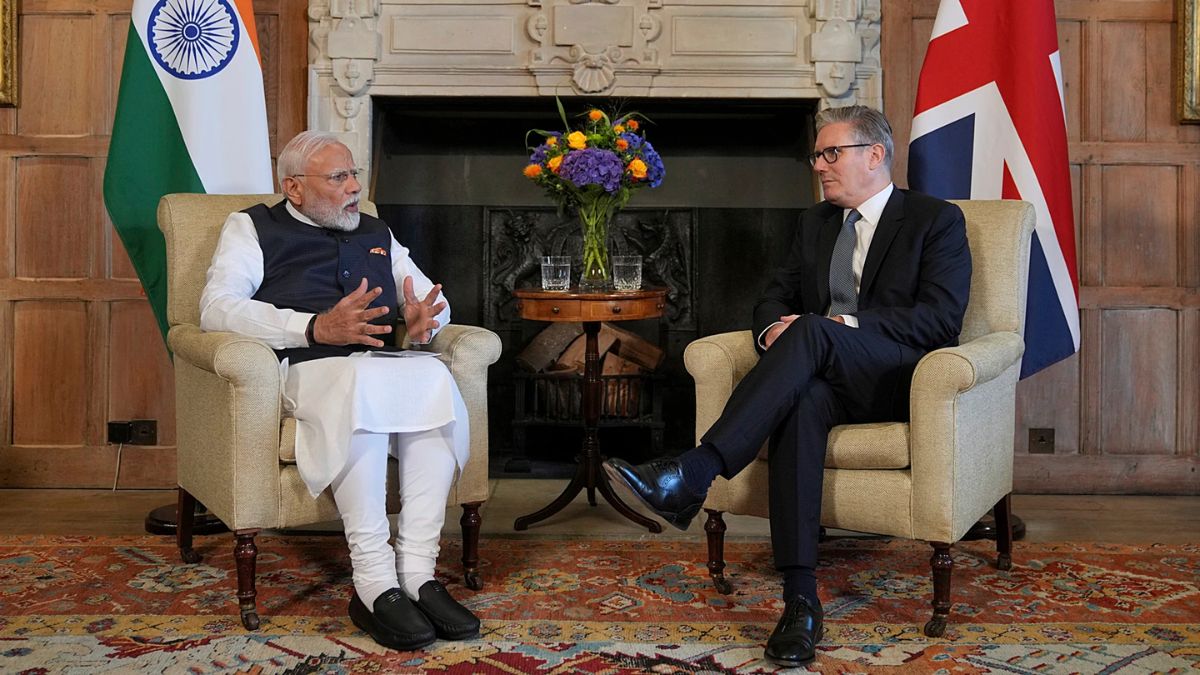
A delegation of UK trade officials, led by Secretary of State for Business and Trade Peter Kyle met Commerce Minister Piyush Goyal amid new irritants emerging in the path of operationalising the Comprehensive Economic and Trade Agreement (CETA) between the two countries.
“Had great conversations on charting the next phase of India-UK economic engagement, advancing shared business priorities, and further strengthening our robust and forward-looking partnership,” Goyal who led the Indian delegation posted on ‘X’.
The operationalisation of CETA, which cleared all legal milestones by March including securing clearance from both houses of the UK’s Parliament, has been delayed because the UK introduced surprise steel duties. Otherwise, both sides expected CETA to enter into force by April. Indian officials had earlier said both countries are trying to find a way around the steel measures.
ALSO READTrump rejigs tariffs on steel aluminium and copper; rates on agri equipment fall to 15%
On 19th March the UK announced a new steel trade measure. From 1 July 2026, the UK government decided to limit tariff-free steel imports, reducing overall quota volumes by 60% compared to the steel safeguard measure. Any imports above these levels will then face a 50% tariff. The measure will apply to imports of steel products that can also be made in the UK. These measures were announced by the UK government on 19th March this year.
Earlier the UK had safeguard measures that also imposed a quota on imports. The new measures reduce that quota. Other than steel measures, the UK’s Carbon Border Adjustment Mechanism (CBAM), which will be operational from January 1, 2027 has also emerged as a hurdle.
Steel is an important export from India to the UK. In 2025-26 India’s exports of iron and steel and their products to the UK stood at $ 893.4 million, which accounts for a significant portion of $ 13.4 billion of total merchandise exports to the UK.
The CBAM will bring in the possibility of additional carbon tax on aluminium, cement, fertiliser, hydrogen, iron and steel.
Officials say that if the exemption from steel measures and CBAM is not forthcoming from the UK then India might claw back some of the concessions it has agreed to in CETA that was signed in July last year.
TOPICSECONOMYPiyush GoyalUnited KingdomThis article was first uploaded on June two, twenty twenty-six, at twenty-five minutes past eight in the night. © IE Online Media Services (P) Ltd