
Follow Us
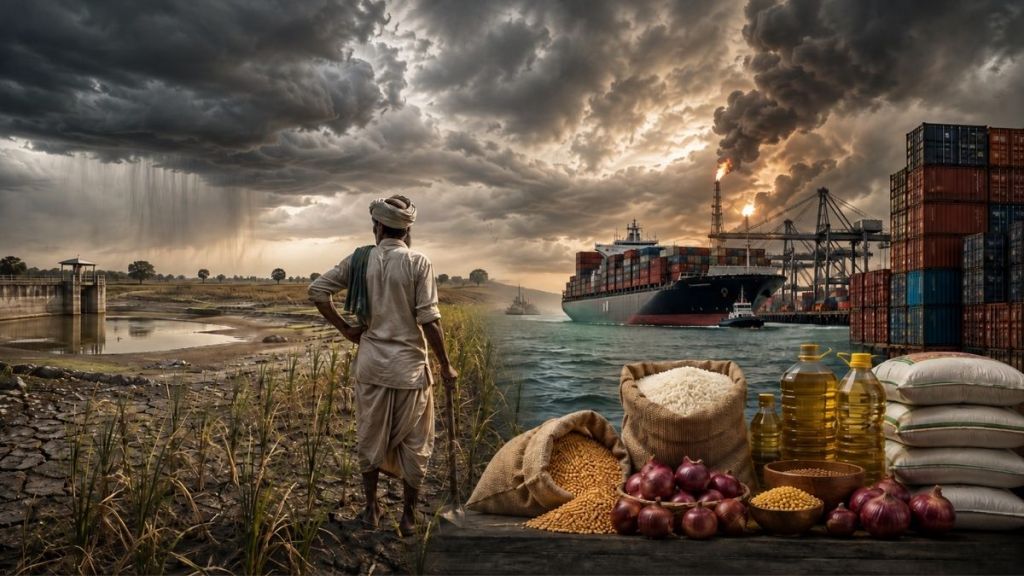
India’s food-price outlook is being squeezed from two directions. A weak and uneven monsoon is threatening to reduce its domestic farm output, while geopolitical disruptions abroad are making some of the inputs and imports India uses to cushion shortages more expensive.
The pressure is beginning to show in prices, although it is not yet an inflation crisis.
IDFC First Bank Economics Research estimates food and beverages inflation at 5.7% in August, up from 5.2% in July, led by proteins, edible oils, prepared food and sugar. Headline retail inflation is estimated at 4.9%, with the bank retaining its FY27 inflation forecast at the same level.
The bigger concern is what happens next.
Rainfall during the southwest monsoon season was 13% below the long-period average as of August 28, according to the report. August alone was running a deficit of 15%, reversing much of the improvement seen in July, when rainfall finished 1% above normal. The shortfall has also been widespread.
Around 42% of the country’s area had received deficient rainfall. That matters for food prices because the monsoon influences both how much farmers plant and how much those crops eventually yield.
As per the report, the sowing of Kharif crops stood 1.8% lower than a year earlier as of August 28, with around 97% of the season’s sowing already completed. Furthermore, rice sowing was down 3.3% while acreage of coarse cereals such as maize, jowar and bajra tracked 2.3% less year-on year as of August 28.
Pulses were the main bright spot, with acreage 1.2% higher, while the shortfall in oilseeds had narrowed to just 0.5%. But with almost all kharif sowing now complete, the focus is shifting from how much land has been planted to whether those crops receive enough water to deliver a good yield.
A modest fall in acreage need not translate into an equally large fall in production if rainfall is adequate during critical growing stages. Conversely, crops already in the ground can still suffer if moisture remains scarce.
This makes the condition of India’s upcoming monsoon and water reservoirs increasingly important both for the remainder of the kharif season and for the winter crop that follows.
ALSO READUsed clothes to Thai pet food: What fine print of India’s import bill tells about its economy
The water problem does not end with the monsoon
There is another weakness below the headline rainfall numbers: India is carrying a smaller water reservoir cushion into the latter part of the year.
Notably, reservoirs that often support irrigation activities in farming states held water equivalent to 67.8% of their usable storage capacity as of August 27, according to the IDFC report.
The amount of water available in India’s reservoirs is down an estimated 12% from the level recorded at the same time last year and is roughly 4% less than the 10-year average.
The report further stated that the conditions were particularly weak in the South, where reservoirs were at 57.3% of capacity compared with a normal level of 70.4%. In the North, storage was at 60.2% against a normal 73.9%.
Reservoirs show where the pressure is building
This has implications beyond the crops currently in the ground. Once the monsoon ends, farmers begin to plan crops for the winter season that depend more heavily on stored water, groundwater and irrigation systems.
Reservoirs help bridge the gap between the rainy season and crops such as wheat, mustard and gram that are planted later. A weak monsoon can consequently hit food supply twice: first by affecting the kharif crop and then by leaving less water available for the rabi season.
ALSO READBuild first, regulate later: Inside the 358 bn litre water crisis threatening India’s data centre drive
Which crops more vulnerable to volatile rainfall
Not every crop or state is equally vulnerable to a poor monsoon. A crop’s vulnerability to monsoon conditions is heavily influenced by the irrigation cover it can access. Simply put, irrigation cover tells us how much of the cultivated area has access to water from sources other than direct rainfall, including canals, reservoirs, wells and groundwater.
The higher the irrigation cover, the greater the ability of farmers to continue supplying water when rainfall disappoints. Crops grown largely on rain-fed land have much less protection. Some of the examples of such crops and the areas where they are grown in India have been listed in the table below:
Where rainfall and irrigation conditions diverge
The comparison shows why a national rainfall deficit can only tell part of the story.
Punjab has suffered a sharper rainfall shortfall than Karnataka, for instance, but its relatively stronger irrigation infrastructure and coverage gives farmers a much larger fallback when the monsoon disappoints.
Rajasthan and Karnataka, by contrast, combine relatively weaker irrigation facilities and coverage with deficient rainfall to leave the yield of its farm products such as pulses, oilseeds and coarse cereals heavily exposed to monsoon conditions.
That difference can eventually matter for prices because crops with weaker irrigation buffers are more vulnerable if rainfall remains inadequate during critical stages of growth.
ALSO READMonsoon Tracker: With deficit at 13%, India may see its weakest monsoon since 2009
What does IMD’s monsoon forecast reveal ?
The latest official weather signals still warrant caution. The India Meteorological Department said on August 29 that subdued rainfall activity was likely to continue over Peninsular India during the following week.
This comes after its forecast that rainfall during August and September was likely to be below normal. El Niño adds another layer of uncertainty.
The Ministry of Earth Sciences told Parliament in July that El Niño had strengthened from weak conditions in June to moderate levels in July and could intensify further during October-December.
The Australian Bureau of Meteorology has taken a relatively stronger view of the current Pacific warming, while also tracking the Indian Ocean Dipole, another oceanic pattern that can influence India’s rainfall.
A positive Indian Ocean Dipole can sometimes offset part of El Niño’s adverse effect on the monsoon. But the eventual strength, timing and interaction of the two remain uncertain.
For food prices, that makes the next few weeks important. The issue is no longer simply whether India receives enough rain in aggregate, but whether the remaining rainfall reaches the crops and regions that need it at the right time.
Geopolitical uncertainty adds to the pressure
Ordinarily, weaker domestic production does not have to result in a sharp food-price shock. India can draw upon government stocks, irrigation, imports and policy interventions to bridge shortages.
The problem in 2026 is that some of those cushions have become costlier to use.
The West Asia conflict disrupted global fertilizer and raw-material supply chains during 2025-26, pushing up freight and insurance costs and causing shipping delays and price volatility, according to the government.
Imports of ammonia, phosphoric acid and sulphur were among those affected, while potash faced higher landed costs. India has substantial exposure to supplies from the region.
The government has said Gulf countries account for roughly 20-30% of India’s urea imports and around 30% of its DAP imports. The region also supplies close to half of India’s LNG imports. Natural gas, in turn, is a major raw material used to manufacture urea domestically.
This does not mean India is running short of fertilizer. The Centre has maintained that inventories are adequate, while diversifying suppliers, increasing domestic production and arranging additional imports.
More than 42 lakh tonnes of urea were contracted through global tenders in April and June alone. The issue is cost rather than immediate availability.
If imported fertilizer, raw materials and shipping become more expensive, somebody has to absorb that increase.
Allowing it to reach farmers raises cultivation costs. Shielding farmers through administered prices and subsidies can instead push up the government’s subsidy bill. Either way, the cost of insulating agriculture from the global shock rises.
Edible oils exposes another vulnerability
A similar problem sits directly inside India’s food basket. India produces most of the food it consumes and remains a net exporter of agricultural products overall. Edible oils are a major exception as imports continue to form a major part of India’s edible oil consumption.
This creates a different kind of exposure. A domestic rainfall shock can hurt oilseed production, while movements in international vegetable-oil prices, freight rates and the rupee can increase the cost of importing edible oil that India may not be able to domestically produce.
The state-level picture adds to that vulnerability. Rajasthan accounts for 21.6% of India’s oilseed production and Maharashtra another 18.3%, while irrigation coverage in both states remains below 50%.
Oilseed acreage nationally is only 0.5% lower than last year so far, so there is no large sowing shock yet. But with just 32% of oilseed acreage irrigated, eventual production will remain sensitive to how rainfall behaves during the rest of the growing period.
That is also why edible oils are already among the components contributing to the increase in food inflation estimated for August.
ALSO READIndia vs Bangladesh: Who is really better off? GDP per capita tells only part of the story
Not a food-price spiral yet
For now, the inflation picture remains contained. IDFC FIRST Bank expects vegetable inflation to moderate despite pressure on onion prices, while headline CPI is estimated at 4.9%.
But the margin for comfort is narrowing. Weak rainfall and lower reservoir levels are increasing risks to domestic supply, just as the West Asia conflict is making fertilizers, freight and some imports more expensive.
The coming weeks will therefore matter less for whether the monsoon ends with a neat label of “normal” or “deficient” and more for where the remaining rain falls, how reservoirs recover and whether standing crops receive enough moisture during critical stages.
That is where geopolitics and bad weather converge.
In an ordinary year, a domestic crop shortfall can be softened through stocks, imports or favourable global prices. In 2026, India is entering the final stretch of the monsoon with weaker water buffers while the cost of using some of those external cushions has risen.
The risk to consumers is therefore not simply that India may grow less food. It is that keeping food plentiful and affordable could itself become more expensive.
TOPICSagri sectorAgri-economyagricultureAgriculture SectorCPICPI InflationCrop pricesDeficient monsoonECONOMYEl NinoFood & Beveragesfood inflationGeopoliticsInflammationinflationinflation calculationKharif cropsMonsoonMonsoon 2026Monsoon RainspulsesStrait of HormuzSuper El Nino + 0 MoreThis article was first uploaded on August thirty, twenty twenty-six, at fifty-two minutes past five in the evening. © IE Online Media Services (P) Ltd