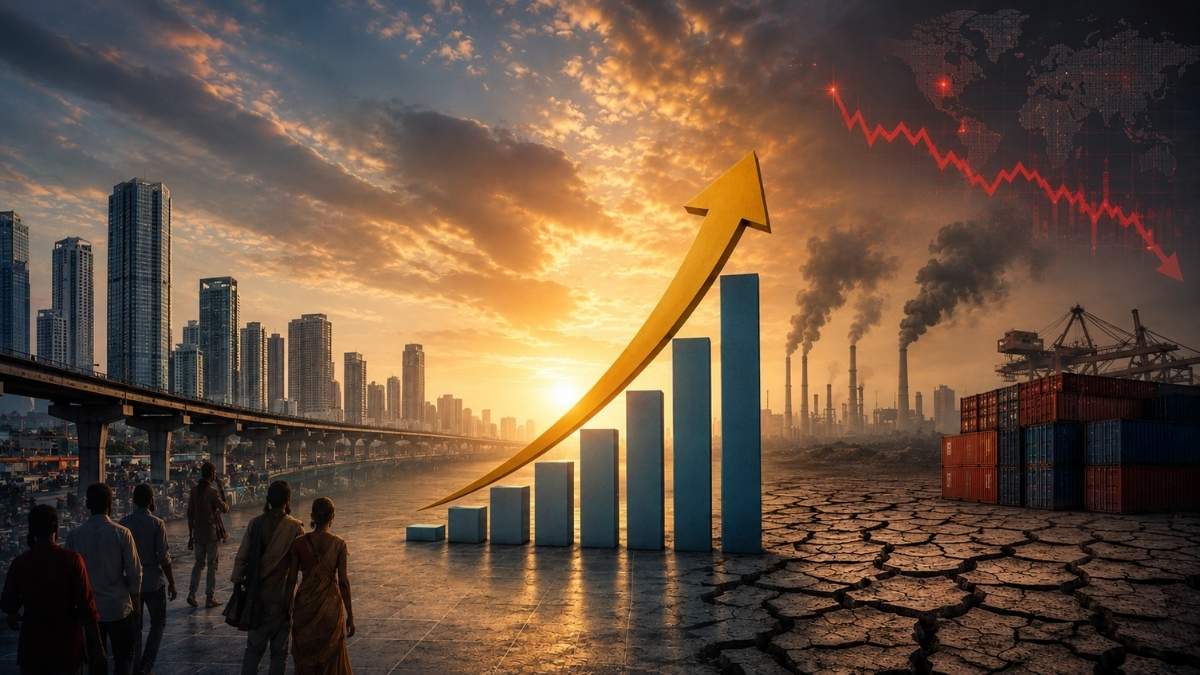
India’s economic growth is expected to moderate in FY27 after accelerating to 7.7% in FY26. According to economists at Elara Capital, the improvement in FY26 was a cyclical recovery in demand rather than a structural shift in the economy. Motilal Oswal expect the FY27 growth to slow to 6.5% broadly in line with the Reserve Bank of India’s (RBI) revised estimate of 6.6%.
The economists note that FY27 is facing headwinds since the beginning of the fiscal year unlike in FY26 where growth remained strong through most of FY26 and peaked at 8.3% in Q2 FY26 before moderating slightly in Q4 FY26.
Here are the big challenges India’s economy is facing in FY27.
1. EL Nino and food inflation could hit rural demand
Concerns over the possible emergence of a Super El Nino event and forecasts of below-normal monsoon rainfall could affect agricultural output and push up food prices. “However, the impact on aggregate GDP is likely to be less severe than in the past, given the declining share of crop production in the economy and the broader composition of agricultural GVA,” Motilal Oswal noted.
ALSO READIndia’s Q4 GDP rises to 7.8% as domestic demand offsets external weakness
Despite this, higher food inflation because of EL Nino could significantly impact rural households, where food accounts for a larger portion of household spending. This may weaken rural consumption and hurt sectors such as FMCG, entry-level automobiles and consumer durables.
2. High crude oil prices threaten growth and inflation outlook
Elevated crude oil prices amid ongoing Iran-US war, could increase input costs for companies, squeeze profit margins and slow industrial activity.
ALSO READRBI holds repo rate: FY27 growth forecast cut as oil shock escalates – 5 crucial takeaways
Rising fuel costs to balance the losses faced by the OMCs because of high crude prices may also push up inflation and reduce consumers’ purchasing power. State-run fuel retailers have already raised petrol prices by about 7.8% and diesel prices by about 8.6%, as per RBI, recent fuel price increases alone could add around 36 basis points to headline inflation.
3. Exports likely to remain under pressure in FY27
Export growth has also slowed amid weaker international demand and geopolitical uncertainty and Motilal Oswal expects merchandise exports to remain under pressure in FY27.
While services exports have remained resilient so far, the report warns that increasing adoption of artificial intelligence and automation could create medium-term challenges for lower-value IT and business-process outsourcing services.
Investment activity may also moderate during the year. Central government capital expenditure could be lower than last year due to fiscal pressures, while private sector investment is expected to remain cautious amid global uncertainties.
“Investment growth is also likely to moderate in FY27, with central government capex potentially lower by around Rs 1 trillion due to fiscal pressures, although spending is still expected to remain at a sizable Rs 11.2 trillion, while state government capex could remain robust at Rs 9-10 trillion. Private capex is likely to stay subdued amid elevated uncertainty,” Motilal Oswal said.
4. West Asia tensions pose downside risks to FY27 growth: Elara Capital
Elara Capital also said that risks remain tilted to the downside if geopolitical tensions in West Asia continue beyond the first quarter of FY27. “Elevated energy prices remain a key risk, as disruptions to global supply chains and lower energy-related shipping activity could translate into higher input costs and inflationary pressures,” Elara Capital said.
“Mobility indicators have also softened, reflecting the impact of precautionary measures and weaker travel activity,” Elara Capital added.
Conclusion
Economists noted that weather-related risks, elevated commodity prices, weaker exports, and softer consumption and investment growth are going to create downward pressure on India’s economy.
“However, financial services, real estate, professional services, and utilities are likely to remain key growth drivers, supported by strong credit growth, financialisation, formalisation, rising power demand, and continued infrastructure spending,” Motilal Oswal noted.
TOPICSEl NinoGDPGDP growthRBIReserve Bank of India + 0 MoreThis article was first uploaded on June nine, twenty twenty-six, at fifty-three minutes past nine in the morning. © IE Online Media Services (P) Ltd