The price of Bitcoin has weakened after failing to surpass the $94,000 resistance level. Currently, it is trading below critical volume thresholds, raising concerns about a potential deeper correction in the near term.
Key Takeaways
– The rejection at $94,000 strengthens the bearish outlook.
– Trading beneath the point of control indicates increased downside pressure.
– Falling below support at $88,960 could trigger a decline toward $76,510.
Bitcoin (BTC) continues to exhibit signs of structural vulnerability as the market consolidates following weeks marked by volatility. The recent inability to break through the technical resistance around $94,000 has placed sellers back in control.
This price zone serves not only as a psychological hurdle but also aligns with significant technical indicators such as Fibonacci retracement levels, volume profile data, and high-time-frame (HTF) structural resistance. With Bitcoin now moving lower and slipping under its point of control (POC), there is an elevated risk for further downward movement unless buyers step up at key support zones.
Critical Technical Levels for Bitcoin Price
The $94,000 mark remains a formidable resistance area linked with multiple factors: it coincides with the 0.618 Fibonacci retracement level; represents the Value Area High (VAH); and acts as an important HTF rejection point.
Bitcoin’s drop below its Point of Control signals that bears have taken command within this trading range.
Support near $88,960 stands as bulls’ last stronghold; breaching this could open pathways toward liquidity zones around $76,510.
You may also find interesting: Stunning images revealing new Satoshi Nakamoto sightings at New York Stock Exchange
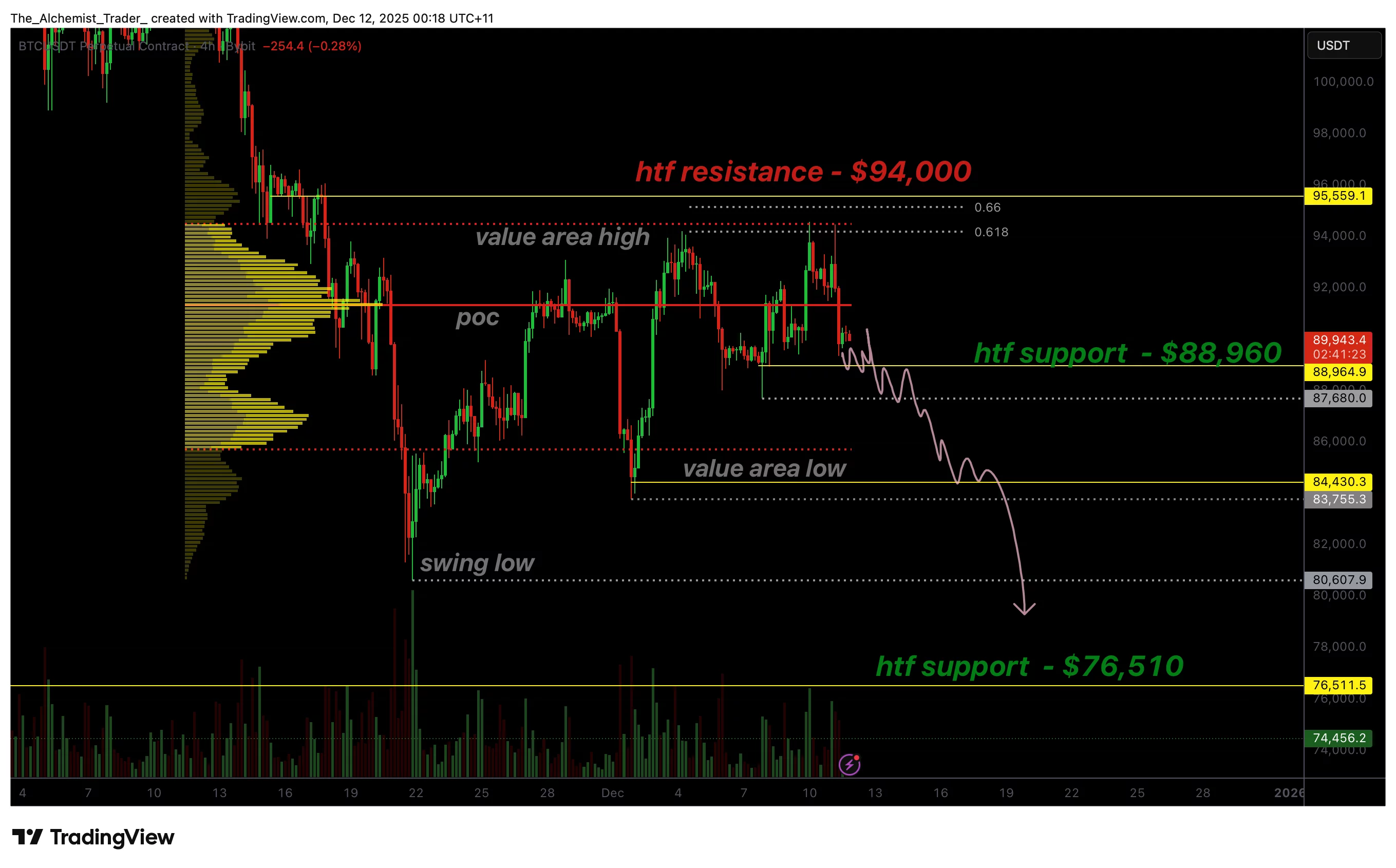
The region near $94K continues to shape Bitcoin’s short-term trading dynamics. Market participants have repeatedly failed to close above this threshold—an area encompassing key technical markers like the 0.618 Fibonacci retracement from recent corrections and acting as both Value Area High and HTF resistance that consistently halts bullish momentum.
Each unsuccessful attempt adds weight to bearish sentiment. The latest downturn was exacerbated by heightened volatility tied to Federal Reserve policy expectations for 2026 alongside looming liquidation risks estimated around two billion dollars.
A crucial development is Bitcoin’s fall beneath its Point of Control—the price zone registering highest traded volumes during this range—which often marks a shift from equilibrium toward directional bias favoring sellers. While prices remain under POC territory, selling pressure dominates and liquidity gravitates towards lower value areas making further declines more probable.
You might also be interested in: Internet Computer faces selling pressure testing critical supports near liquidity walls
The next major focus lies on support around $88,960—a level that recently served as bulls’ final defense line representing upper bounds of Value Area Low (VAL). Should prices decisively break below here with sustained closes underneath it would invalidate short-term bullish setups opening doors towards lower liquidity pockets ahead.
If such breakdown materializes BTC may target liquidity clusters near previous swing lows approximately at $76,510—another significant HTF support zone where buyers historically emerged strongly during past consolidation phases.
A revisit into these depths would push Bitcoin into extended retracement territory potentially challenging broader market confidence especially amid developments like American Bitcoin increasing treasury reserves which recently drove SPS higher following accumulation totaling over 416 BTC units previously reported .
Anticipated Price Movement Outlook
Currently locked within rotational ranges unless bulls manage reclaiming POC coupled with closing above critical resistance at ~$94K downside momentum remains favored by prevailing conditions.
A confirmed breach beneath ~$88K likely accelerates declines targeting ~$76K supports while overcoming those hurdles will be essential before any meaningful bullish reversal can gain traction again on charts going forward .