Bitcoin is currently trading at approximately $96,000, influenced by contrasting factors from spot ETF inflows and the options market that are affecting its price dynamics.
The current valuation is just outside a range of about $90,000 to $94,000—a range that has remained stable despite fluctuations in spot demand for Bitcoin through US-listed exchange-traded funds.
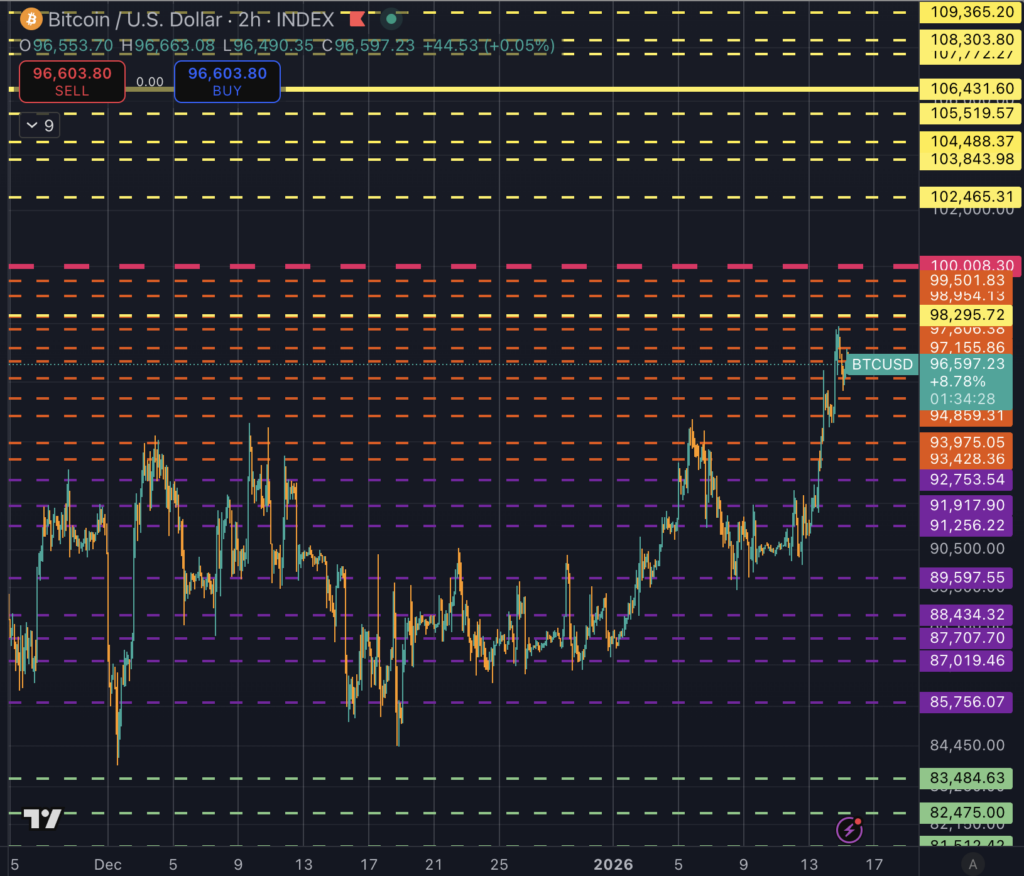
The recent surge past the $94,000 mark to an intraday high of $97,800 offers hope for those who believe Bitcoin has moved beyond its typical four-year cycle. The pressing question now is whether this signals the beginning of a new bullish trend or if it’s merely a temporary spike caused by short-term macroeconomic factors.
ETF Inflows Rise as Bitcoin Approaches New Highs
As reported by Farside Investors, net inflows into US spot Bitcoin ETFs reached an impressive total of $840.6 million on January 14th after hitting $753.8 million in the previous session.
This brought total inflows since January 8th to around $1.06 billion despite experiencing two significant outflow days earlier in this timeframe.
At current levels, this equates to roughly 11,000 BTC created over five sessions—an amount typically expected to push prices higher under less constrained conditions.
The options market structure has absorbed much of this momentum so far.
Data from CryptoGamma indicates that aggregate dealer positioning remains in a net-long gamma configuration with an estimated net gamma around +386,000 at a price close to $96,800.
In such scenarios, dealer hedging tends to reduce realized volatility by mechanically selling during upward movements and buying during declines—this behavior reinforces stability within heavily trafficked strike zones.
CryptoGamma’s model identifies nearby reference points at approximately $96,000 on the upside and around $94,000 on the downside while highlighting a lower inflection point near $91,500 should prices dip below their current range.
The metrics for volatility support this picture of compression; seven-day realized volatility hovers near 32% annualized—closely matching implied volatility around 33% for at-the-money options.
This translates into daily fluctuations averaging about 1.7%, or roughly equivalent to about $1,600, consistent with recent trends.
This alignment between realized and implied readings indicates market pricing stability rather than acceleration—even as sporadic spikes occur in spot flows.
An Explanation for Bitcoin’s Range-Bound Behavior Amid Strong ETF Inflows
The interplay between these forces clarifies why Bitcoin’s price movement seems restrained even amidst substantial ETF inflows.
While ETF creations generate genuine demand in the spot market,long gamma positioning acts as counterbalance absorbing flows unless they arrive consistently or coincide with shifts in options exposure due either contract rollovers or expirations .
This results in what can appear as calmness within markets—not due lack interest but rather structural design .
The flow data underscores that bids from ETFs have not been uniform throughout
After witnessing net outflows totaling $398.8 million on January eighth followed by another $250 million drop on ninth , inflow patterns resumed unevenly , registering $116 .7million influx twelve before accelerating midweek
This pattern suggests burst-driven demand instead continuous allocation waves increasing likelihood prices remain contained while dealer gamma stays positive .
Additions From Macro Timing Influence Near-Term Setup
P>
P >
The Federal Reserve’s policy meeting scheduled concludes January twenty-eighth according Fed calendar
Markets are closely monitoring projected rate paths extending into twenty-six amid diverging forecasts major banks heightened focus monetary policy signaling.
Separately New York Fed outlined plans exceeding fifty-five billion dollars liquidity operations spanning mid-January through mid-February.
These elements hold significance because long-gamma regimes typically suppress volatility until disrupted sustained directional flow external risk repricing.
Consecutive sessions marked large-scale ETF influx combined acceptance above upper limit existing ranges would weaken stabilizing effects derived dealers’ hedging strategies.
Conversely clusters associated with ETF withdrawals macro-induced risk-off movements could align coinciding decay exposing lower thresholds where hedged positions reverse direction.
Status Quo Remains Unchanged For Now
P >
Current behavior surrounding bitcoin reflects environment wherein structural forces dominate action reinforcing upper limits established option positions continue play role defining parameters .
The next pivotal shift may hinge upon persistence flowing dynamics shifting first:
Will breakout exert sustained pressure overcome existing option constraints validate upward trajectory ? Or will it falter risking retreat back test liquidation points nearing ninety-one thousand again?