
Bitcoin has continued its downward trend for six months following a peak of $126,000. Although the correction has been significant, both on-chain and market indicators suggest that this decline may not yet be finished.
The price is nearing a crucial support area where many long-term investors previously made their purchases. A drop below this threshold could lead to a decline towards the $50,000 mark.
Institutional Selling Increases Downside Risks
A recent 1% decrease in corporate Bitcoin [$BTC] reserves highlights growing pressures from debt obligations and ongoing market weakness. While this reduction might seem minor, it is significant considering institutional holders typically maintain long-term positions.
Recent reports from AMBCrypto revealed that at least four corporations reduced their Bitcoin holdings between March and early April.
Mara Holdings spearheaded the sell-off by liquidating 15,133 $BTC, valued at over $1 billion in March. Following them were Riot Platforms and Empery Digital, which together sold off 2,295 $BTC, worth approximately $156 million as of April 2nd.
Despite these sales, corporate entities still hold around 1.16 million $BTC, valued at about $77 billion. However, this substantial position is becoming increasingly vulnerable as Bitcoin trades close to the average cost basis of key long-term holders—many of whom are aligned with institutional accumulation levels.
Focus on Long-Term Holder Cost Basis
An analysis of on-chain data through UTXO Realized Price Age Distribution reveals an important trend. This metric tracks the average purchase price of Bitcoin across various holding periods and provides insights into investor behavior.
The latest data indicates that Bitcoin is approaching a cost basis of $63,049 for those who acquired it between 18 months to two years ago; this level now serves as a potential turning point.
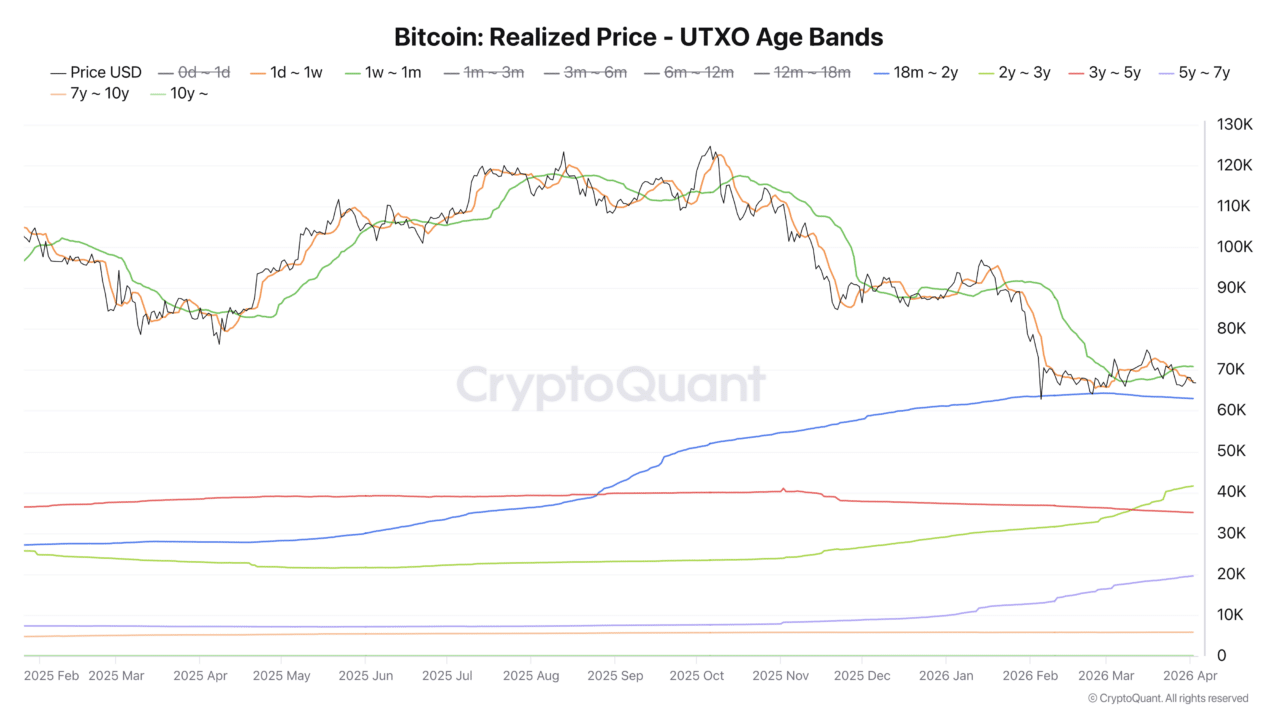
With current trading prices around $66,794, the gap above this cohort’s cost basis has significantly decreased. A sustained downturn could push these investors into losses and heighten defensive selling behaviors.
Additonally,short-term holders introduce another layer of risk; those who entered within the last month are particularly sensitive to market fluctuations and more likely to exit under pressure—further intensifying downward momentum。
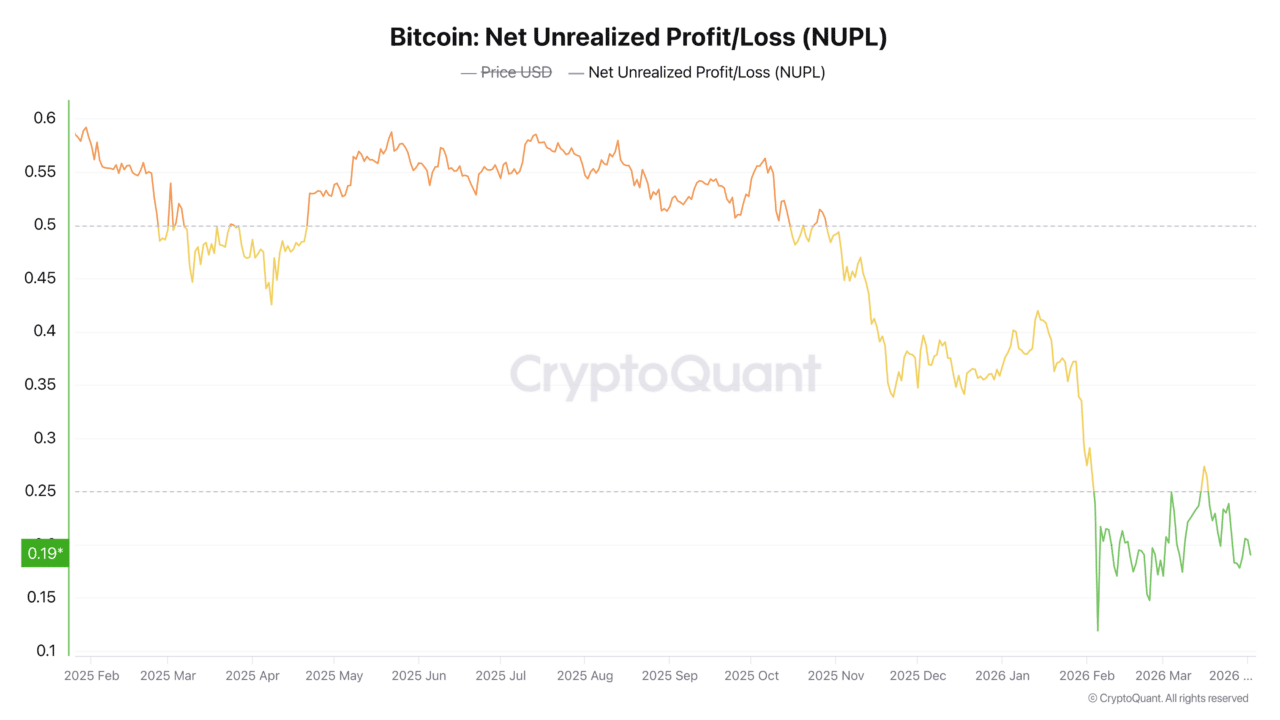
The Net Unrealized Profit/Loss (NUPL) metric supports this narrative; currently sitting at 0.6 indicates a notable contraction in unrealized profits throughout the network。
If profitability continues to wane,the likelihood for capitulation rises especially if prices keep declining。
Poor Capital Inflows Restrict Recovery Potential
The structure within markets suggests another limitation:weak capital inflows。
Selling activity shows muted demand over recent months。In total,Bitcoin saw roughly$8 .04 billion in spot purchases during past120 days with only$6 .17 billion coming in during last90 days。
This level remains inadequate for absorbing ongoing selling pressure or fostering robust recovery 。

Simultaneously , macroeconomic uncertainties continue affecting risk sentiment . Prolonged geopolitical tensions alongside global economic instability have prompted investors toward more cautious strategies , leading them away from allocating funds into high-risk assets like Bitcoin .
If capital inflows do not improve significantly , markets may struggle with stabilization efforts leaving Bitcoin susceptible further declines short term .
Conclusion Summary
*Public private entities have collectively reduced approximately one percent their bitcoin holdings amid increasing selling pressures.
*Currently bitcoin trades near acquisition costs previous investors accumulated eighteen months two years ago increasing downside risks.