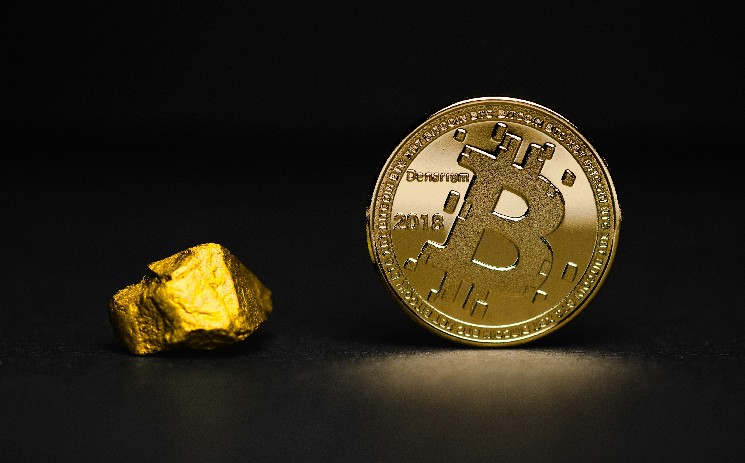
According to JPMorgan, a prominent investment bank on Wall Street, Bitcoin (BTC) is demonstrating greater resilience compared to traditional safe-haven assets like gold and silver, which are currently facing challenges due to capital outflows, adjustments in positioning, and declining liquidity.
In a report released on Wednesday by analysts led by Nikolaos Panigirtzoglou, it was noted that the weakening liquidity conditions in the gold market have resulted in its market breadth falling below that of Bitcoin at present.
Despite experiencing a significant drop from its record highs last October following the onset of conflict in Iran, Bitcoin has displayed relative strength over recent weeks. Initially reacting sharply alongside other risk assets during geopolitical uncertainty—plummeting into the low $60,000 range—Bitcoin triggered substantial liquidations as investors sought to minimize risk.
This sell-off was short-lived; prices have since stabilized within the high $60,000s to low $70,000s even amidst ongoing tensions and rising oil prices exceeding $100 per barrel. This price behavior indicates that Bitcoin is acting less like a straightforward safe haven during immediate shocks and more like a high-beta macro asset—it initially sells off but then finds support as capital flows return and long-term holders step back in once panic subsides.
Gold has experienced approximately a 15% decline this month alone after an overcrowded rally pushed prices up towards record levels near $5,500 back in January. Silver has mirrored this downward trend after peaking around $120. Analysts at JPMorgan attribute these declines primarily to increasing interest rates along with a stronger U.S. dollar coupled with widespread profit-taking from both retail and institutional investors.
The data regarding fund flows supports this transition; nearly $11 billion exited gold ETFs within just three weeks of March while inflows into silver ETFs accumulated since last summer have been reversed according to their findings. In contrast, Bitcoin funds have continued attracting net inflows throughout this same timeframe.
The positioning data tells an analogous story; JPMorgan’s measure for institutional activity—which relies on open interest from Chicago Mercantile Exchange (CME) futures—indicates significant growth in exposure towards gold and silver extending through late 2025 into early 2026 followed by steep reductions starting January as investors trimmed their positions. Conversely, Bitcoin futures positioning has remained relatively stable over recent weeks.
Additionally diverging momentum signals were observed; trend-following investors such as Commodity Trading Advisors (CTAs) have significantly decreased their exposure toward gold and silver markets with indicators shifting from overbought territory down into below-neutral ranges—a shift likely contributing further pressure on recent price drops for these metals while Bitcoin’s momentum appears to be recovering from oversold levels toward neutrality suggesting easing selling pressure ahead.
The disparity is further underscored by liquidity conditions where now Gold’s market breadth lags behind that of bitcoin—a reversal of typical trends—and Silver’s liquidity continues deteriorating exacerbated by thinner market depth impacting recent price fluctuations according to reports provided earlier.
At publication time today—the largest cryptocurrency trades around $69K while Gold hovers near $4,450 per ounce alongside Silver priced at about $69 per ounce
Read more: Wall Street broker Bernstein calls bitcoin bottom keeps year-end target at$150K