The price of Bitcoin has surged past the significant threshold of $68,000, currently trading around $67,321 after experiencing a rise of over 5% within a single day. This upward movement followed remarks from U.S. Trade Representative Jamieson Greer regarding the stability of tariffs with China. The market responded positively as concerns about renewed trade tensions subsided. Despite this price increase, on-chain metrics indicate that the overall market structure remains precarious.
Trump Administration Indicates Tariff Consistency with China
Jamieson Greer announced that the administration plans to keep tariffs on Chinese imports in a range between 35% and 50%. He remarked, “We anticipate maintaining this level and do not plan to escalate further.” These comments were made ahead of an upcoming meeting between President Donald Trump and Chinese President Xi Jinping.
The Supreme Court recently invalidated previous tariffs imposed under IEEPA authority. In response to this ruling, President Trump enacted a temporary tariff rate of 15% on imported goods. However, certain items subject to Section 232 tariffs are exempt from this new rate.
Greer also mentioned that some nations might face tariff rates exceeding 15% for a temporary duration lasting up to 150 days. He emphasized that the objective is “to ensure continuity in our trade program.” This indication of stable trade policy helped alleviate uncertainty across various risk assets including Bitcoin.
Nevertheless, China has issued warnings about potential retaliation if new U.S. tariffs are implemented beyond what has been agreed upon previously. Chinese officials have indicated that any additional trade measures would provoke counteractions, adding complexity to the current ceasefire situation.
Bitcoin Remains Stagnant Despite Recent Gains
In recent weeks, Bitcoin has been fluctuating within a range between $60,000 and $70,000. The current valuation places $BTC approximately 47% lower than its all-time peak—a decline consistent with mid- to late-stage bear markets observed in earlier cycles.
Data from Glassnode reveals that nearly 9.2 million $BTC, which constitutes almost half of its circulating supply is currently held at a loss—an occurrence typically seen during advanced phases of bear markets.
Additionally, companies holding $BTC, such as Strategy which we reported earlier have also recorded losses.
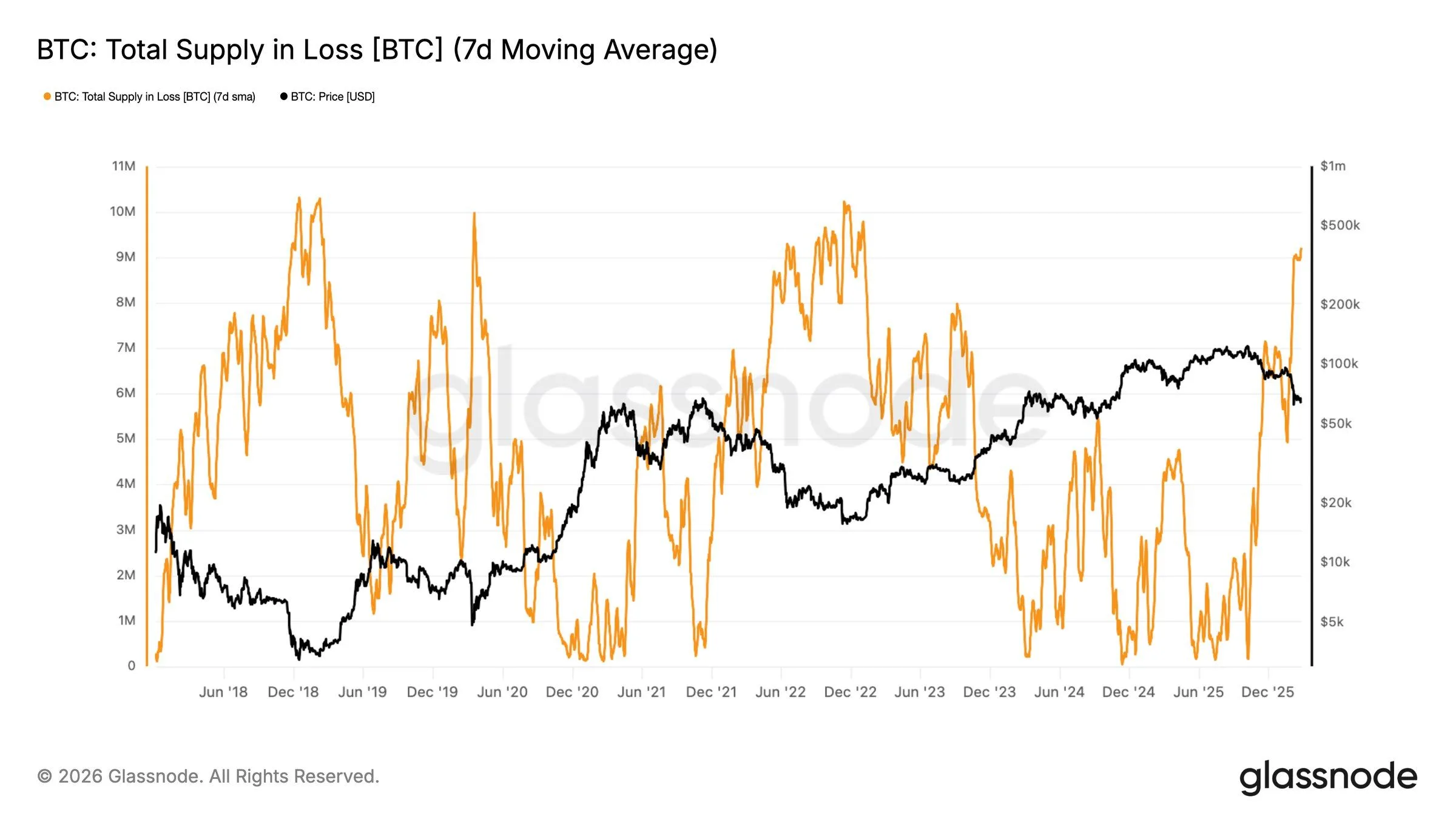
Source: Glassnode
The breadth across markets remains weak; fewer assets are trading above long-term trend levels while cumulative spot volume delta has turned negative across major exchanges.
ETF flows continue to show outflows indicating limited institutional interest at present.
Smoothing Out Liquidity and Leverage Conditions
The open interest for Bitcoin futures saw a dramatic decrease amid recent downturns; it plummeted from $15.9 billion down to roughly $8.73 billion—a clear sign reflecting broad leverage adjustments throughout derivatives markets.
Perpetual funding rates have returned close to neutral levels suggesting speculative positions have cooled off significantly; however sustained positive funding conditions remain absent indicating limited bullish sentiment persists among traders.
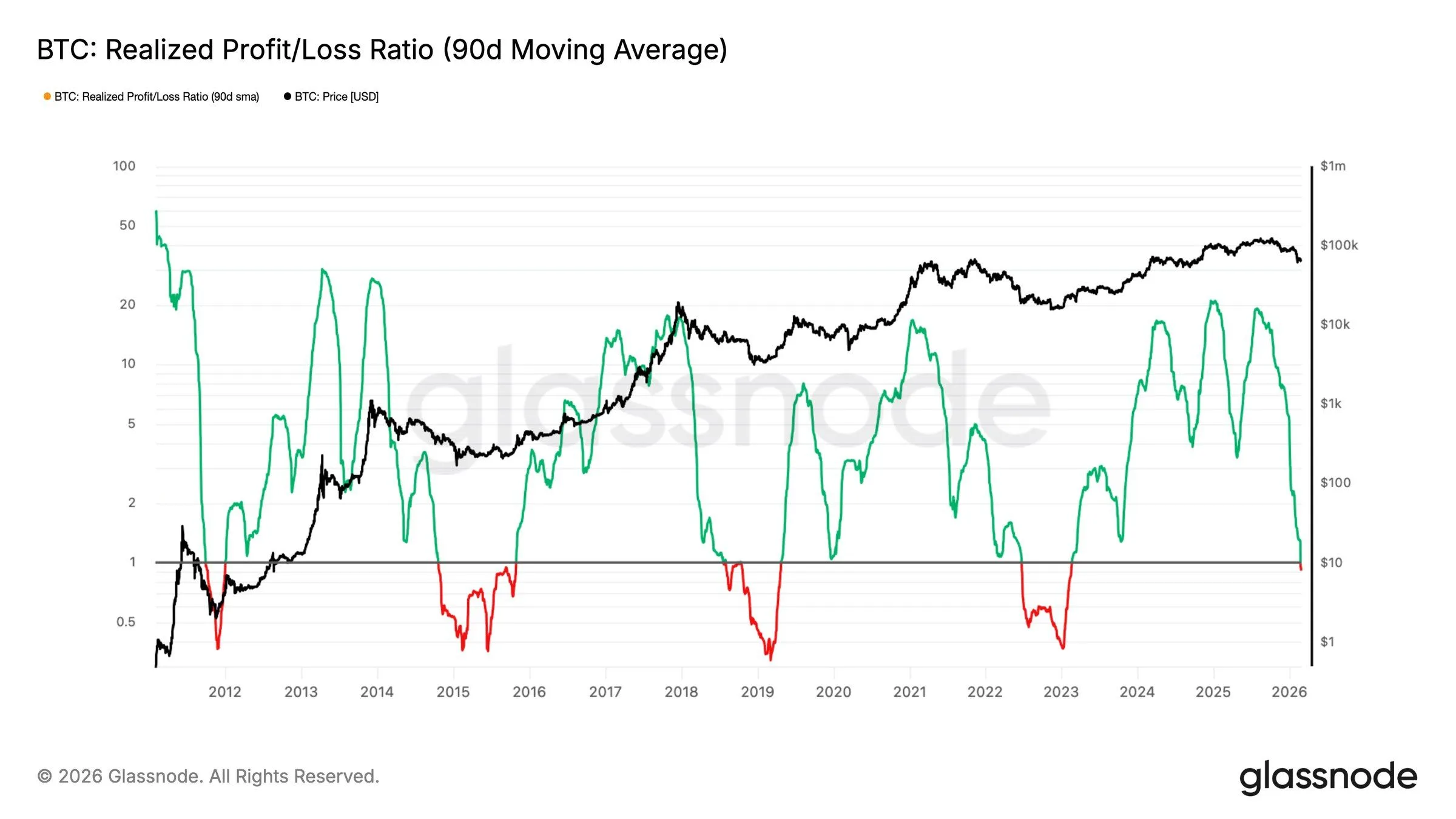
Source: Glassnode
The realized profit-to-loss ratio over the last ninety days has dipped below one—confirming an environment characterized by excess losses along with deteriorating liquidity conditions.
According to Glassnode’s analysis time spent beneath $70k increases pressure exerted on weaker balance sheets within cryptocurrency ecosystems .
Implied volatility appears stabilized without sharp expansions occurring recently . Dealer gamma positioning indicates prices remain sensitive towards incremental order flow movements ; thus , while stabilization is underway , structural recovery confirmation still eludes us .