Bitcoin along with other leading cryptocurrencies experienced a significant decline today as concerns over a possible trade conflict between the United States and the European Union triggered liquidations exceeding $864 million throughout the crypto market.
On Monday morning, Bitcoin’s value dropped by 3%, reaching $92,284 amid rising tensions regarding trade policies between the U.S. and EU. This development has pushed Bitcoin closer to an important support threshold.
Data from crypto.news indicates that during early trading hours in Asia, Bitcoin’s price plunged sharply from $95,419 down to $92,284 before stabilizing near $92,672 at the time of reporting.
Other prominent digital assets such as Ethereum (ETH), Binance Coin (BNB), XRP, and Solana (SOL) also suffered declines alongside Bitcoin. Consequently, the total cryptocurrency market capitalization decreased by 2.8%, settling at approximately $3.22 trillion during this session.
The price drop led to over $864 million worth of liquidations within the crypto space; notably, long position liquidations accounted for around $783 million of this figure according to CoinGlass data — most occurring within a recent 12-hour window.
Long liquidation events happen when falling prices force traders holding bullish positions to close out their trades in order to meet margin requirements—this can create a cascading effect that further depresses prices. Analysts attribute today’s sell-off primarily to investor anxiety about escalating tariff disputes potentially spiraling into an all-out trade war between Washington and Brussels.
Earlier statements from U.S. President Donald Trump threatened several European countries—including Denmark, Norway, Sweden, France, Germany, UK nations like England and Finland—with tariffs starting at 10% on February 1 unless Greenland is sold to America; these tariffs could rise up to 25% by June if no agreement is reached.
The European leadership condemned these demands as outright blackmail that risks damaging transatlantic ties and undermining NATO unity. In response measures are being prepared including retaliatory duties on roughly €93 billion worth of American imports plus activation of anti-coercion mechanisms within EU policy frameworks.
This geopolitical uncertainty compounds existing negative sentiment already affected by delays in legislative progress concerning U.S.-based cryptocurrency regulations—specifically postponement of Senate hearings on key bills like the Digital Asset Market Clarity Act after losing backing from major industry players such as Coinbase earlier last week.
Additionally bearish pressure emerged due to renewed outflows from spot Bitcoin exchange-traded funds (ETFs). According to SoSoValue statistics released for January 16th Friday trading session alone saw net withdrawals totaling nearly $395 million across twelve spot BTC ETFs following four consecutive days where inflows had amounted close to $1.8 billion cumulatively.
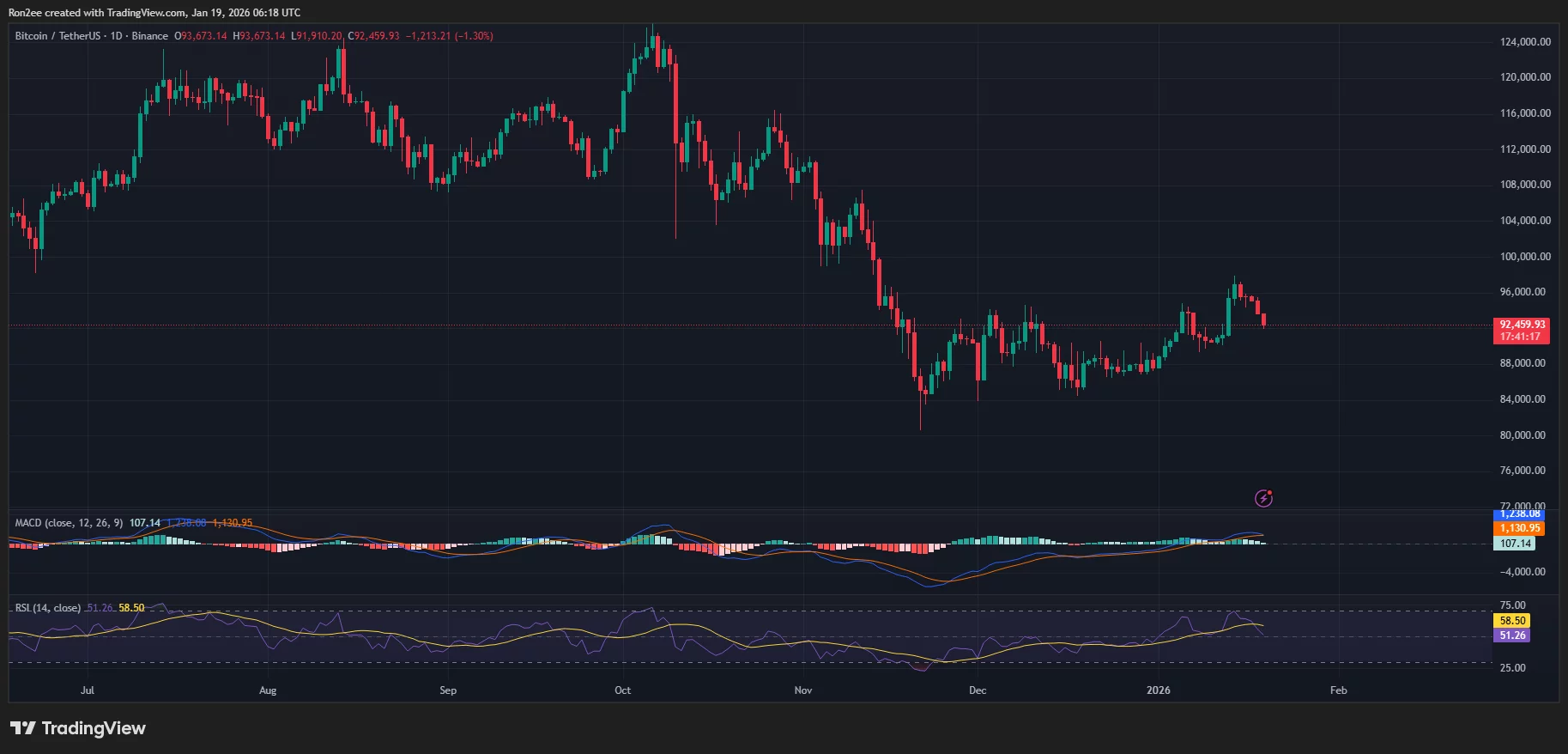
Technical Overview: Bitcoin Price Movement
The daily chart reveals that Bitcoin is nearing an ascending trendline which has served as critical support since late November last year; this line coincides closely with its 50-day simple moving average (SMA), forming a crucial technical convergence zone for price action analysis going forward.

If prices breach below this combined support level it may trigger further downside momentum targeting December’s low near $84{,&}500.
Conversely if buyers manage reclaiming above the SMA-50 line then relief rallies aiming toward resistance levels around$98{,&}000 could materialize again soon thereafter.
Nevertheless momentum indicators such as MACD & RSI currently hint towards bearish tendencies—the MACD recently formed a negative crossover while RSI retreated back toward neutral territory after peaking above overbought zones just last week.
You may also be interested in:
Binance Australia resumes AUD deposits & withdrawals after two years
Coinbase CEO challenges claims about White House withdrawing CLARITY Act backing
Please note: This article serves educational purposes only and should not be considered financial advice or investment guidance under any circumstances.