“`html

As Bitcoin [$BTC] has cooled following a significant rally, the underlying market flows indicate a distinct divergence between selling pressure and accumulation. The price has retreated from the $100K–$110K range down to the mid-$70K area, reflecting short-term uncertainty.
During this period, mega-whales holding over 10k $BTC distributed approximately 25,500 $BTC, securing their profits. In contrast, sharks with holdings of 100–1,000 $BTC absorbed around 37,920 $BTC over thirty days. This rotation indicates that mid-tier players are stepping in as prices weaken, thus reinforcing a defensive base.
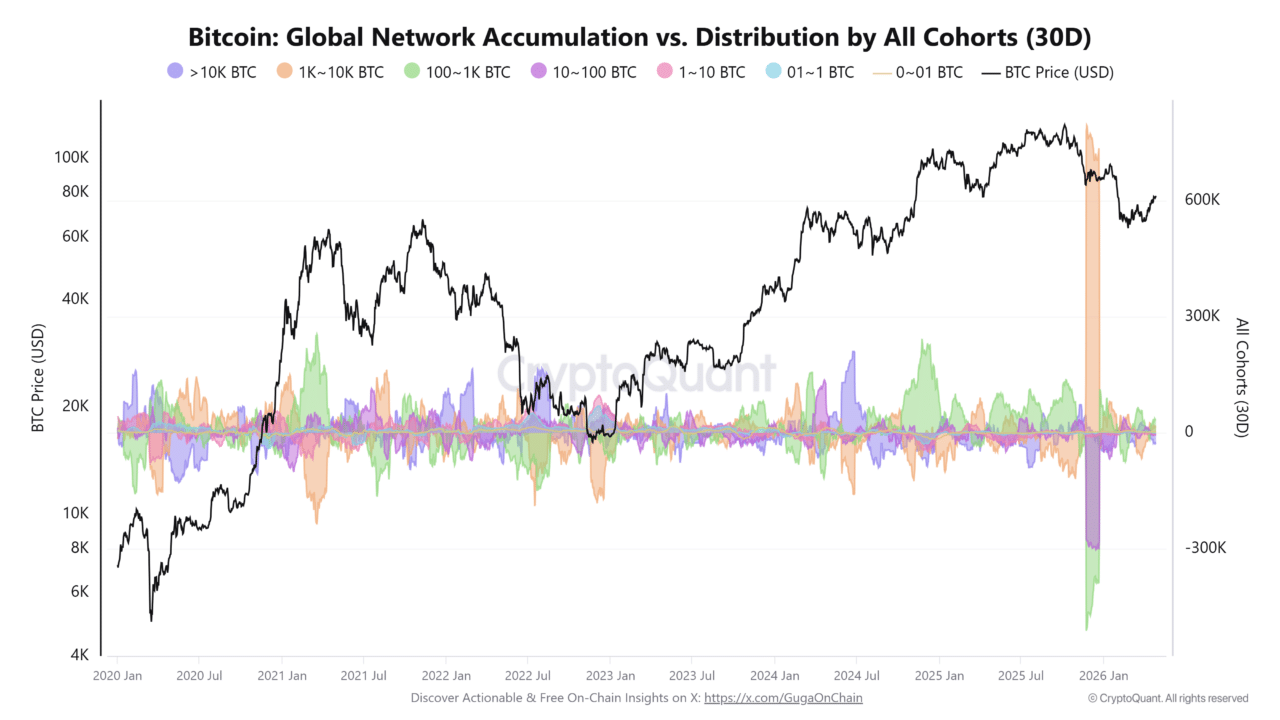
At the same time, Exchange Reserves remained around 2.6 million $BTC, marking a multi-year low and suggesting that coins are being moved off exchanges into long-term custody which tightens supply. Should demand return to the market under these conditions, it could support upward movement; however weak participation may delay any potential expansion.
The Influence of Whale Positions and ETF Flows on Bitcoin Confidence
As Bitcoin stabilizes after recent fluctuations in price volatility, positioning across both derivatives and spot markets is beginning to diverge.
This shift is occurring as institutional demand absorbs available supply; spot ETFs have purchased nearly 19,000 $BTC within five days—significantly exceeding miner output during this timeframe. These inflows serve to tighten liquid supply further while reinforcing a structural floor beneath prices.

The Fear and Greed Index recently approached a level of 48 indicating that retail sentiment remains cautious at present. While whales continue accumulating assets quietly behind the scenes; retail sales provide necessary liquidity for transactions within this environment . If conviction among participants grows stronger , it could lead towards increased growth opportunities ; however hesitancy might prevent follow-through even amidst rising structural demands .
The Impact of FOMC Uncertainty and Rising Yields on Bitcoin’s Risk Appetite
As markets gear up for April’s FOMC meeting set for April28th , positioning becomes tighter due largely because uncertainties surrounding policy direction increase significantly . Traders expect sharp movements depending on whether or not Fed signals hawkish or dovish intent moving forward .
The yield on ten-year Treasury bonds hovered near four point thirty-one percent at time of writing , reflecting firm financial conditions prevailing throughout current economic landscape today . Such levels raise opportunity costs associated with holding non-yielding assets like bitcoin which ultimately pressures overall risk appetites among investors looking elsewhere instead towards safer instruments limiting inflow possibilities into crypto space itself too!
Meanwhile this “spring-loaded” setup creates tension across various markets where positions compress ahead before decision day arrives ! Should yields rise further then riskier assets may face downside consequences whereas softer stances taken by authorities could release sidelined capital thereby supporting recovery efforts too!
Overall we can conclude here : bitcoin remains driven primarily by its own supply dynamics amidst macroeconomic pressures existing currently – any breakout hinges upon easing conditions allowing accumulated supplies meet returning demands effectively enough !
Final Summary
Bitcoin’s tightening supplies reflect mid-tier accumulation patterns alongside growing ETF demands coupled rising long positions absorbing distributions made previously yet macroeconomic factors keep expansions reliant upon renewed demand returns!
$ BTC
stays range-bound while whale convictions build against cautious retail sentiments – FOMC directions likely determine whether longs drive breakouts eventually!
“`
### FAQ
**Q1: What does it mean when Bitcoin shows signs of cooling?**
A1: When Bitcoin cools after a rally, it indicates reduced buying pressure leading to price corrections.
**Q2: How do mega-whales influence market trends?**
A2: Mega-whales can significantly impact market trends through large sell-offs or accumulations which affect overall liquidity.
**Q3: Why are exchange reserves important?**
A3: Exchange reserves indicate how many coins are held on exchanges versus those in long-term storage; lower reserves often suggest tighter supply.
**Q4: What role do ETFs play in cryptocurrency markets?**
A4: ETFs (Exchange-Traded Funds) can absorb significant amounts of cryptocurrency from circulation increasing scarcity while providing institutional investment avenues.
**Q5:** How does macroeconomic pressure affect cryptocurrencies like Bitcoin?
A5:** Macroeconomic factors such as interest rates influence investor behavior impacting their appetite for riskier assets including cryptocurrencies.
As markets gear up for April’s FOMC meeting set for April28th , positioning becomes tighter due largely because uncertainties surrounding policy direction increase significantly . Traders expect sharp movements depending on whether or not Fed signals hawkish or dovish intent moving forward .
The yield on ten-year Treasury bonds hovered near four point thirty-one percent at time of writing , reflecting firm financial conditions prevailing throughout current economic landscape today . Such levels raise opportunity costs associated with holding non-yielding assets like bitcoin which ultimately pressures overall risk appetites among investors looking elsewhere instead towards safer instruments limiting inflow possibilities into crypto space itself too!
Meanwhile this “spring-loaded” setup creates tension across various markets where positions compress ahead before decision day arrives ! Should yields rise further then riskier assets may face downside consequences whereas softer stances taken by authorities could release sidelined capital thereby supporting recovery efforts too!
Overall we can conclude here : bitcoin remains driven primarily by its own supply dynamics amidst macroeconomic pressures existing currently – any breakout hinges upon easing conditions allowing accumulated supplies meet returning demands effectively enough !
Final Summary
Bitcoin’s tightening supplies reflect mid-tier accumulation patterns alongside growing ETF demands coupled rising long positions absorbing distributions made previously yet macroeconomic factors keep expansions reliant upon renewed demand returns!
$ BTC
stays range-bound while whale convictions build against cautious retail sentiments – FOMC directions likely determine whether longs drive breakouts eventually!
“`
### FAQ
**Q1: What does it mean when Bitcoin shows signs of cooling?**
A1: When Bitcoin cools after a rally, it indicates reduced buying pressure leading to price corrections.
**Q2: How do mega-whales influence market trends?**
A2: Mega-whales can significantly impact market trends through large sell-offs or accumulations which affect overall liquidity.
**Q3: Why are exchange reserves important?**
A3: Exchange reserves indicate how many coins are held on exchanges versus those in long-term storage; lower reserves often suggest tighter supply.
**Q4: What role do ETFs play in cryptocurrency markets?**
A4: ETFs (Exchange-Traded Funds) can absorb significant amounts of cryptocurrency from circulation increasing scarcity while providing institutional investment avenues.
**Q5:** How does macroeconomic pressure affect cryptocurrencies like Bitcoin?
A5:** Macroeconomic factors such as interest rates influence investor behavior impacting their appetite for riskier assets including cryptocurrencies.