In response to Ethereum co-founder Vitalik Buterin’s assertion that the initial vision of layer-2 solutions as the main scaling mechanism is outdated, several builders in the layer-2 space have voiced their opinions. Buterin called for a shift towards more specialized functions within these systems.
In a post published on Wednesday, Buterin pointed out that many layer-2 solutions have not fully leveraged Ethereum’s security features due to their ongoing dependence on multisig bridges. He noted that the base layer is becoming increasingly capable of accommodating higher transaction volumes through gas-limit adjustments and future native rollups.
This statement elicited reactions from various Ethereum layer 2 projects, with most agreeing that rollups need to evolve beyond merely being cost-effective alternatives to Ethereum. However, there were differing views on whether scaling should remain a central focus for these technologies.
The Ethereum ecosystem is currently navigating a revised roadmap aimed at enhancing the capabilities of its base layer while allowing L2s to redefine themselves as specialized platforms catering to specific technical requirements.
Ethereum Layer 2 Developers Acknowledge Changes While Debating Scaling Focus
Karl Floersch, co-founder of the Optimism Foundation, expressed his enthusiasm about tackling the challenge of creating a modular L2 stack designed for “the full spectrum of decentralization” in an X post.
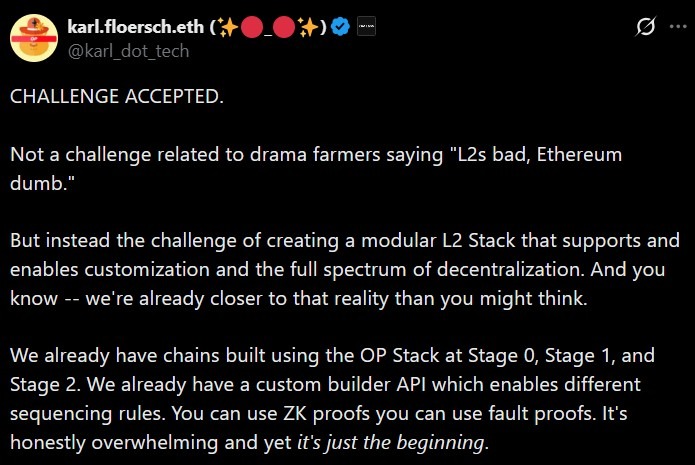
Source: Karl Floersch
He also recognized significant challenges ahead, such as prolonged withdrawal periods and inadequate tooling for cross-chain applications along with unready Stage 2 proofs. “Stage 2 isn’t production-ready,” he stated while emphasizing that current proofs lack sufficient security for major bridges. Additionally, he advocated for implementing native precompiles in Ethereum specifically designed for rollups—a concept recently highlighted by Buterin as essential for facilitating trustless verification processes.
On another note, Steven Goldfeder—co-founder at Offchain Labs which develops Arbitrum—took a firmer position in an extensive thread on X. He contended that although advancements have been made within the rollup model itself, scaling remains an intrinsic value associated with L2s.
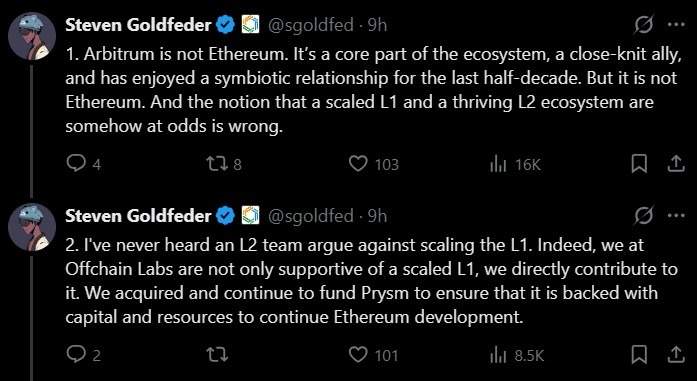
Source: Steven Goldfeder
Goldfeder clarified that Arbitrum was not merely created as “a service” benefiting Ethereum; rather it was developed because Ethereum offers a secure and low-cost settlement framework conducive to large-scale rollup operations. He also challenged notions suggesting that an enhanced mainnet could supplant current throughput managed by L3 networks; citing instances where both Arbitrum and Base executed over 1,000 transactions per second during peak times compared to lower figures processed by Ethereum itself.
If institutions perceive hostility towards rollups from within the ecosystem surrounding Ethereum’s network structure or policies may lead them toward launching independent Layer-1 chains instead of building upon existing infrastructure offered by ETH networks.”
Related: The volume of stablecoin ‘dust’ transactions has tripled following Fusaka according to Coin Metrics analysis
Differentiation Emphasized by Base; Starknet Aligns Itself With New Direction
Eli Ben-Sasson—the CEO at StarkWare responsible for developing non-EVM compatible Starknet—provided succinct feedback via X stating simply: “Say Starknet without saying Starknet.” This comment implies some ZK-native Layer 3 solutions already view themselves fitting into specialized roles similar those outlined previously discussed By Vitalik Buterin himself regarding future developments across this evolving landscape overall!
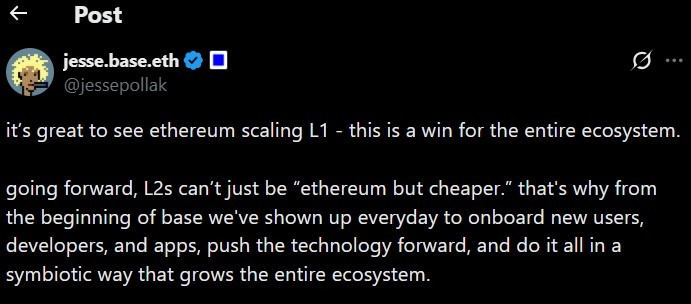
Source: Jesse Pollak