
Follow Us
The global economy has absorbed the economic shock from the war in the Middle East better than the International Monetary Fund initially expected, but the cushion could weaken if oil prices rise again.
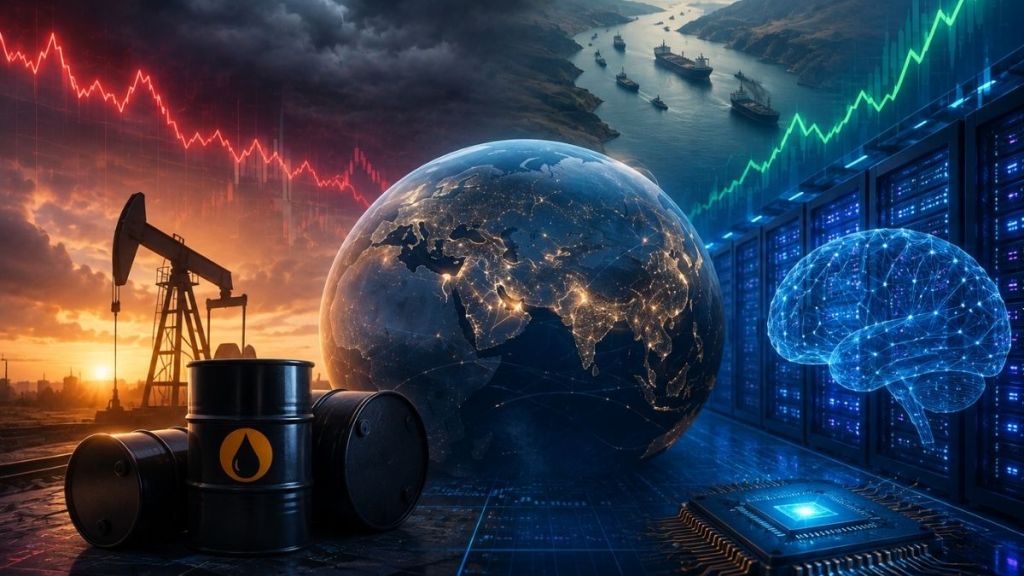
IMF managing director Kristalina Georgieva said strong investment in artificial intelligence and data centres, particularly in the United States, has supported corporate earnings and consumer spending even as the conflict disrupts energy markets. She described the global economy as being caught in a “tug of war” between the energy shock and the AI investment cycle, Reuters reported.
But Georgieva warned that the energy shock is not over. A renewed increase in oil prices could push inflation higher, forcing central banks to keep interest rates restrictive for longer. That could increase debt-servicing costs and weaken economic activity.
ALSO READUS sanctions Indian firms over $119 million in alleged Iran petroleum deals
The warning comes as markets remain sensitive to developments around the Strait of Hormuz. Brent crude fell more than 2% to around $86.4 a barrel on Wednesday as investors responded to renewed Iran-Oman talks over the waterway. US West Texas Intermediate crude was also lower.
The decline has eased some immediate pressure on the global economy, but it does not eliminate the risk of another oil-price shock if shipping through the strait remains disrupted.
How is AI helping global economy?
AI investment has emerged as an important source of economic activity while energy markets remain under pressure.
Georgieva said the AI-led growth cycle, initially concentrated heavily in the US, is spreading to other economies as companies increase investment in data centres and AI hardware. That spending is supporting corporate earnings and consumer demand, providing a counterweight to weaker activity caused by higher energy costs.
The IMF had previously identified technology investment as one factor helping the global economy absorb the energy shock. But the Fund has also cautioned that many countries have yet to see the full productivity benefits of AI.
That means the AI investment cycle can cushion the shock, but it cannot fully offset the economic consequences of a prolonged energy disruption.
Why is IMF still worried about oil prices?
The biggest risk is a fresh increase in crude prices. Higher oil prices can raise transport and production costs and eventually feed into consumer prices. They can also increase the cost of fertilizer and other energy-intensive goods.
That creates a difficult situation for central banks. If inflation rises again because of energy costs, policymakers could have less room to cut interest rates even if economic growth slows.
ALSO READIran discovers over 7.5 trillion cubic feet of gas amid US conflict, sanctions: Report
Georgieva warned that a renewed oil-price rise could force central banks to maintain a restrictive policy stance, with knock-on effects on debt-servicing costs and economic activity.
The risk is particularly significant because governments are already dealing with high debt and borrowing costs. Georgieva also called for credible plans to bring fiscal deficits and debt onto a sustainable path.
Why does Hormuz matter for global economy?
The Strait of Hormuz remains one of the key risks for the oil market because it normally carries around one-fifth of global oil and LNG shipments.
Traffic through the waterway has remained far below normal levels during the conflict. Reuters reported that only five commodity vessels passed through on Tuesday, while Iran and Oman were discussing a possible temporary navigation corridor and mine-clearance measures.
The situation is complicated by conflicting estimates of how much oil is actually moving through the strait. US officials have cited substantially higher flows than some shipping-data providers, making the precise level of disruption difficult to establish.
For the global economy, however, if shipping restrictions worsen and crude prices rise sharply again, the inflation cushion could disappear quickly.
What has prevented a bigger economic shock?
Several factors have helped the global economy absorb the disruption.
Countries have used oil reserves, diversified energy supplies and increased renewable-energy capacity. Some have also temporarily increased coal use. These measures have helped reduce the immediate impact of the disruption on economic activity.
The AI investment cycle has provided another source of growth, particularly in the US.
But these buffers are not unlimited. If the disruption continues and oil inventories decline further, the global economy could face a more difficult combination of higher energy prices, persistent inflation and weaker growth.
For now, the IMF’s assessment is that the global economy has proved more resilient than initially feared. But Georgieva’s warning is that the balance could shift quickly if oil prices surge again.
AI investment may be cushioning the Iran war’s economic shock for now. A renewed oil-price spike could test how long that cushion lasts.
Disclaimer: The economic and market outlook discussed in this article is subject to change as developments in the Middle East, oil markets and global financial conditions evolve. References to inflation, oil prices, economic growth and monetary policy are not forecasts or investment advice.
TOPICSIMFOil pricesUS Israel Iran WarThis article was first uploaded on August twenty-six, twenty twenty-six, at fifty-seven minutes past five in the evening. © IE Online Media Services (P) Ltd