
Follow Us
Less than a fortnight to the end of the south-west monsoon season (June–September), the area under kharif crops is down marginally by 1.4%. However, concerns are mounting about crop growth and yield due to the skewed nature of rainfall distribution.
Uneven rain distribution and significant inter-regional disparity in rainfall patterns are likely to impact clutches of crops including paddy, oilseeds and pulses, analysts say.
“While the overall acreage picture remains broadly stable, some key crops, paddy and ragi have come under pressure due to uneven rainfall distribution and water availability concerns during critical sowing and transplanting windows,” Pushan Sharma, Director, Crisil Intelligence, told FE. Crisil intelligence’s latest assessment stated that kharif crop acreage is likely to be marginally lower year-on-year, in the range of 0%-1%. Overall, the area sown under the kharif crops—paddy, pulses, oilseeds, cotton, sugarcane and coarse cereals—stood lower at 109.49 million hectare (Mha), 1.4% below the previous year’s level, according to the agriculture ministry.
ALSO READPaddy farmers in Punjab, Haryana to get first carbon credits for climate-friendly crops
The pressure is being faced by parts of southern India, where rainfall deficits and lower reservoir storage levels have constrained agricultural activity. Eastern regions have also witnessed pockets of weather-related stress, leading to a more cautious acreage outlook, Crisil stated.
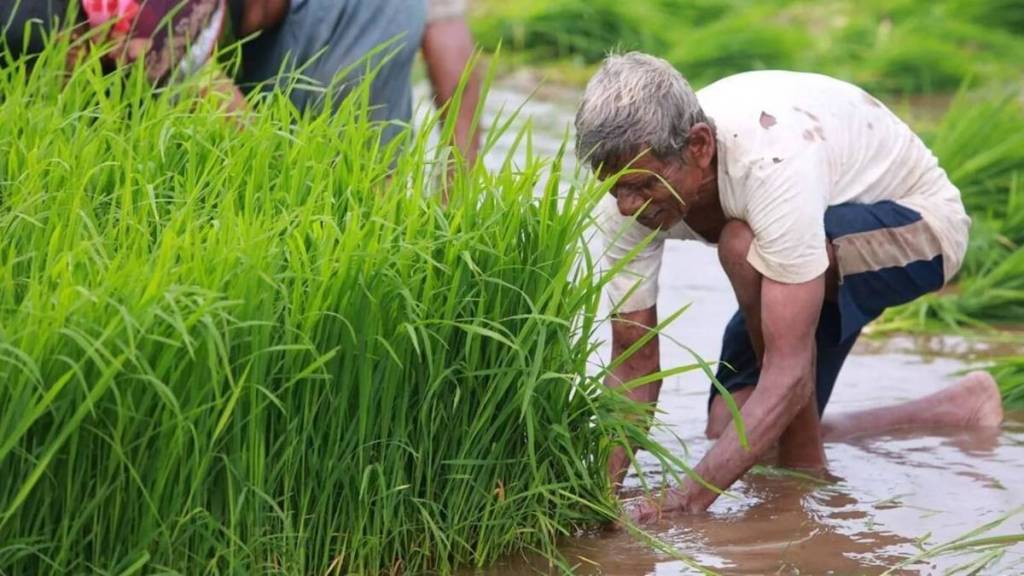
Area under paddy declined by close to 4% to 42.68 Mha in the ongoing kharif season compared to the previous year owing to deficient monsoon rains, the ministry stated. “Overall, the decline in rice area coverage is mainly attributable to substantial reductions in Karnataka, Telangana, Uttar Pradesh, Andhra Pradesh, Madhya Pradesh, Jharkhand, Tamil Nadu and Maharashtra,” the ministry noted.
“With kharif sowing largely complete, attention now turns from acreage to yield, as lower reservoir levels and uneven rainfall during critical crop stages could weigh on productivity,” Shashi Kant Singh, Partner – agriculture food and agribusiness, PwC India said. While area under pulses variants including tur, urad and moong has increased marginally from the previous year to 11.71 Mha, rains during the next few weeks across parts of Maharashtra and Karnataka would be crucial for better yield.
“Tur crop is currently under stress across parts of Maharashtra and Karnataka, while rains in coming weeks would be beneficial for better yield,” Nitin Kalantri, managing director, Kalantry Food Products, a Latur, Maharashtra-based pulses processor, told FE. With a monsoon deficit of 14.7% against the benchmark till Sunday, overall rainfall (June-September) is likely to be ‘deficient’—below 90% of the benchmark this season. This season’s rainfall is likely to be the lowest since 2009. Previously, overall rainfall during the monsoon season was in the ‘deficient’ range in 2002 (-20.9%), 2009 (-18.3%), 2015 (-12.7%) and 2014 (-10.15).
Modi, Xi vow to address trade imbalance
Regionally, central India saw precipitation in the normal range, while northwest India (-9.9%), east and north-east (-24.8%) and south peninsular India (-27.8%) remained below normal. So far, out of 740 odd districts, 47% or 343 districts have received “deficient” to “large deficient” rainfall. Over 53% or 398 districts have so far received “normal” to “large excess” precipitation.
After scanty rainfall received in June at 36% below the benchmark, July saw a revival of monsoon rains at 1% above the LPA, which is within the “normal” range and had given a boost to kharif crop sowing. However, the August rainfall was also unevenly distributed with 16.3% below the LPA, and all regions except the monsoon core zone of central India received ‘deficient’ rainfall. For September, the met department forecast “below normal” or below 91% of the benchmark.
The agriculture ministry is still assessing the production prospects of kharif crops, yet an official said productivity would not be impacted significantly.
TOPICSKharif cropsThis article was first uploaded on September thirteen, twenty twenty-six, at fifty-two minutes past five in the evening. © The Indian Express (P) Ltd