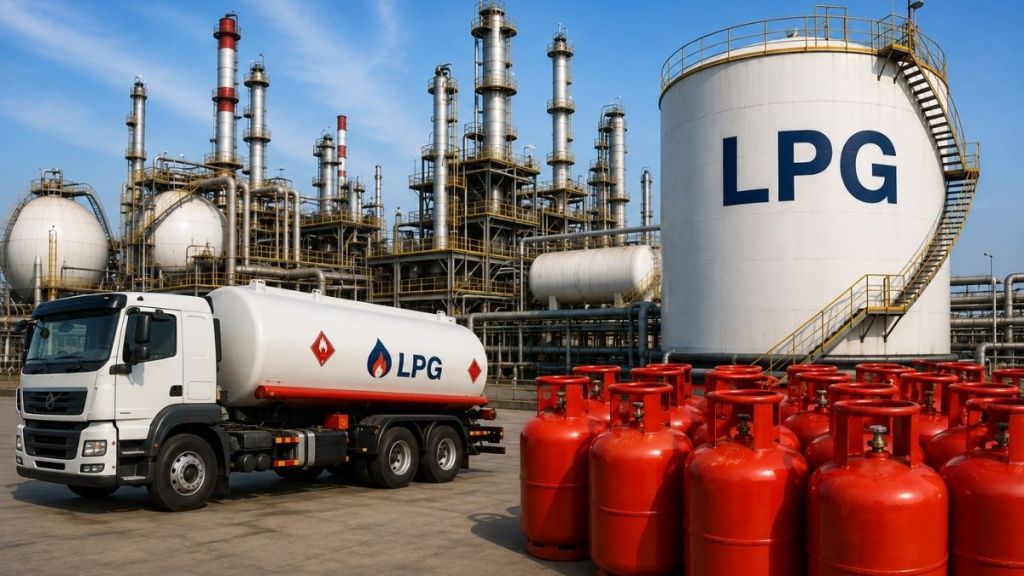
India has set a maximum daily LPG production capacity of 63,810 metric tonnes across state-run and private refineries and upstream oil companies.
The decision comes amid its moves to protect domestic cooking gas supplies and build buffers after the US-Israeli war against Iran disrupted supplies of the essential fuel, according to a government order dated August 13. The order sets company-wise production capacities and gives the government powers to ask oil companies to raise LPG output when required.
The order, issued by the Ministry of Petroleum and Natural Gas, amends the Petroleum Products (Maintenance of Production, Storage and Supply) Order, 1999. It creates a new framework for LPG production and supply and requires oil refining and upstream companies to maintain adequate infrastructure for storing, evacuating and transporting the specified quantities of LPG.
The biggest individual share goes to Reliance Industries Ltd (RIL). Its DTA and SEZ operations have a maximum LPG production capacity of 18,000 metric tonnes per day, according to the schedule attached to the order. That is about 28.2% of the total 63,810-metric tonne capacity listed by the government.
ALSO READThree orders, Rs 1.53 lakh crore: Submarine, missile and corvette deals could reshape India’s defence order pipeline
The government document classifies the 63,810-metric tonne figure as the maximum LPG production potential across the listed refineries and upstream fields. It is therefore a capacity figure, rather than a statement that all 63,810 metric tonnes will be produced every day.
The schedule covers 24 refinery and upstream oil company entries. Public sector companies account for 31,470 metric tonnes per day, private companies account for 25,880 metric tonnes per day, and upstream fields add another 6,460 metric tonnes per day. Together, they bring the total LPG production potential to 63,810 metric tonnes per day.
The order gives the government a mechanism to increase production if it considers higher domestic availability necessary. It can issue written directions to oil refining companies, oil marketing companies and upstream oil companies to raise LPG production for a specified quantity and period.
Reliance gets the biggest LPG share
Reliance Industries has the largest individual LPG production capacity in the government’s new schedule. The RIL entry covers its DTA and SEZ operations and carries a maximum production capacity of 18,000 metric tonnes per day. No other individual company or refinery in the schedule comes close to that figure.
RIL’s allocation works out to about 28.2% of the total 63,810-metric tonne daily capacity listed in the order. The next largest individual allocation belongs to BPCL’s Kochi refinery, with a maximum LPG production capacity of 4,800 metric tonnes per day.
MRPL’s Mangalore refinery has a capacity of 4,600 metric tonnes per day, while Nayara has a capacity of 4,480 metric tonnes per day. HMEL has a maximum capacity of 3,400 metric tonnes per day, while IOCL’s Paradip refinery has a capacity of 3,360 metric tonnes per day.
Among upstream companies, GAIL has the highest specified LPG capacity at 3,030 metric tonnes per day. ONGC has 2,450 metric tonnes per day, while Oil India has 980 metric tonnes per day.
The public sector companies have a combined capacity of 31,470 metric tonnes per day. This is higher than the private-sector total of 25,880 metric tonnes per day. But the PSU figure comes from several refineries and companies.
ALSO READWhat does it take to become a ‘Lakhpati Didi’? Inside India’s 3.46 crore rural women’s economy
The private-sector figure includes RIL, HMEL and Nayara. RIL alone accounts for 18,000 metric tonnes per day. Among state-run companies, IOCL has the largest combined capacity across the refineries listed in the schedule.
IOCL’s facilities at Digboi, Guwahati, Barauni, Gujarat, Haldia, Mathura, Panipat, Bongaigaon and Paradip have a combined maximum LPG production capacity of 13,430 metric tonnes per day. IOCL’s Paradip refinery has the highest individual capacity among its listed plants at 3,360 metric tonnes per day. Panipat follows at 2,360 metric tonnes and Mathura at 2,200 metric tonnes.
BPCL’s three listed refineries have a combined capacity of 7,380 metric tonnes per day. Kochi accounts for the largest part at 4,800 metric tonnes, followed by Mumbai at 1,800 metric tonnes and Bina at 780 metric tonnes. HPCL’s Mumbai and Visakh refineries have capacities of 1,820 metric tonnes and 2,020 metric tonnes per day, respectively.
MRPL’s Mangalore refinery has a capacity of 4,600 metric tonnes per day. CPCL’s Manali refinery has a capacity of 1,480 metric tonnes per day. NRL’s Numaligarh refinery has a capacity of 240 metric tonnes, while HRRL has a capacity of 1,540 metric tonnes per day.
What can government do if LPG supplies tighten?
The August 13 order gives the government wider powers to respond to a domestic LPG supply shortage. If the Central Government considers it necessary in the public interest to ensure adequate availability, equitable distribution and availability at fair prices, it can issue written directions to oil refining companies, oil marketing companies and upstream oil companies.
Those directions can require companies to increase LPG production to a specified level for a specified period. Companies must meet the higher production requirement within the time set by the government.
The government can also require companies to follow restrictions on alternative uses of input streams needed for LPG production. The order requires companies to implement technically and economically feasible measures to maximise LPG production beyond the minimum production quantities specified in the schedule.
The government specifically lists naphtha-to-LPG conversion and the conversion of gasoline-based fluid catalytic cracking units to petro-fluid catalytic cracking units among the possible measures. Companies can also undertake other upgrades that can increase LPG output.
The order also puts infrastructure obligations on the companies. All public sector, joint venture and private sector oil refining companies and upstream oil companies must develop, expand and maintain adequate infrastructure for LPG storage, evacuation and transportation.
They can use their own infrastructure or other entities such as railways and road tankers to handle the required quantities.
This is important because higher production alone does not guarantee that LPG will reach consumers.
The companies must also maintain the infrastructure required to move the fuel from production facilities to the wider supply network.
The government has also built a mechanism to revise the production schedule. It will update the schedule on January 1 and July 1 every year.
The revisions can include LPG production from new refineries and upstream companies. They can also include additional production from existing companies because of changes in infrastructure, technology, evacuation, supply, transportation or distribution.
The Centre for High Technology or another authorised agency will monitor the implementation of directions issued under the new rules.
Companies that violate such directions can face penalties under the Essential Commodities Act, 1955. The government order therefore does not simply publish a 63,810-metric tonne figure.
It establishes a system that allows the government to monitor LPG production capacity, require higher output when needed and ensure that companies maintain the infrastructure needed to store and move the fuel.
The distinction between capacity and actual production remains important. The schedule calls the 63.81 thousand metric tonnes per day figure the “Total Liquified Petroleum Gas Potential”. It lists the maximum production capacity for each refinery or upstream company. It does not say that all companies must produce their maximum capacity every day.
Instead, the government can issue separate directions to raise production for a specified period if it considers that necessary. The new framework also gives companies a clear capacity benchmark.
RIL has the largest individual allocation at 18,000 metric tonnes per day. The PSU group has the largest combined share at 31,470 metric tonnes per day, while private companies together have 25,880 metric tonnes per day.
Upstream fields contribute another 6,460 metric tonnes per day.
TOPICSeconomy newsLPGThis article was first uploaded on August sixteen, twenty twenty-six, at thirty-eight minutes past eight in the night. © IE Online Media Services (P) Ltd