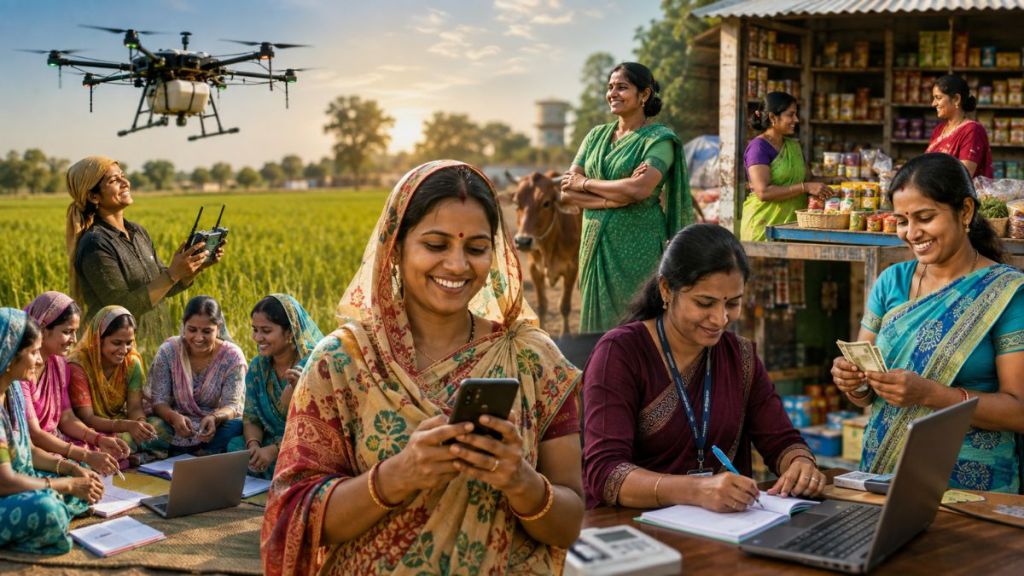
For most of the last two decades, the standard way to describe a rural Indian woman’s relationship with the state was to describe what she received: a ration, a subsidy, a loan waiver, a monthly installment. When Prime Minister Narendra Modi announced from the Red Fort on Independence Day that India would sharply expand the number of women it counts as Lakhpati Didis (currently over 3.46 crore), he was pointing at a target that has become harder to describe in those terms. That is because the woman it refers to is increasingly on the other side of the counter — advising a farmer, signing up a policyholder, running a group enterprise or helping a neighbour reach a bank.
But Lakhpati Didi is only one part of a much larger shift.
Across India, women are increasingly appearing in the rural economy not just as beneficiaries of government support, but as banking intermediaries, insurance agents, agricultural service providers, entrepreneurs, producers and, increasingly, sellers with access to organised markets.
That change is being built through several different kinds of schemes — some run by the Centre, others by states, and many operating through the same SHG networks.
Taken together, they begin to look less like a collection of welfare programmes and more like an emerging economic architecture.
The first layer: Putting money in women’s hands
The fastest-growing layer is also the simplest: direct cash transfers.
By FY26, more than 15 states had introduced some form of unconditional monthly or annual transfer paid directly into women’s bank accounts, according to a July 2026 working paper by the Economic Advisory Council to the Prime Minister. The programmes were estimated to cost around ₹1.7 lakh crore and reach close to 12 crore women. However, the schemes differ considerably.
Madhya Pradesh’s Ladli Behna Yojana provides ₹1,250 a month to eligible women. Maharashtra’s Majhi Ladki Bahin Yojana provides ₹1,500 a month. Odisha’s Subhadra provides ₹10,000 a year. Karnataka’s Gruha Lakshmi provides ₹2,000 a month to eligible women heads of households.
हमने दिल्ली लक्ष्मी योजना शुरू की, जिसमें जरूरतमंद बहनों को ₹2,500 प्रति माह देने का काम शुरू किया है।
मुझे खुशी है कि इतने कम समय में हमारी लगभग 7,25,000 बहनों ने इस योजना के अंतर्गत अपना रजिस्ट्रेशन कराया है। 17 लाख बहनों को इस योजना के अंतर्गत लाभ देने का हमारा टारगेट है।… pic.twitter.com/yLVRsI8ps5
— Rekha Gupta (@gupta_rekha) August 15, 2026
Punjab’s Mukh Mantri Mawan Dhian Satikar Yojana, meanwhile, has been allocated ₹9,300 crore in the state’s 2026-27 Budget, with the scheme providing ₹1,000 a month to eligible women and ₹1,500 to eligible Scheduled Caste women.
ALSO READIs drinking water at railway stations safe? Inside CAG’s E. coli findings and two decades of warnings
The significance of this layer is its reach. Unlike a livelihood programme that requires a woman to join an SHG, access credit or start an enterprise, a cash transfer can put a predictable stream of money directly into the beneficiary’s bank account.
A July 2026 EAC-PM study of women’s cash-transfer programmes in Maharashtra and Odisha found evidence of higher savings, account balances and spending among beneficiaries, along with financial spillovers within households. In Maharashtra, the study found month-end bank balances rose 84%, or ₹6,884 per beneficiary, while monthly spending increased 46%, or ₹1,349. In Odisha, balances rose 45%, or ₹6,887, while monthly spending increased 28%, or ₹1,920.
But cash is not an enterprise.
It can improve financial security and purchasing power; it does not automatically create a business, a skill or a market role. That is where the next layer comes in.
From beneficiary to economic participant
The more structural change is taking place through DAY-NRLM, the government’s rural livelihoods mission built around women’s SHGs.
By July 2026, around 10.05 crore rural women had been mobilised into 92 lakh SHGs. The SHG-bank linkage system had facilitated more than ₹13.41 lakh crore in cumulative credit disbursement, according to the Ministry of Rural Development’s written Lok Sabha reply in July.
The network has also created a class of women whose role is not to receive a financial service but to deliver one.
In a February 3, 2026 written Lok Sabha reply, the Ministry of Rural Development said 50,548 Bank Sakhis had been deployed and had collectively enabled women SHGs to access institutional bank credit amounting to ₹12.18 lakh crore since 2013-14.
‘मुख्यमंत्री लाड़ली बहना योजना’ 1 करोड़ 25 लाख से अधिक बहनों की सशक्तिकरण का माध्यम बनी है। इसके साथ ही ‘लाड़ली लक्ष्मी योजना’ के तहत 53 लाख 55 हज़ार से अधिक बेटियां लाभान्वित हो रही हैं : मुख्यमंत्री डॉ. मोहन यादव @DrMohanYadav51 #MadhyaPradesh #IndependenceDay2026 pic.twitter.com/d6OhwSuIZE
— Women & Child Development Department, MP (@mp_wcdmp) August 15, 2026
Then there are Krishi Sakhis and Pashu Sakhis, who provide support on farming and livestock activities. The architecture is important because it changes the economic role assigned to the woman: she is no longer simply the end-user of a government programme. She can become part of the delivery system itself. This is also where Lakhpati Didi sits.
The Ministry of Rural Development, in a July 21 parliamentary reply, cited the 3ie Impact Evaluation Study (2025), based on two rounds of data collection conducted in 2019 and 2024 across nine states and covering about 23,000 households. It found household incomes had increased by 9.5% in NRLM blocks, while income gains in mature community-institution clusters ranged from 12% to 33%. The study also reported a 6-11% increase in per-capita household consumption.
That does not prove every SHG becomes a successful enterprise. It does, however, provide evidence that the livelihood architecture can have an income effect as it matures.
Then comes the technology layer
The most visible example is Namo Drone Didi. The scheme aims to provide 15,000 drones to women SHGs, with the groups using them to provide agricultural services such as spraying liquid fertilisers and pesticides to farmers. The government provides financial assistance of up to 80% of the drone package cost, subject to a maximum of ₹8 lakh.
A traditional rural livelihood model generally involves a woman producing something like milk, food, handicrafts, agricultural output and then trying to find a buyer.
The same broader ecosystem is visible in insurance. LIC’s FY26 investor presentation, which reports data as of March 31, 2026, said 3.45 lakh Mahila Career Agents had been appointed under its Bima Sakhi programme since December 9, 2024. The women had sold 21.94 lakh policies and generated ₹2,848.36 crore in new business premium; 61.16% of policies and 57.72% of premium procured by Bima Sakhis came from rural areas.
The result is a widening definition of what a rural woman’s economic activity can be: banker, insurance agent, farm adviser, livestock adviser, entrepreneur or technology-enabled service provider.
मधुबनी की 50 वर्षीय सोनदाई दीदी ने जिंदगी का एक लंबा सफर परिवार के लिए समर्पित किया। बच्चों की शादी हुई, घर-परिवार की जिम्मेदारियाँ पूरी हुईं, तो उन्होंने सोचा-अब क्यों न अपने लिए भी कुछ किया जाए?
इसी सोच ने उन्हें जीविका से जोड़ा। मुख्यमंत्री महिला रोजगार योजना से मिली ₹10,000… pic.twitter.com/U5WZQbq6NE
— JEEVIKA Bihar (@brlps_jeevika) August 16, 2026
The missing piece was always the market
The government has increasingly moved beyond the question of how to create women’s livelihoods to the question of where those women will sell what they produce.
At a June 14, 2026 review meeting chaired by Rural Development Secretary Rohit Kansal, the Ministry of Rural Development said the establishment of 700 SHE-MARTs and 1,000 District Fulfilment Centres was being proposed as part of an integrated marketing ecosystem for SHG products and women-led enterprises.
The Rural Development Ministry has subsequently said it plans 700 SHE-Marts and 1,000 district fulfilment centres, alongside initiatives around product innovation, packaging, quality compliance and ONDC partnerships.
Credit can give a woman capital. An SHG can give her a collective platform. A livelihood programme can give her a business. A drone can turn her into a service provider. But none of those, by themselves, guarantees a customer. SHE-Marts aim to be an attempt to build that missing market link.
ALSO READIndia’s LPG safety net: How govt is building a buffer against supply shocks by focusing on domestic production
The same logic is already visible in digital commerce. Under DAY-NRLM, women-led SHG enterprises are being connected to e-commerce platforms, while the government’s Womaniya initiative on GeM is designed to connect women-led enterprises and SHGs to public procurement.
There is also a fiscal question
The rapid expansion of the cash-transfer layer cannot be separated from the finances of the states funding it.
Punjab provides a useful example. Its 2026-27 Budget estimates ₹90,335 crore in committed expenditure on salaries, pensions and interest payments — equivalent to 72% of its estimated revenue receipts. It has also budgeted ₹9,300 crore for the Mukh Mantri Mawan Dhian Satikar Yojana. The state estimates a revenue deficit of ₹21,955 crore and a fiscal deficit of ₹39,971 crore for the year.
SHE-MART के जरिए ग्रामीण महिलाओं द्वारा तैयार किए गए स्थानीय उत्पादों को ग्राहकों तक सीधी पहुंच मिलेगी।
यह पहल केवल उत्पादों की बिक्री नहीं, बल्कि महिलाओं के कौशल, उद्यमिता और आत्मनिर्भरता को नई पहचान देने की दिशा में एक कदम है।#SHEMART #VBRAMG #WomenEmpowerment #SHG… pic.twitter.com/inAkxEKukv
— ग्राम्य विकास विभाग, उत्तर प्रदेश (@UpRuralDev) August 16, 2026
That does not mean the women’s transfer is itself being financed through borrowing. It does, however, illustrate the broader trade-off: states are expanding recurring transfers at the same time as their budgets face competing demands for infrastructure, productive expenditure, salaries, subsidies and debt servicing.
What this new rural economy looks like
It is through the growing stack around the rural woman: a cash transfer that improves financial security; an SHG that creates collective economic power; a Bank Sakhi who connects women to formal credit; Krishi and Pashu Sakhis who deliver services; a Lakhpati Didi building a sustained livelihood; a Drone Didi selling an agricultural service; a Bima Sakhi distributing insurance; and, increasingly, a SHE-Mart or digital platform providing a route to market.
The scale of the underlying network is already substantial. DAY-NRLM now covers more than 10 crore rural women through SHGs, while the Ministry of Rural Development said in its July 28, 2026 Lok Sabha reply that the Start-up Village Entrepreneurship Programme had supported 4.32 lakh rural enterprises by June 2026.
The government is now trying to connect those pieces.
That is what makes the six-crore Lakhpati Didi target more consequential than a headline number. The target is not simply about getting more women above an income threshold. The accompanying policy push increasingly involves credit, enterprise creation, technology, financial services and market access.
However, the real test of this women-centered economy will be whether these programmes remain separate schemes or begin to function as a chain: financial security leading to participation, participation leading to enterprise, enterprise leading to markets, and markets allowing those enterprises to survive without depending indefinitely on the scheme that helped create them.
TOPICSdirect benefits transferEmployment schemeLok SabhaRuralWomenWomen at workwomen entrepreneurs + 0 MoreThis article was first uploaded on August sixteen, twenty twenty-six, at nineteen minutes past nine in the night. © IE Online Media Services (P) Ltd