Entering 2025, a notable change in the gaming industry is that the boundary between players and developers is becoming increasingly blurred. In the past, game content was primarily created by development teams, with players responsible for experiencing and consuming it. Today, map editors, modding communities, user-generated levels, and digital creation tools are gradually becoming widespread, and an increasing number of players wish to participate in building the worldview, narrative, and gameplay.
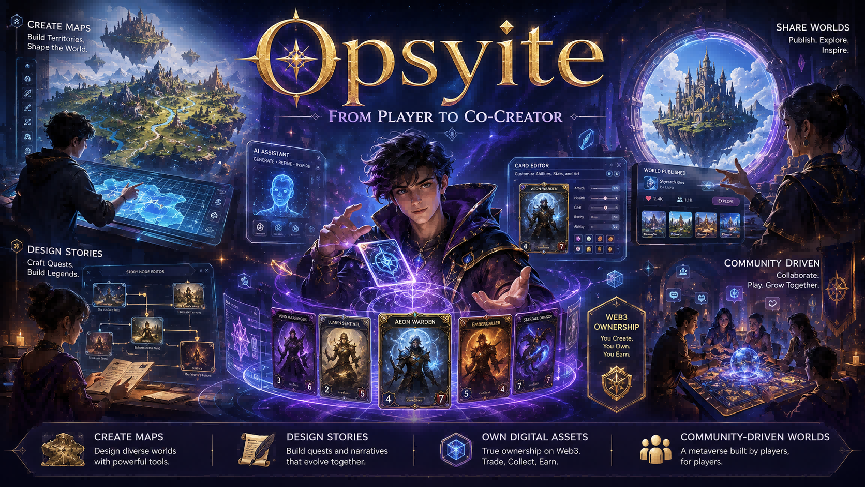
Opsyite is built on this trend, making player co-creation a key component of the long-term development of card games. The project is set in a multidimensional universe that has been re-fused due to “spacetime rifts,” where players take on the role of “mysticists” who can perceive the rifts. By collecting cards, exploring maps, and participating in battles, players influence the development direction of different dimensions.
Unlike traditional card games that update content according to fixed versions, Opsyite aims to allow players to participate in designing some maps, side storylines, quests, and skill modules. The AI editor planned in the project will provide assistance to players who lack programming and professional art skills. Players can describe scene themes, enemy characteristics, and quest logic in natural language, and the tool will generate an initial framework, after which they can continue to modify rules, numerical values, and narrative details.
For example, one player can design a challenge map set in a lava ruin, with rules such as sustained high temperatures, energy enhancement, and time-limited escape; another player can create a reconnaissance mission centered on a misty forest, making visibility, route selection, and deck choices the key to clearing the level. After review and balance testing, high-quality works can enter the community map pool, limited-time events, or the exploration lists of other players.
This mechanism changes not only the quantity of content but also the relationship between players and games. In the past, what players left behind after investing time was mainly levels, equipment, and rankings; in a co-creation system, maps, storylines, and skill designs can also become long-term recorded digital content. Opsyite plans to utilize blockchain to record creator identity, frequency of work usage, and licensing status, providing a relatively transparent basis for subsequent profit distribution.
Of course, allowing players to create content does not mean that all content can directly enter the game. Card games have high requirements for numerical balance and rule consistency. If a map offers excessive rewards, or if a certain skill module clearly disrupts the competitive environment, it may affect the entire economic and competitive system. Therefore, Opsyite still needs to use AI simulation, community evaluation, and manual review to filter works based on difficulty, rewards, and playability.
The native token of the project, OSYTC, primarily serves functions such as content publishing, card growth, ecosystem incentives, and governance within this system. Creators can receive rewards based on the actual usage of their works, but whether a work can continue to generate value still depends on whether players are willing to repeatedly experience it, rather than relying solely on token subsidies to maintain popularity.
From the perspective of the industry environment in 2025, user-generated content has become an important way to extend the lifecycle of games. However, platforms that can truly form a stable ecosystem typically need to simultaneously possess simple creation tools, clear review standards, and a sufficiently active player community. The direction proposed by Opsyite has a certain realistic foundation, but it still needs to be gradually validated through editor experience, content quality, and revenue-sharing mechanisms.
For Opsyite, player co-creation is not simply adding a feature to the existing card gameplay, but rather an attempt to shift the game world from “continuously updated by the team” to “jointly expanded by the team and the community.” When players can not only collect cards and complete tasks, but also leave their own maps and stories, the game content has the opportunity to develop more lasting vitality.