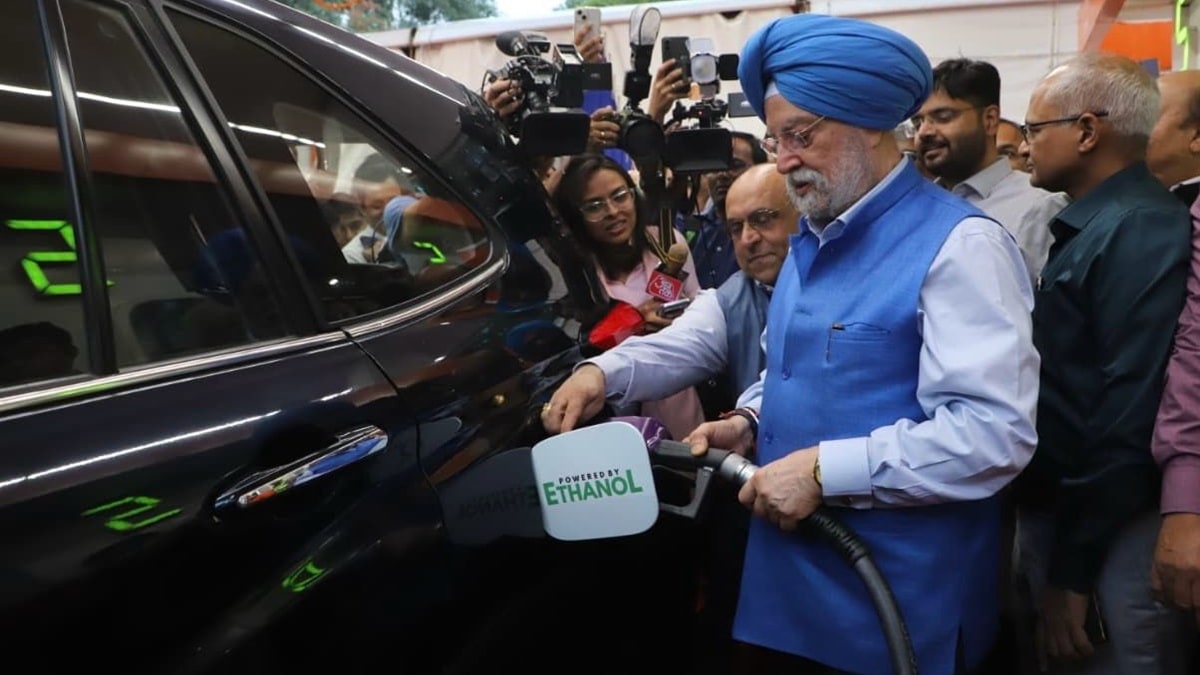
India has launched E85 fuel as part of a wider plan to reduce dependence on imported crude oil. But the new fuel is meant only for flex-fuel vehicles, not regular petrol or E20-compliant cars.
India’s E85 launch is not just another fuel station story. It is the Centre’s latest attempt to solve a much older problem: how to reduce the country’s dependence on imported crude oil without waiting for the transport economy to fully shift to electric vehicles.
Union Petroleum and Natural Gas Minister Hardeep Singh Puri launched E85 fuel at an Indian Oil retail outlet in New Delhi on World Environment Day. The fuel, made up of 80-85% ethanol and 14-19% petrol, will initially be available at select public sector oil marketing company outlets and is meant only for flex-fuel vehicles.
That distinction is important. The launch has triggered confusion among vehicle owners, with social media claims suggesting that petrol and E20 vehicles may soon be forced to use E85. The government has clarified that this is not the case.
“E85 fuel is meant exclusively for specially designed flex-fuel vehicles,” Puri said, adding that regular petrol and E20-compatible vehicles will continue to operate on the fuel they were designed for.
Why E85 matters for India’s oil bill
The real significance of E85 lies beyond the pump price.
India remains one of the world’s largest crude oil importers and consumers. This makes domestic fuel substitution a strategic issue, not just an environmental one.
Every increase in ethanol blending reduces the amount of petrol that needs to be produced from crude oil. In simple terms, the higher the share of ethanol in transport fuel, the lower the import exposure for that portion of fuel demand.
The government’s pitch is built around this calculation.
According to the Petroleum Ministry, ethanol blending in petrol has increased from 1.53% in 2014 to 20% now. The ministry says this shift has helped save over Rs 1.84 lakh crore in foreign exchange and substituted nearly 302 lakh metric tonnes of crude oil imports.
Puri summed up the government’s case in one line: “Every litre of ethanol replaces imported fossil fuel.”
This is why E85 is being positioned as the next step after E20. India has already reached 20% ethanol blending, a target that was originally set for 2030 and later advanced. The Centre now wants to move towards higher blends for vehicles that can technically handle them.
What exactly is E85?
E85 is a high-ethanol fuel blend. Unlike E20, which contains up to 20% ethanol and 80% petrol, E85 flips the equation. It contains 80-85% ethanol and only 14-19% petrol.
But this also means it cannot be used like regular petrol.
A flex-fuel vehicle is designed to run on multiple ethanol-petrol blends, ranging from E20 to E85 or even E100, depending on vehicle certification.
Regular petrol vehicles and E20-compliant vehicles are not built for such high ethanol content. Filling E85 in a non-compatible vehicle can create performance and durability issues.
The government has said E85 dispensers will carry clear signage to show that the fuel is meant only for compliant vehicles. For consumers, therefore, the rule is straightforward: unless the vehicle manufacturer certifies the vehicle as flex-fuel compatible, E85 is not for the tank.
Cheaper at pump, but mileage will matter
The Centre is also trying to make the fuel attractive through pricing. E85 has been priced nearly Rs 20 per litre lower than conventional petrol. In Delhi, the fuel was cited at Rs 82.12 per litre at launch.
At first glance, that looks like a strong consumer proposition. But the final saving will depend on mileage.
Ethanol has lower energy content than petrol. This means a vehicle running on E85 may deliver lower fuel efficiency than it does on petrol, even if the fuel is cheaper per litre. The actual economics will depend on the price gap, vehicle tuning, driving conditions and the efficiency of the flex-fuel engine.
That is why the fuel’s biggest immediate value may not be as a consumer saving move, but as an energy security play.
The E85 rollout has started across 48 retail outlets of public sector oil marketing companies. The government plans to scale this to 500 outlets by December 2026 and around 5,000 outlets by December 2027.
The ministry expects this rollout to help raise India’s aggregate ethanol blending level to nearly 26% by 2030-31.
If half of new two-wheelers and four-wheelers shift to flex-fuel vehicles, the government estimates that it could generate demand for over 312 crore litres of ethanol.
In his note, Hardeep Puri further pointed out that if such a transition takes place, it could generate roughly Rs 12,403 crore in additional income for farmers. Such a transition could also save about Rs 15,151 crore in foreign exchange annually and cut carbon dioxide emissions by 66.4 lakh metric tonnes, he said.
The natural resource optimisation question
While the ethanol push cuts down carbon emissions, import dependency and forex bills simultaneously, research published by NITI Aayog suggests that the government needs to also focus on reducing the amount of water utilised in creating ethanol.
Ethanol is a domestic fuel, but how it is produced matters. If a large part of ethanol comes from sugarcane, the fuel shift can put pressure on water. NITI Aayog’s ethanol blending roadmap had flagged the need to encourage less water-intensive feedstock and second-generation ethanol.
The report noted that one litre of ethanol from sugar requires about 2,860 litres of water, and recommended incentives to source ethanol from less water-intensive crops such as maize and from farm waste.
In simple terms, E85 can help reduce India’s crude oil import bill. But if the ethanol behind it is produced in a water-heavy way, the country may end up solving one resource problem while worsening another.
TOPICSECONOMYHardeep Singh PuriThis article was first uploaded on June six, twenty twenty-six, at three minutes past eight in the night. © IE Online Media Services (P) Ltd