
Oil markets are behaving in a way that few experts expected. The effective closure of the Strait of Hormuz, combined with the loss of more than 10 million barrels per day of Middle Eastern supply, should have produced a severe price shock. Instead, crude has remained far below the $200-a-barrel levels that many analysts once viewed as inevitable under such circumstances.
According to a Bloomberg report, the explanation lies in a series of extraordinary market adjustments. Bloomberg reported that record American oil exports, an unexpected slowdown in Chinese crude demand, coordinated reserve releases by major importing nations and alternative shipping routes from Gulf producers have collectively acted as a buffer. For India, however, the sustainability of those buffers may matter more than the current price itself.
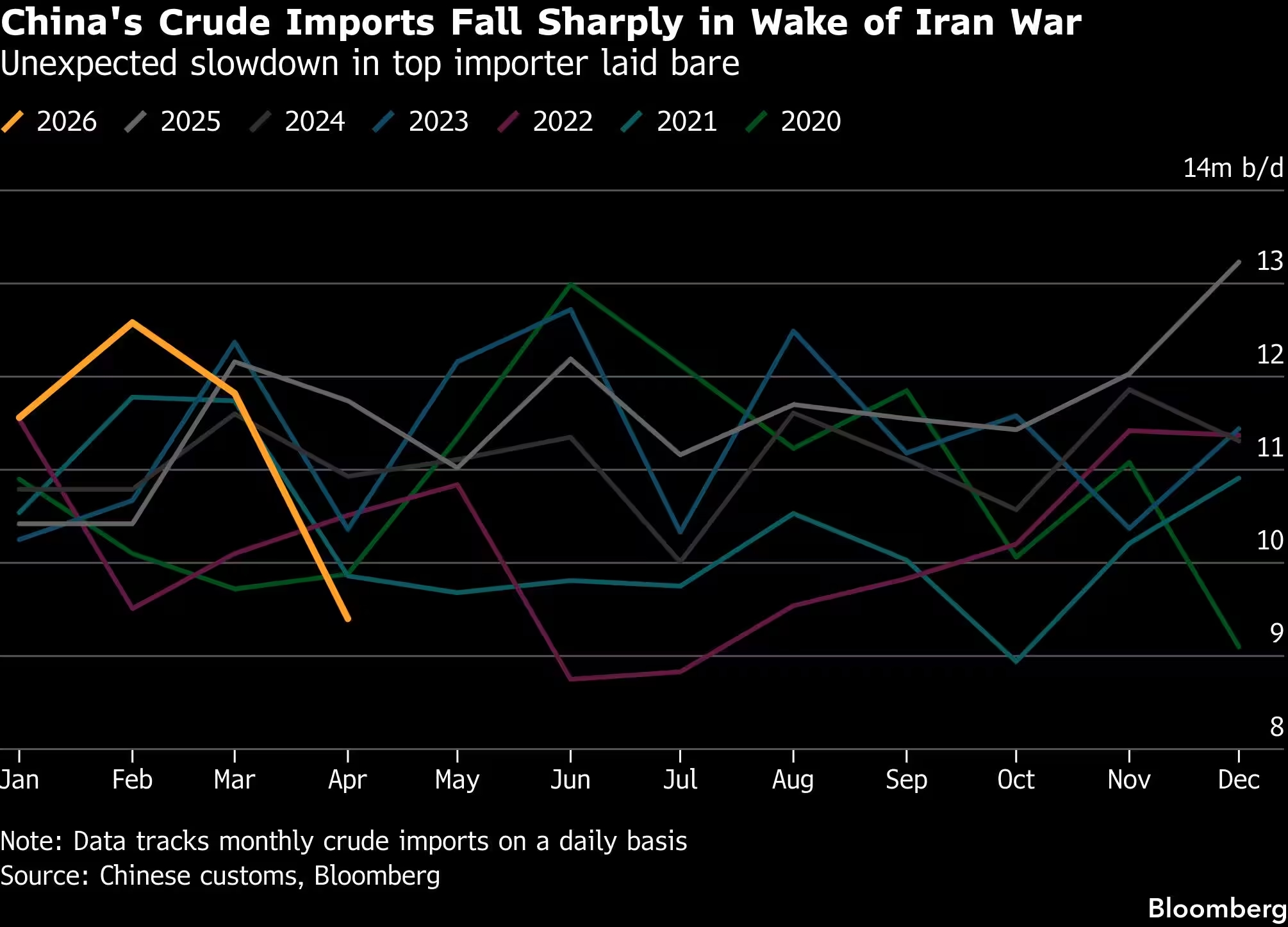
China has emerged as the biggest surprise in the market. Bloomberg, citing data posted by Vortexa Ltd, reported that the world’s largest crude importer cut inbound shipments by nearly 40% in May compared with last year’s average.
That reduction was enough to offset between one-third and one-fifth of the barrels lost to the war, depending on the estimate used, the Bloomberg report stated.
For India, the development matters because global crude prices feed directly into the country’s import bill, trade deficit and inflation risks. India imports a large share of its crude requirement that makes the country quite exposed to any prolonged disruption in West Asian energy flows.
Stabalisation efforts undertaken by US
The US has also played a stabilising role. Bloomberg reported that American crude and fuel exports in May were more than two million barrels a day higher than last year’s average. This has helped fill part of the gap left by disrupted West Asian supplies.
Emergency stock releases have added another buffer. Bloomberg said the Trump administration pledged to release 172 million barrels from the Strategic Petroleum Reserve as part of a broader effort by advanced economies to ease the supply crunch.
In one week last month, the US stockpile fell by 1.4 million barrels a day, according to the report. Nearly half the barrels released so far have gone to Europe and other overseas markets.
ALSO READWest Asia conflict, rising fuel & El Nino to weaken India’s economy in Q1FY27: Economists
US oil production, supported by the shale boom, has also allowed Washington to use its energy position more aggressively in the crisis.
At the same time, Gulf producers have moved part of their exports through alternate routes. Saudi Arabia has used its East-West pipeline to the Red Sea, while the UAE has moved barrels through Fujairah, outside the Gulf, Bloomberg reported.
Why Hormuz still matters
The current relief does not reduce the strategic importance of Hormuz. The US Energy Information Administration has described the Strait of Hormuz as one of the world’s most important oil chokepoints. In 2024, oil flows through the strait averaged around 20 million barrels a day, equal to about one-fifth of global petroleum liquids consumption.
The US EIA has also said that flows through Hormuz account for more than one-fourth of global seaborne oil trade. Asian markets are the most exposed. China, India, Japan and South Korea are among the top destinations for crude moving through the strait.
This is why the present market calm may be deceptive. If the buffers weaken before normal flows resume, import-dependent economies are likely to face renewed pressure.
India’s Russian crude cushion
During the ongoing West Asia crisis, India also benefited from the US waiver restricting sanctions on Russian oil that made it easier for Indian refiners to increase purchases.
Russian crude flows to India averaged about 1.76 million barrels a day in May, 63% higher than in February, according to Bloomberg. This has helped Indian refiners at a time when Middle Eastern supplies remain disrupted.
But the relief depends on policy waivers, shipping availability, discounts and payment channels. It is not the same as a permanent solution to India’s crude import vulnerability.
ALSO READIsrael-US ‘in sync’ on Iran war, says Israeli envoy to India; Trump sees weekend deal possible
During instability in the wider middle western region, India took great strides in diversifying its import basket. Where India imported necessary commodities from a wide stream of countries including Iran
India has already felt the pressure from higher oil prices with petrol prices rising four times in the past few weeks. The pressure of higher global crude prices has also impacted India’s consumer facing businesses as the FMCG industry stares at higher logistics and travel based costs.
Decoding the China factor that helped keep prices below $200
For now, weak Chinese demand has been one of the biggest reasons prices have not moved higher. Bloomberg reported that China’s refinery throughput in May and June is estimated at around 13 million barrels a day, citing Kpler and Energy Aspects Ltd. That compares with an average of 14.8 million barrels a day last year.
The slowdown has been linked to multiple factors. As per Bloomberg, China has stopped adding aggressively to its strategic crude stockpile.
Analysts interviewed by Reuters also pointed to China’s shift towards coal-based feedstock for chemicals and the rise of electric vehicles, which is curbing gasoline demand.
While these workarounds and larger reductions have helped offset crude prices from surging to more dangerous levels so far, market experts interviewed by Bloomberg project that if China returns to pre-war crude buying levels while Hormuz remains disrupted, oil prices could move higher again.
Inventories are thinning
The bigger warning from reports filed by Reuters and Bloomberg appear to be the alarming rate at which strategic reserves, and oil stockpiles have fallen across the globe. US oil inventories have fallen to the lowest level in more than two decades, while stockpiles at Cushing, Oklahoma, are nearing operational lows, the report said.
Pimco’s Greg Sharenow told Bloomberg that the system is tightening by 70 million to 80 million barrels every week. That means the current support from inventories and reserve releases cannot continue indefinitely.
The International Energy Agency has also warned that inventories have been used to soften the immediate impact of supply disruptions. But if inventories keep falling, the ability of consuming nations to absorb fresh shocks will weaken.
What it means for India
For India, the immediate relief is that oil has not moved to the extreme levels feared by markets. This gives policymakers some breathing space on inflation, fuel pricing and the current account.
Former Planning Commission deputy chairman Montek Singh Ahluwalia has warned that India should work with the assumption that oil prices may remain above $100 a barrel for the next few months if the West Asia crisis drags on.
His argument is important because it shifts the policy question from a short-term price spike to a longer period of elevated oil prices. Finance minister Nirmala Sitharaman has framed the pressure through the “three Fs” — fuel, fertiliser and forex.
Fuel is the most direct channel, as higher crude prices raise India’s import bill and complicate fuel pricing. Fertiliser is the second pressure point, since higher global energy and input costs can raise subsidy risks and farm-sector costs. Forex is the third, because higher oil and gold imports can widen external-sector pressure and weigh on the rupee.
The present market balance is being held together by weaker Chinese demand, higher US exports, emergency reserves, Russian crude flows and alternate Gulf routes However as noted by analysts at Bloomberg, these are cushions, not permanent fixes.
If Chinese demand returns, US export capacity tightens, reserve releases slow, or Hormuz flows remain restricted for longer, the oil market could again move into a sharper price-risk phase. For India, that would mean a renewed test of energy security at a time when crude remains central to inflation, trade and growth.
TOPICSBrent crudeCrude pricesDonald TrumpECONOMYFMCGRussian OilStrait of HormuzUS Israel Iran War + 0 MoreThis article was first uploaded on June six, twenty twenty-six, at forty-one minutes past ten in the night. © IE Online Media Services (P) Ltd