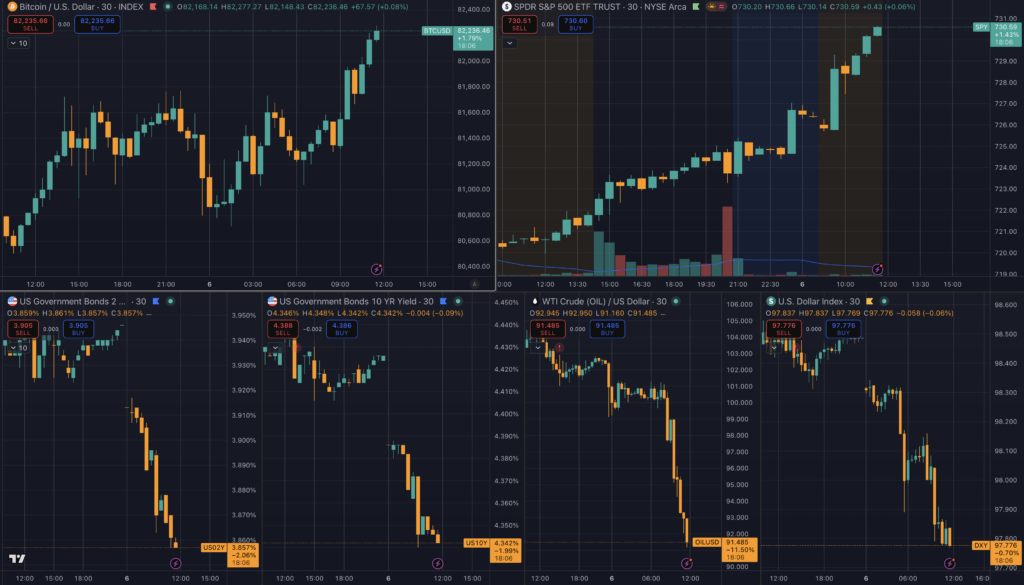
On May 6, Bitcoin is trading above $82,000 amidst fluctuating oil prices, Treasury yields, the dollar’s performance, and US stock movements. This volatility has left investors feeling fatigued after recent months of market upheaval.
This price movement reignites the ongoing debate about Bitcoin as an inflation hedge while leaving many questions unanswered. It also challenges the narrative that $BTC has definitively decoupled from traditional equities.
Currently, the low-$80,000 range serves as a critical indicator for determining whether $BTC is gaining traction due to macroeconomic volatility or if buyers are merely engaging in another bear-market rebound.
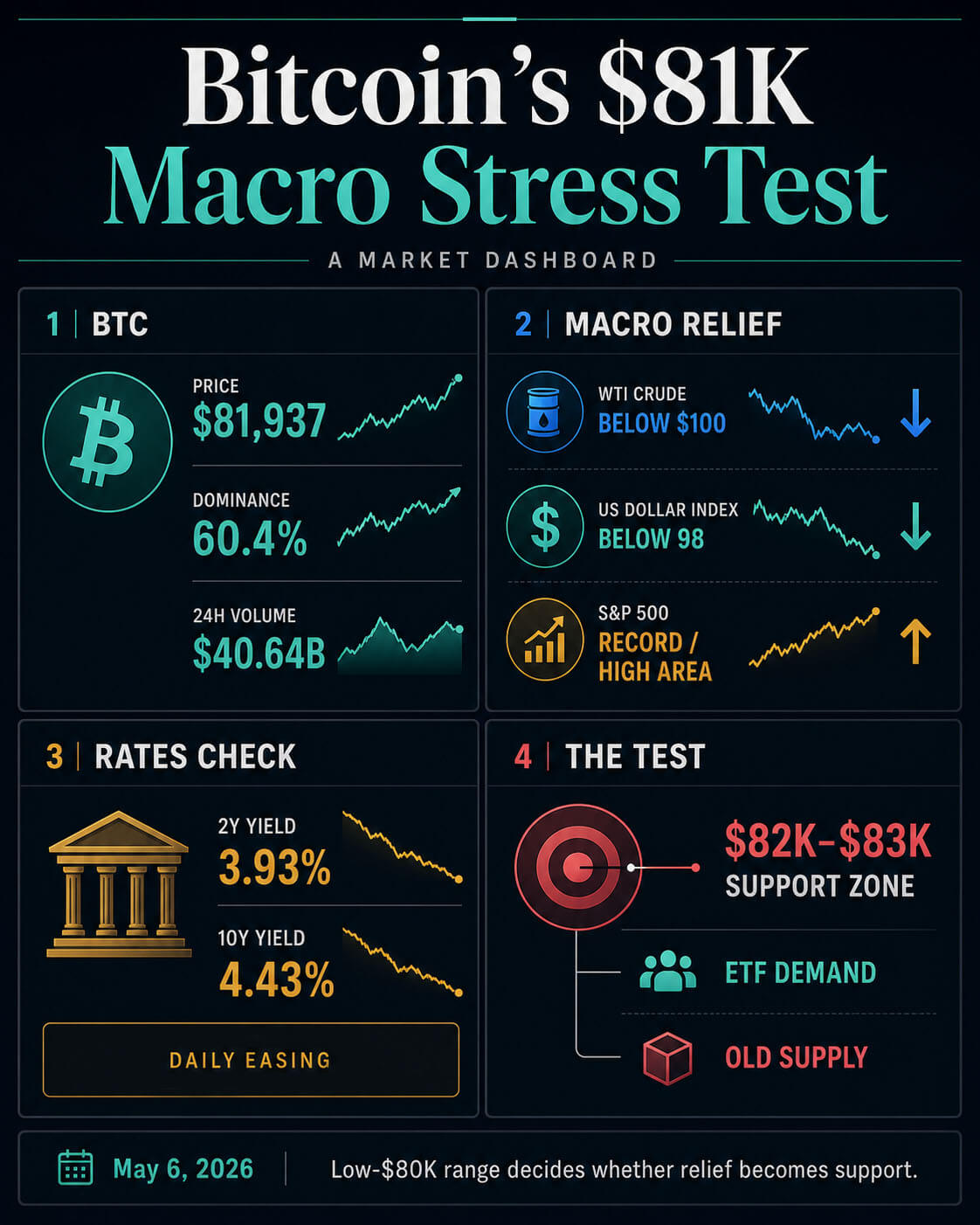
The market setup appears unusually tight. As reported by CryptoSlate, Bitcoin’s price hovers around $82,000 with a dominance rate of approximately 60.4% and a trading volume exceeding $40 billion over the past 24 hours.
Simultaneously, WTI crude oil prices have dipped below $100; the US Dollar Index stands under 98; official Treasury data indicates easing yields for both two-year and ten-year bonds; and the S&P 500 index approaches record highs.
This creates a dual interpretation of market conditions. On one hand, Bitcoin may be attracting conditional demand from investors seeking liquid hedges against geopolitical instability and policy uncertainty.
Conversely, it could be navigating various phases within risk cycles influenced by ETF demand fluctuations alongside technology sector enthusiasm driven by Asia’s markets—along with varying impacts from oil news and dollar weakness at different intervals.
The relationship between Bitcoin prices and macroeconomic indicators on May 6
The Macro Relief Trade Signals Various Messages
The macroeconomic landscape has improved rapidly again; however each element conveys distinct implications. Crude oil falling below $100 alleviates immediate inflationary pressures stemming from earlier spikes in oil prices. A weaker dollar makes holding dollar-denominated risk assets more manageable.
The S&P 500’s surge into record territory suggests that traditional risk appetite remains robust outside cryptocurrency markets. Meanwhile daily Treasury data reflects only minor easing in two-year and ten-year bond yields despite sharper intraday movements observed on charts.
This distinction is crucial because if bond-market shifts are overstated—a notion prevalent across social media—the argument supporting Bitcoin’s independence weakens significantly.
A previous analysis by CryptoSlate suggested this could indicate a potential breakaway from SPY (S&P ETF), but also cautioned that such divergence might mirror differing lead markets or trading sessions instead of true separation between asset classes.
Signal
Suggestion
Caveat
$BTC
Buyers defending low-$80k area
$82k-$83k must establish support
WTI below $100 & DXY under ’98’
Macro pressure on risk assets eases
Headline-sensitive move can reverse quickly
S&P near record/highs area <
Active risk appetite beyond crypto
<td complicates clear equity-decoupling claim
ETF inflows & profit-taking
<td New demand meets old supply
<td Rally needs continued absorption above '$80K'
Signal
Signal:
What it Suggests:
Caveat:
–>
&nbs;
&nbs;
nbsp;
The table illustrates why this current movement should be interpreted more as a stress test rather than an outright declaration of strength. $ BTC$ BTC$ B T C$ B T C$ B T C$ B T C’$ B TC’
‘strong enough to compel fresh evaluations but every bullish indicator carries its own caveats.’
‘ETF inflows provide momentum yet long-term holders may capitalize on higher pricing to distribute their holdings.’
‘Although some positive trends emerge within blockchain metrics recent frameworks still suggest further proof is needed regarding demand strength.’
” />
The Role Of ETF Demand In Driving Market Momentum”
“The bullish narrative begins with absorption.” Long-term holders have been distributing their assets during periods of strength while spot-based ETFs attracted over “$1 .1 billion during May’s initial two trading days,” according to CryptoSlate.
This metric holds greater significance than just headline price fluctuations since when new interest continuously absorbs older supply levels—Bitcoin can effectively push through resistance barriers.
Such interests might arise even amid softening blockchain metrics.” Currently prevailing setups enable coexistence between weak-demand frameworks alongside rising values longer than typical scenarios dominated solely via native crypto exchange flows.”
Traders are closely monitoring levels surpassing “$81 ,000″. The marketplace has treated lower ranges ($80 ,000) simultaneously serving recovery lines along seller tests.
A breakout beyond these thresholds indicates sustained interest whereas consistent retention exceeding”$82 ,000-83 ,00 would convey something even stronger indicating buyers transforming prior resistances into bases rather than merely reacting passively towards favorable macro developments.”
Furthermore,”the ETF channel refines institutional narratives significantly.” While it’s tempting to characterize these movements broadly indicative returning institutional demands strongest evidence points specifically towards heightened activity surrounding ETFs.
Inflow patterns exhibit potential potency yet remain tactical—they could diminish swiftly should overarching macros shift unexpectedly leading volatility increases occur stalling around levels where long-term stakeholders become inclined toward selling off portions held previously acquired investments.”
This necessitates flow persistence becoming pivotal input factors influencing future trajectories ahead moving forward post-initial relief bids fading away altogether!
If sustained purchasing persists against sellers supplying positions maintained over threshold amounts nearing eighty thousand dollars range then potentially paving pathways establishing firm foundations overall trajectory aligning upward momentum! Conversely cooling flows combined continued distributions suggest same level reverting ceilings once again hindering progress achieved thus far!
### Why The Bull-Trap Question Remains Relevant”
One compelling argument cautioning against pursuing upward moves lies within discrepancies arising faster improvements relative underlying demand signals exhibited throughout timeframe observed recently analyzed closely via CryptoSlates’ earlier bear-market framework which indicated weaknesses across various areas including liquidity constraints existing pressures stemming averages needing reclamation before labeling any transitions durable turns occurring presently witnessed unfolding dynamics shifting gradually evolving continuously altering landscapes surrounding investment opportunities emerging today!
**Q1:** What factors influence Bitcoin’s current price?
**A:** Several elements contribute to Bitcoin’s pricing dynamics including geopolitical events affecting investor sentiment along with broader economic indicators like inflation rates treasury yields currency valuations stock performances.
—
**Q2:** How does ETF demand affect cryptocurrency markets?