Peter Schiff has once again captured attention with his trademark sarcastic take on Bitcoin, this time targeting the so-called “mathematical” basis of the cryptocurrency. Responding to a widely shared post that lauded Bitcoin as a rules-driven monetary system—contrasting it with gold’s physical nature and fiat currency’s political influences—the financial commentator expressed an unusual moment of agreement before bluntly declaring, “Bitcoin is worthless.”
Schiff’s Persistent Skepticism: Downplaying Bitcoin After January CPI Data
Schiff’s recent comments surfaced just an hour prior to the release of critical U.S. economic data for the month. On February 13th, the U.S. Bureau of Labor Statistics announced that headline Consumer Price Index (CPI) for January rose by 0.2% month-over-month, falling short of analysts’ expectations at 0.3%. Meanwhile, core CPI matched forecasts at 0.3%, marking a slight increase from December’s 0.2%, signaling persistent inflationary pressures beneath the surface.
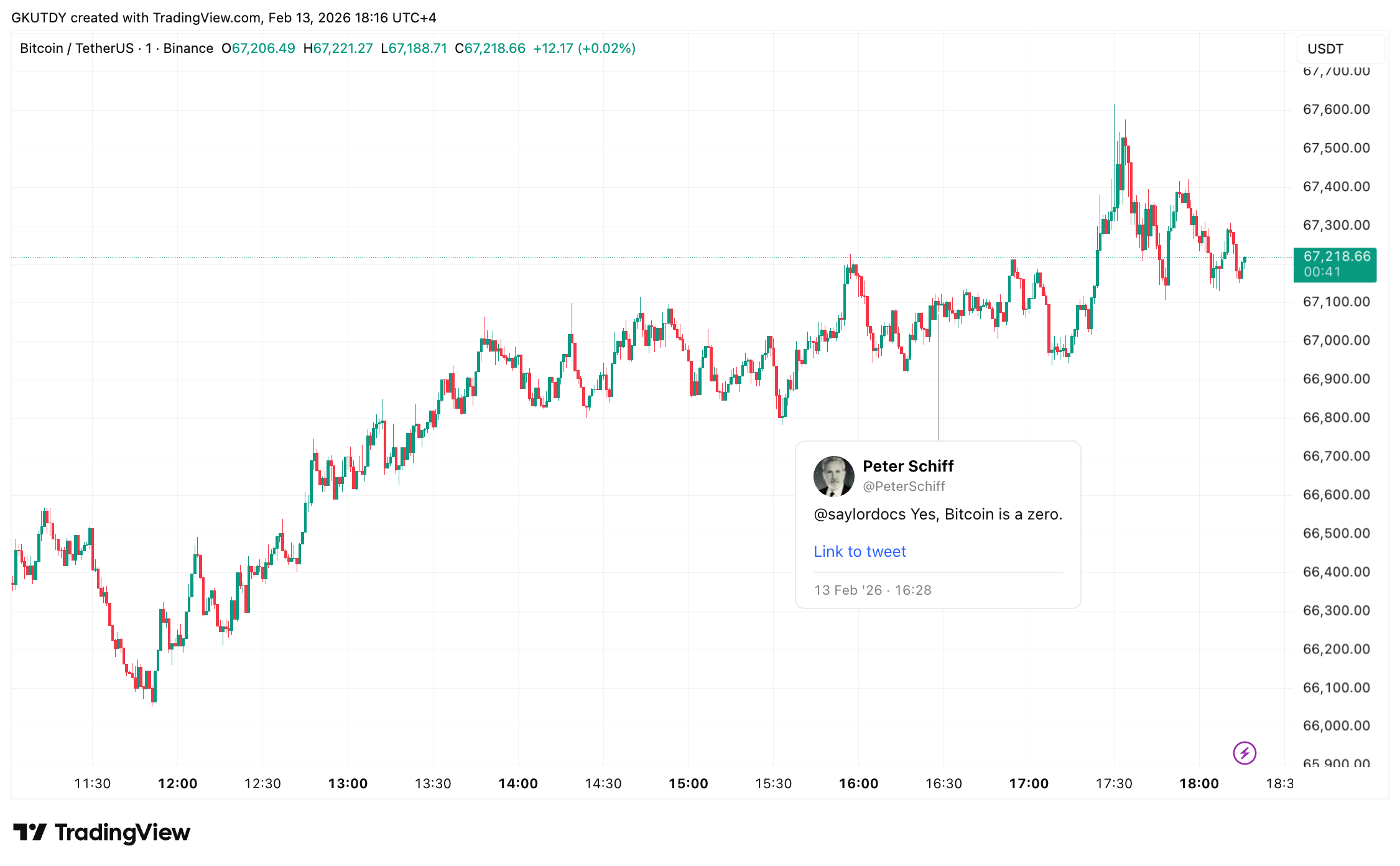
Following this announcement, Bitcoin experienced a brief surge to $67,600 according to Binance charts on TradingView as softer headline inflation boosted market sentiment.
Nonetheless, optimism was quickly tempered by core inflation figures; traders retraced their steps and $BTC settled around $67,360 within minutes on one-minute interval charts—oscillating between $65,300 and $67,600 throughout the day.
For over ten years now Schiff has maintained his stance: Bitcoin lacks intrinsic yield or cash flow and serves no industrial purpose—unlike gold which he champions as a tangible asset backed by real demand.
The staunch supporters of Bitcoin argue back citing its hard-coded limit of 21 million coins along with programmed halving events and monetary policies free from political manipulation—a claim complicated by how U.S policies influenced crypto markets in both 2025 and continue into 2026.
The supply mechanics remain consistent for Bitcoin today at an issuance rate of approximately 3.125 $BTC per mined block.
Yet despite these features—and after halving in value since its October peak in late-2025—Bitcoin struggles to maintain steady capital inflows especially when compared against traditional safe-haven assets like gold.
With all eyes now fixed on the upcoming Federal Open Market Committee meeting scheduled for March 4th,
dollar liquidity continues to dominate market dynamics,
digital assets led by Bitcoin included.
This divide reflects two interpretations: one viewing mathematical protocols as sound fiscal discipline while Schiff sees them merely as hollow symbolism devoid of substance.