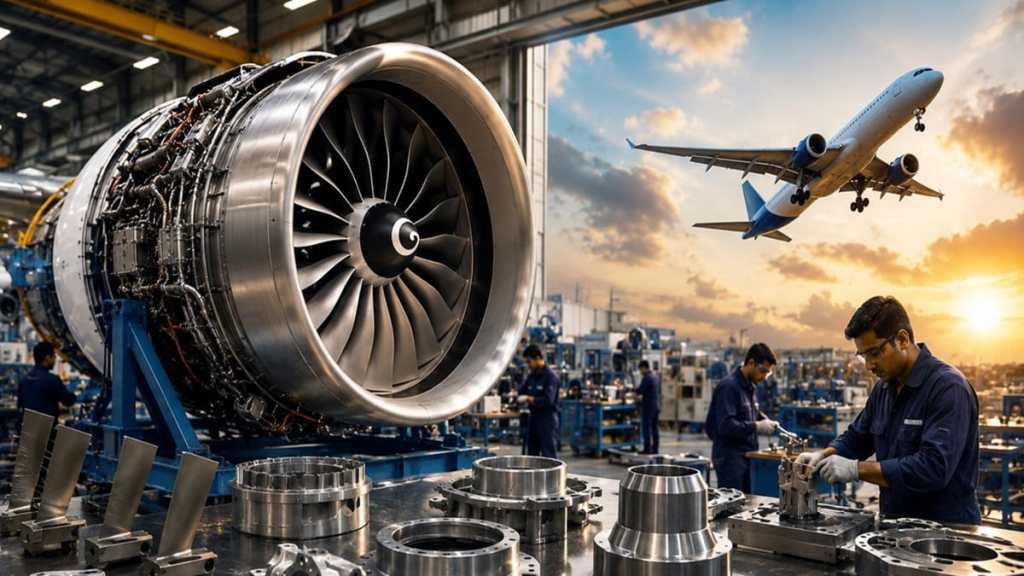
India is emerging as a key alternative manufacturing base of the global aerospace industry, with the country’s share in the global aerospace components market expected to rise sharply over the next three years, according to the brokerage firm Antique Stock Broking.
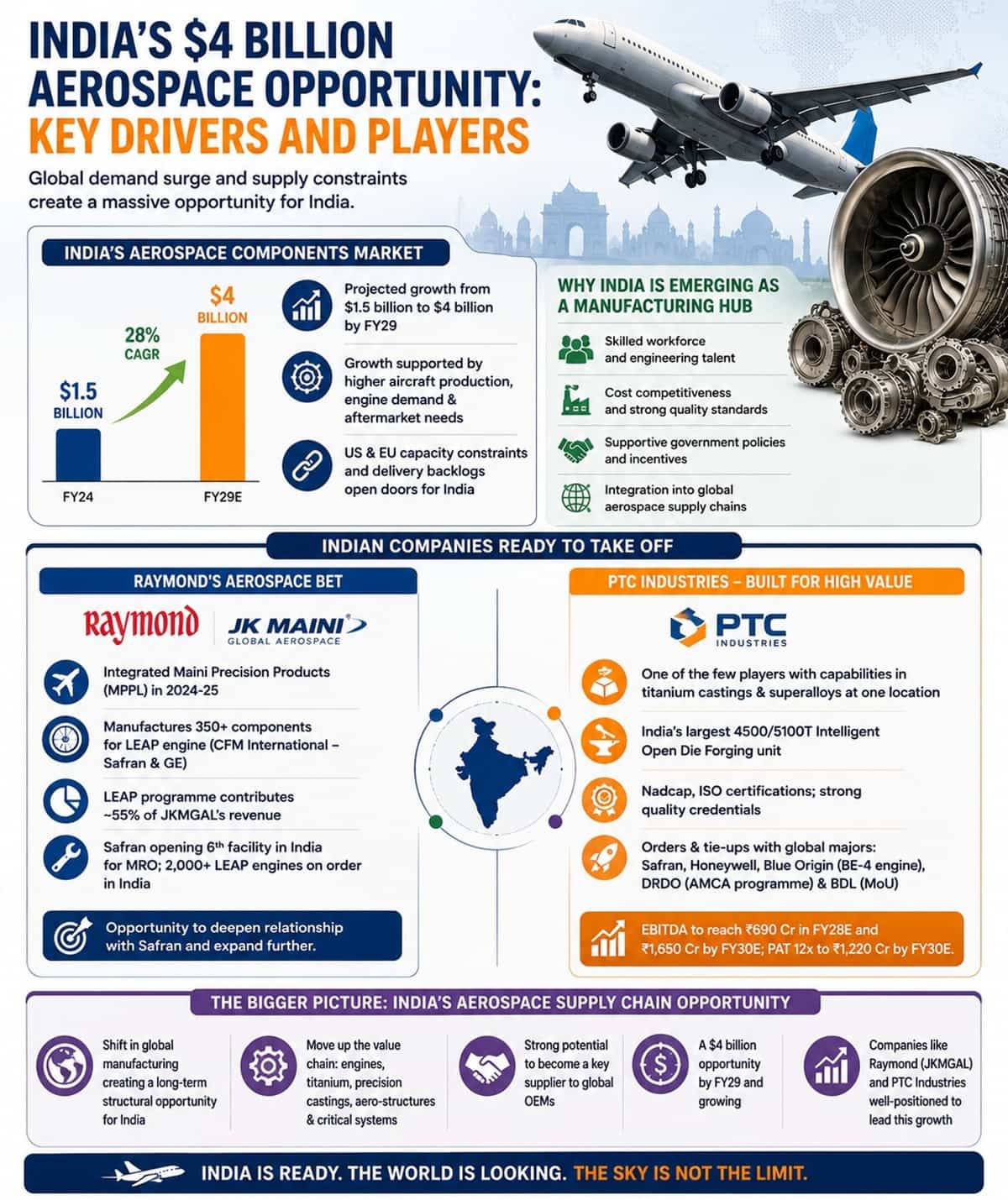
The firm, in its August 2026 report, “India Defence Sector-Ordering to Gain Momentum,” said India’s aerospace components market is expected to grow from $1.5 billion to $4 billion by FY 29, translating into a 28% compound annual growth rate (CAGR).
The opportunity comes as global aircraft production and engine demand rise, while traditional aerospace manufacturing hubs in the US and Europe face capacity constraints and extended delivery backlogs.
Why India is emerging as an aerospace manufacturing hub
According to the brokerage firm, growth in the global aerospace components market is being supported by higher aircraft sales, increasing engine replacement requirements and strong aftermarket demand.
The report, however, noted that traditional manufacturing centres in the US and Europe Union (EU) are struggling to keep pace with demand, resulting in longer order backlogs and delivery cycles. In turn, this is creating an opportunity for Indian manufacturers to become part of global aerospace supply chains and help address capacity constraints.
Raymond’s JK Maini Global Aerospace and PTC Industries, which are expanding their capabilities across precision components, titanium castings, superalloys and other critical aerospace applications.
ALSO READThree orders, Rs 1.53 lakh crore: Submarine, missile and corvette deals could reshape India’s defence order pipeline
Raymond’s aerospace bet
Raymond’s aerospace opportunity has been strengthened through its integration of Maini Precision Products (MPPL), completed in 2024-25.
The report said the transaction strengthened Raymond’s presence across aerospace, defence, electric vehicles and automotive components, with MPPL bringing an established precision manufacturing business supplying companies such as Safran, GE and Bosch.
Raymond is now separating the businesses into two focused entities-JK Maini Global Aerospace Ltd (JKMGAL) for aerospace and defence, and JK Maini Precision Technologies Ltd for automotive components and engineering consumables.
JKMGAL has a significant presence in the commercial aircraft engine supply chain. The company manufactures more than 350 components for the LEAP engine, produced by CFM International, the joint venture between Safran and GE.
According to the brokerage, the LEAP programme currently contributes an estimated 55% of JKMGAL’s revenue.
The opportunity could expand further as Safran Aircraft Engines increases its presence in India. The report said Safran is opening its sixth site in India for maintenance, repair and overhaul (MRO) work.
India is also described as CFM’s third-largest market, while LEAP engines power around 75% of India’s commercial airline fleet. More than 2,000 LEAP engines are reportedly on order, creating a sizeable potential market for India component suppliers.
Against this, the firm said it sees an opportunity for JKMGAL to build further on its relationship with Safran.
PTC Industries targets high-value aerospace components
While Raymond’s opportunity is closely linked to the commercial aircraft and LEAP engine ecosystem, PTC Industries is building capabilities in more specialized materials and components. The brokerage described PTC as one of the few companies capable of manufacturing titanium castings and superalloys at a single location.
The company has commissioned facilities covering titanium melting, casting, forging, rolling and aerofoils. It has also commissioned what the report described as India’s largest forging system, a 4500/5100T Intelligent Open Die Forging unit at its SMTC facility in Lucknow.
PTC’s aerospace credentials have also been strengthened through certifications and accreditations, including Nadcap NDT reaccreditation with Merit, Nadcap Heat Treating (HIP) with Merit and ISO 14001/45001 certifications for its Mehsana facility.
Global aerospace programmes open up opportunities
PTC has also begun building relationships with major international aerospace companies. According to the brokerage firm, PTC-Aeroalloy is participating in the development and supply programme for Blue Origin’s BE-4 engine.
The company has also entered into a long-term supply agreement with Honeywell Aerospace Technologies for titanium and superalloy precision investment castings. In addition, PTC has secured an order from Safran Aircraft Engines for cast components for the LEAP-1A and LEAP-1B engines.
The company has separately received an order for critical titanium castings worth approximately Rs 110 crore, which is scheduled to be executed over 24 months.
PTC has also signed an MoU with Bharat Dynamics Ltd (BDL) for a proposed joint venture covering propulsion systems, guided bombs and aero-engines, subject to the required approvals. Another development highlighted by the report is PTC’s receipt of a Letter of Technical Acceptance (LoTA) from CEMILAC under DRDO for an indigenous titanium rear fin root casting for the Advanced Medium Combat Aircraft (AMCA) programme.
ALSO READInside IAF’s Rs 7.07 lakh crore wishlist, and the one aerospace giant poised to cash in
PTC’s earnings could accelerate
The expansion of PTC’s manufacturing capabilities and its growing order pipeline are also expected to translate into significant financial growth.
The brokerage firm projects PTC’s EBITDA to rise from its current levels to Rs 690 crore in FY 28E and Rs 1,650 crore by FY30E.
Its net profit is projected to increase 12-fold, from Rs 100 crore in FY26 to Rs 1,220 crore by FY30E, according to the firm.
The report expects PTC to enter a phase of accelerated growth as its recently commissioned facilities ramp up and its existing order pipeline begins converting into revenue.
India’s aerospace supply-chain opportunity
The broader opportunity extends beyond individual companies. With global aerospace manufacturers facing capacity constraints and growing demand for aircraft, engines and aftermarket services, India could increasingly become an important supplier of components to global OEMs.
For Indian manufacturers, the shift represents an opportunity to move beyond lower-value manufacturing and establish capabilities in engines, titanium components, precision castings, aero-structures and other high-value aerospace systems.
(This article discusses specific listed companies (Raymond and PTC Industries), citing third-party market projections, and revenue estimates from Antique Stock Broking. While the coverage highlights broader industry trends in India’s aerospace sector, the explicit analyst ratings and price targets carry financial risk implications for retail investors. Readers should treat these brokerage projections as informational commentary rather than direct personal financial advice, and are strongly encouraged to evaluate their individual risk tolerance and consult a SEBI-registered investment advisor before making investment decisions.)
TOPICSAerospaceDRDOEuropean UnionThis article was first uploaded on August sixteen, twenty twenty-six, at ten minutes past six in the evening. © IE Online Media Services (P) Ltd