The Pentagon has submitted a proposal to the White House seeking an additional $200 billion for military operations in Iran, a sum that translates to nearly 3 million Bitcoin based on current market valuations.
With Bitcoin priced at approximately $68,600, this funding request equates to about 2,915,451 $BTC.
This comparison does not imply that the government is utilizing cryptocurrency or considering Bitcoin as a means of financing military expenditures. Rather, it serves as a method of contextualizing a substantial federal expenditure in terms that investors can relate to when assessing some of the most scrutinized assets globally.
By framing it this way, the request transcends typical budgetary jargon used in Washington and enters into figures that are more comprehensible within market contexts. This proposal comes ahead of any formal presentation to Congress and is already encountering pushback from legislators across party lines.
A Visual Representation of Nearly 3 Million Bitcoin
The most straightforward approach to grasping the magnitude of this request is by comparing it with existing significant Bitcoin holdings.
To begin with, consider the US government’s own stake. According to data from BitcoinTreasuries, entities linked with the US government possess 328,372 $BTC. Therefore, at current prices, a $200 billion war funding demand would represent roughly 2.82 million $BTC, which is about eight times their holdings.
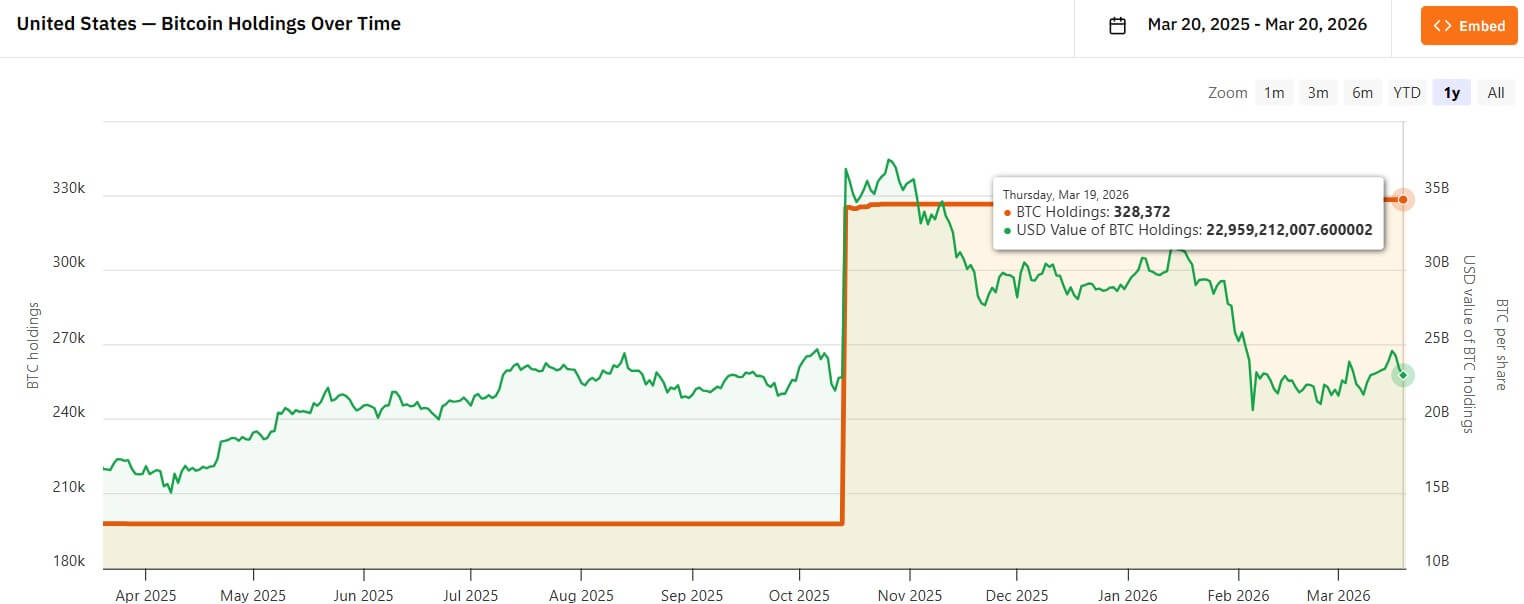
This disparity continues when we look at major corporate and institutional holders within the market.
Strategy holds title as the largest public corporate holder of Bitcoin with approximately 761,068 $BTC. Meanwhile, BlackRock’s iShares Bitcoin Trust (IBIT), recognized as the biggest Bitcoin fund available publicly based on its March share count and basket data held around 785629 $BTC. Additionally,Satoshi Nakamoto—the anonymous creator behind blockchain—is estimated to possess around 1.096 million $BTC.
In these terms alone,the war funding proposal would amount to approximately three times Strategy’s reserves ,nearly three times IBIT’s total holdings,and over two-and-a-half times Satoshi’s presumed collection .
The scale remains impressive even when compared against broader institutional ownership metrics.
The ten US spot ETFs for bitcoin—including IBIT—collectively hold about 1.52 million $ BTC ,indicating that even then,the proposed budget would still equal roughly one point eight six times their total .BitcoinTreasuries also tracks top hundred public companies holding bitcoin treasury assets which add up collectively around one hundred seventy-six thousand six hundred fifteen$ BTC ,which implies this proposition exceeds all those firms combined by almost two point four times .
The comparison extends further; Binance—the leading crypto exchange globally by trading volume—holds significantly less than what this request suggests.
In its proof-of-reserves update released last March,Binance reported possessing over six hundred thirty-nine thousand$ BTC backing user balances.This places their figure at roughly four point four times less than what was requested.
When juxtaposed against remaining issuance levels for bitcoin,the number appears even larger.
Blockchain.com indicates there are currently twenty million three thousand forty-three$ BTC circulating while leaving nine hundred ninety-six thousand nine hundred fifty-seven left yet unmined before reaching maximum supply limit set at twenty-one million coins.Based on current values,this proposed war budget corresponds closely approximating two point eighty-three multiples compared against all bitcoins still available for mining.
Analyzing Why Dollar Figures Are More Manageable Than Those In Bitcoins
This discrepancy highlights fundamental differences between fiat currency systems versus limited digital assets like cryptocurrencies such as bitcoin.
Sizable wartime financial requests can be made using dollars since United States operates under monetary frameworks built upon expanding debt issuance alongside increased supply rates.Politicians may authorize spending financed through Treasury borrowing without needing prior accumulation fixed amounts scarce units.Treasury statistics reveal overall federal debt has surpassed thirty-nine trillion dollars showcasing how expenditures like these get absorbed via deficits coupled together bond issuances.
Conversely,because maximum availability regarding bitcoins exists only codedly capped towards twenty-one millions,new coins become accessible strictly through mining processes requiring time along energy inputted hardware/block-by-block releases.
This reality renders acquiring large quantities difficult compared traditional fiat liabilities generated via sovereign borrowings.
Phrased differently:US authorities may pursue another two-hundred-billion-dollar allocation since dollar-based systems permit ongoing balance sheet expansions via debts; however they cannot replicate similar actions concerning btc given no governing body could create millions fresh new units instantly into existence.