This week, Google released a research paper outlining how a quantum computer could theoretically extract a bitcoin private key in just 9 minutes. The implications of this discovery extend beyond Bitcoin to Ethereum, various other cryptocurrencies, private banking systems, and potentially the entire financial landscape.
Quantum computing is often misinterpreted as merely an accelerated version of traditional computing. However, it represents an entirely different class of machines that operate on principles distinct from conventional computers at the atomic level.
A quantum computer begins with an extremely cold and minuscule metal loop where particles behave in ways that defy our usual understanding of physics under normal Earth conditions.
Grasping what this entails physically is crucial for comprehending the quantum threat rather than just reading about it.
The Mechanics Behind Classical and Quantum Computers
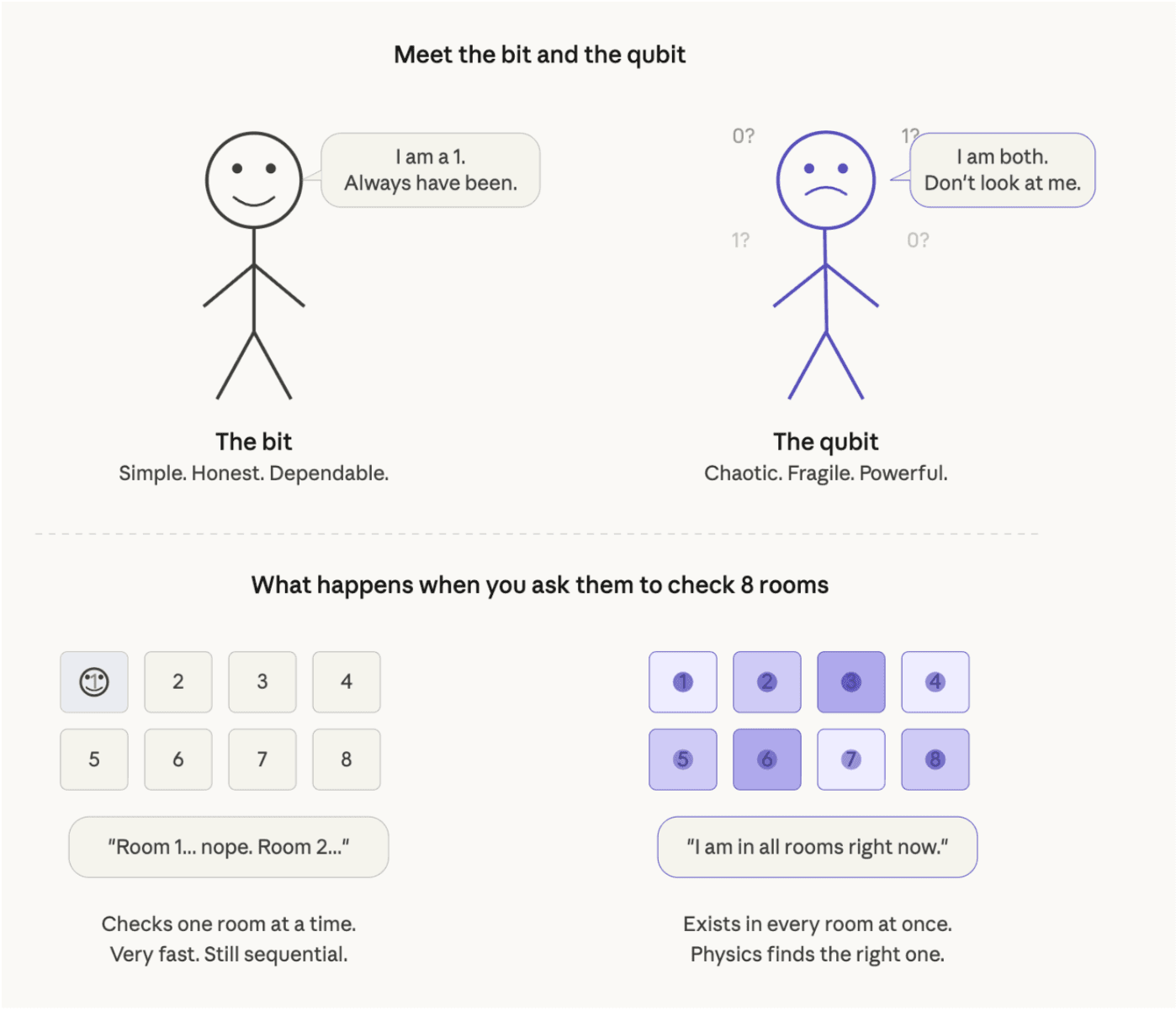
Traditional computers encode information using bits—each bit being either a 0 or a 1. A bit functions like a tiny switch; physically represented by transistors on chips that either allow electricity to flow (1) or block it (0).
Every image, every bitcoin transaction, every character you’ve ever typed is stored as patterns formed by these switches toggling between on and off states. There’s nothing enigmatic about bits; they are tangible entities existing in one of two definite states.
All calculations involve rapidly rearranging these 0s and 1s. Modern chips can perform billions of such operations per second but still process them sequentially—one at a time.
In contrast, quantum computers utilize qubits instead of bits. A qubit can represent not only 0 or 1 but also both simultaneously!
This dual-state capability arises because qubits are fundamentally different physical objects. The most prevalent type used by Google consists of tiny loops made from superconducting metal cooled to approximately 0.015 degrees above absolute zero—colder than outer space yet found here on Earth.
At such low temperatures, electricity flows through the loop without resistance; thus, current exists in what we refer to as a quantum state.
The current within this superconducting loop can flow clockwise (designated as 0) or counterclockwise (designated as 1). However, at the quantum level, it doesn’t have to choose one direction—it flows both ways simultaneously!
Puzzling Physics
If you’re following along so far—excellent! Because things are about to get even more perplexing: the underlying physics isn’t immediately intuitive nor intended to be straightforward.
Everything we encounter daily adheres strictly to classical physics principles which assume objects occupy one location at any given moment. Yet particles behave differently when examined at subatomic scales.
An electron lacks a defined position until observed; similarly for photons regarding polarization until measured—and likewise for currents flowing within superconductive loops—they don’t take specific paths unless compelled otherwise!
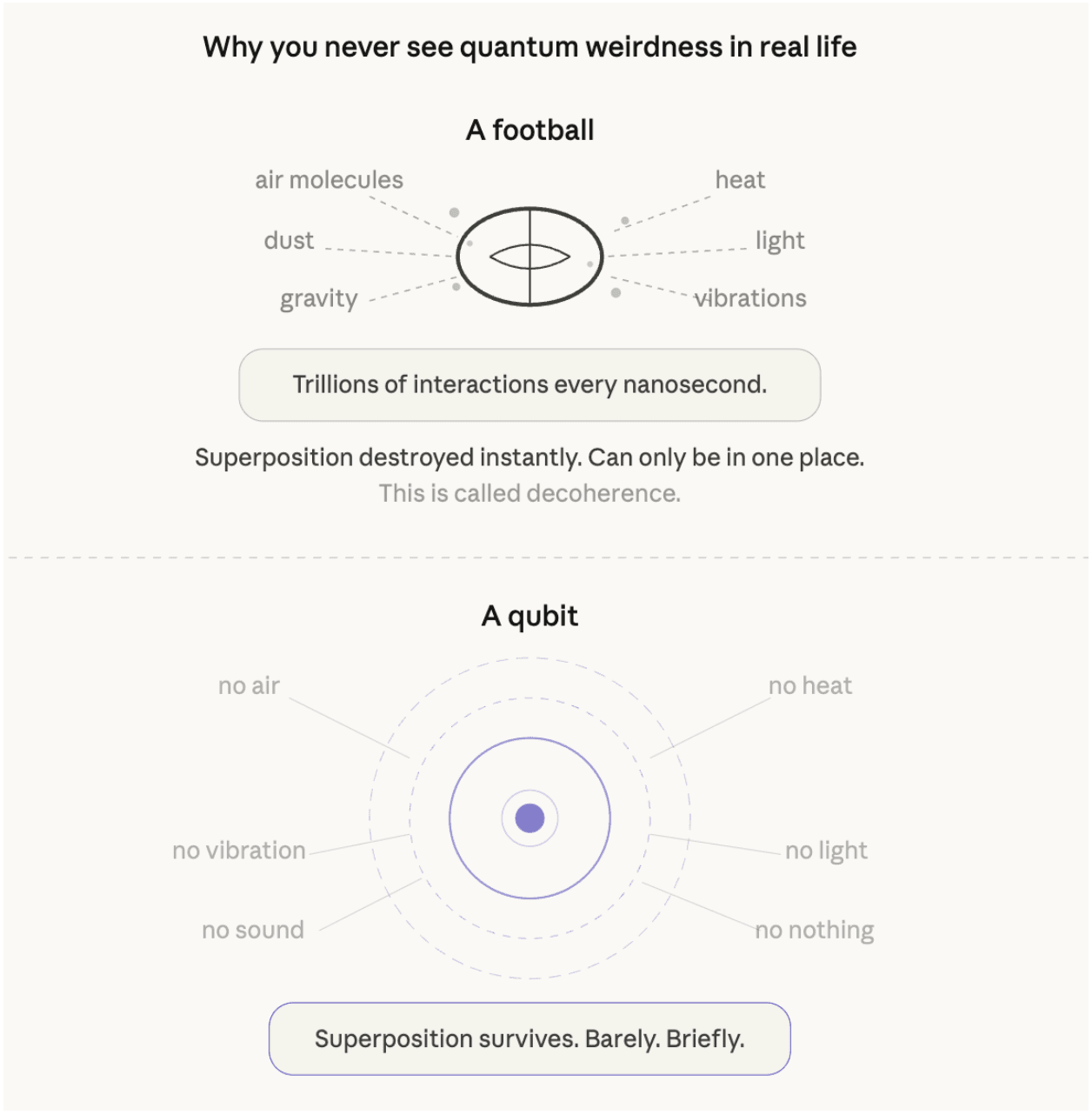
This discrepancy between everyday experiences and particle behavior stems from decoherence: when any quantum system interacts with its environment—including air molecules heat vibrations light—the superposition collapses almost instantaneously.
A football cannot occupy two locations concurrently due its constant interaction with countless air molecules dust sound heat gravity etc., each nanosecond! But if you isolate minuscule currents within near-absolute-zero vacuums shielded against disturbances—their unique behaviors persist long enough for computations.
This complexity explains why constructing reliable quantum computers poses significant challenges engineers must create environments where typical physical laws preventing these phenomena remain suppressed long enough complete calculations successfully!
The machinery developed by Google operates inside dilution refrigerators comparable in size huge rooms colder than anything found naturally surrounding layers shielding electromagnetic noise vibrations thermal radiation!
Additionally even then those fragile qubits constantly lose their delicate states prompting discussions around error correction dominate conversations scaling up efforts!
Certainly therefore true essence lies not faster versions classical computing rather exploiting entirely different sets physical laws applicable solely extreme small scales low temperatures short timeframes
Laying out comparisons further reveals insights:
Together two regular bits yield four possible combinations(00 ,01 ,10 ,11 )but only one state active since currents direct solely unidirectionally .Conversely however employing dual-qubit configurations enables representation all four outcomes concurrently enabling simultaneous directional flows
Add three additional q-bits expands potential eight distinct outcomes while ten equates astonishing possibilities exceeding thousand twenty-four ! Fifty opens door over quadrillion pathways doubling exponentially added units hence illustrates immense scalability potential inherent therein !
The second aspect involves entanglement phenomenon whereby pairs become linked measuring results instantaneously conveys information regardless distance separating them allowing coordinated processing across vast simultaneous configurations unattainable via traditional parallel computations .
Moreover structured designs ensure incorrect answers cancel out overlapping waves flatten while correct ones reinforce stacking higher ultimately leading highest probability accurate measurement conclusion once computation completes !
Thus speed alone doesn’t dictate effectiveness ;it embodies fundamentally novel approaches toward calculation facilitating nature’s exploration vast spaces possibility collapsing down right answer utilizing principles grounded reality instead logic alone .
A Significant Threat To Cryptography
This perplexity underscores alarming ramifications encryption security systems relying mathematical foundations safeguarding digital currencies like bitcoin assumes checking exhaustive keys would exceed universe’s lifespan itself .
However unlike classical methods reliant upon exhaustive searches here emerges new paradigm wherein single entity explores myriad options collectively leveraging interference revealing optimal selections among alternatives available !
Connecting dots brings us back Bitcoin journey : traversing path public-key private takes mere milliseconds conversely reverse route demands million years traditional setups surpass age universe itself asymmetry stands testament proving ownership assets held securely !

Employing algorithm known Shor’s enables bypass through trapdoor reversing processes demonstrating capabilities previously underestimated significantly reducing resource requirements timelines racing ahead confirming blocks generated currency transactions efficiently mitigating risks posed threats arising advances technology landscape shifting paradigms forward continuously evolving cryptographic measures combating vulnerabilities exposed !