
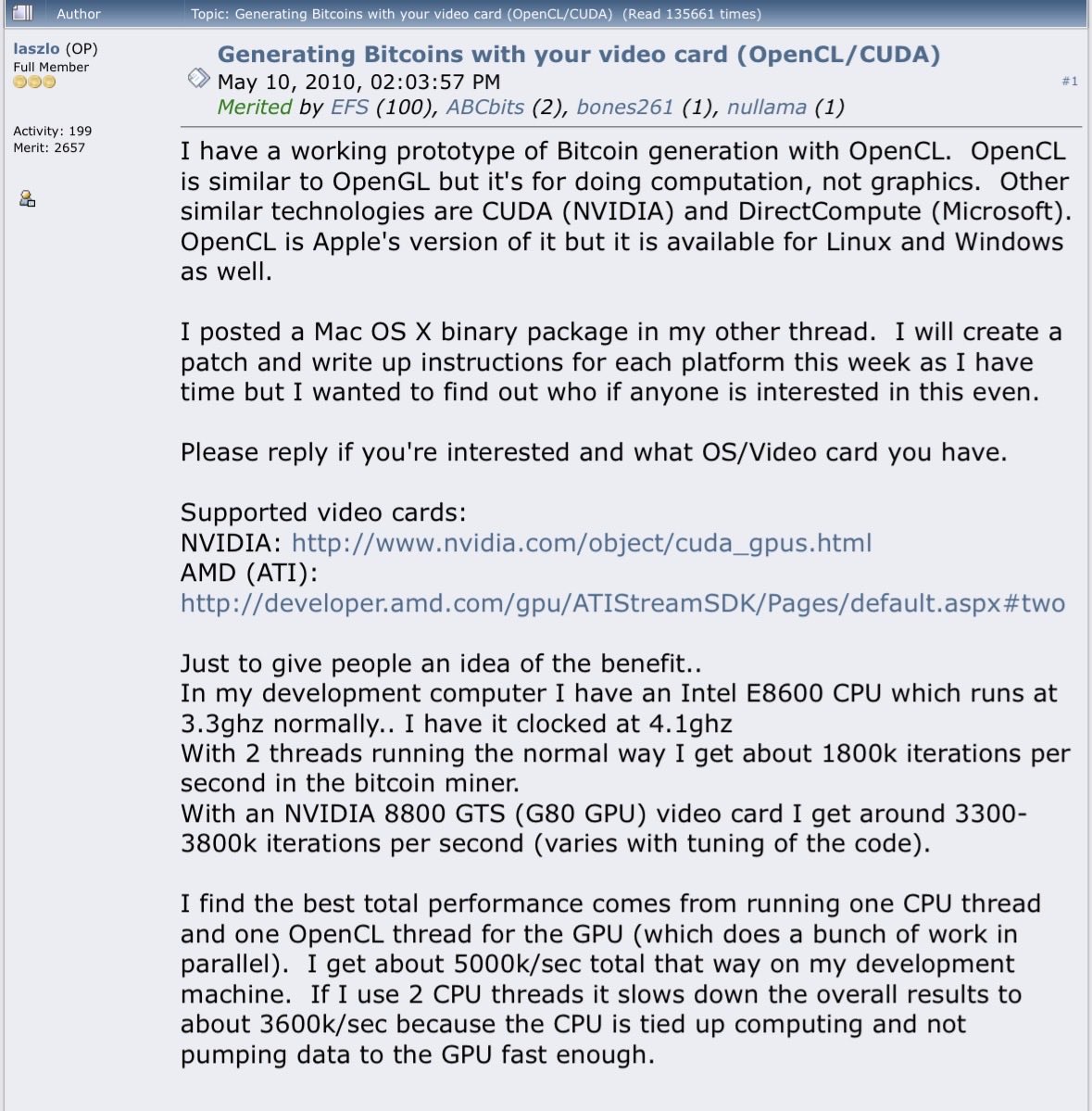
On May 10, 2010, developer Laszlo Hanyecz shared a groundbreaking post on the Bitcointalk forum detailing how to mine Bitcoin using an NVIDIA 8800 GTS graphics card instead of relying solely on a CPU. This date marks the 16th anniversary of that pivotal moment which significantly boosted the network’s hash rate by an astonishing 130,000% by year’s end.
This historical event is noteworthy not only for its technical implications but also for its philosophical impact on Bitcoin. It marked a significant shift away from Bitcoin’s original “democratic” ethos.
Lazslo Hanyecz is often celebrated in popular culture as the pioneer of GPU mining and famously known for purchasing two pizzas for 10,000 $BTC. However, what frequently goes unnoticed is Satoshi Nakamoto’s response to this innovation.
Satoshi reached out to Lazslo after learning about his success and urged him to temper the promotion of this method. He believed in maintaining Bitcoin as a system governed by “one CPU, one vote,” where anyone with access to a home computer could contribute to the network and earn rewards.
The Concerns Behind Bitcoin’s Major Upgrade
The shift towards graphics cards fundamentally disrupted this balance; average PC users found themselves virtually excluded from block mining opportunities. Mining transitioned from being an ideological support mechanism into what resembled a hardware arms race. This was when $BTC began accumulating wealth among those who could invest in high-end graphics chips.
From a technical standpoint, Lazslo merely optimized code tailored for OpenCL and CUDA architectures. His own findings illustrated just how dramatic this leap was when comparing performance metrics:
- An Intel E8600 processor overclocked at 4.1 GHz yielded only about 1.8 million hashes per second.
- A single NVIDIA 8800 GTS graphics card achieved up to approximately 3.8 million hashes per second.
This combination allowed Hanyecz not only to capture significant portions of network blocks but also enabled him to mine thousands of coins daily using just one machine.
A decade and six years later, it becomes clear that rather than undermining Bitcoin’s integrity, Hanyecz’s innovation actually accelerated its evolution; without embracing GPU mining technology early on, it’s plausible that the network would have struggled against future user surges or potential security threats.
FAQ Section:
- What did Laszlo Hanyecz do?
Laszlo Hanyecz introduced GPU mining techniques through his influential post on Bitcointalk in May 2010 which revolutionized how Bitcoin was mined. - Why did Satoshi Nakamoto oppose GPU mining?
Satoshi viewed it as contrary to his vision of “one CPU one vote,” fearing it would concentrate power among those who could afford advanced hardware while sidelining average users from participating equally in securing the network. - DID GPU Mining change bitcoin?
Yes! The introduction of GPU mining shifted bitcoin from being accessible primarily via CPUs into competitive territory dominated by specialized hardware manufacturers leading towards centralization risks within bitcoin ecosystem governance structure over time!