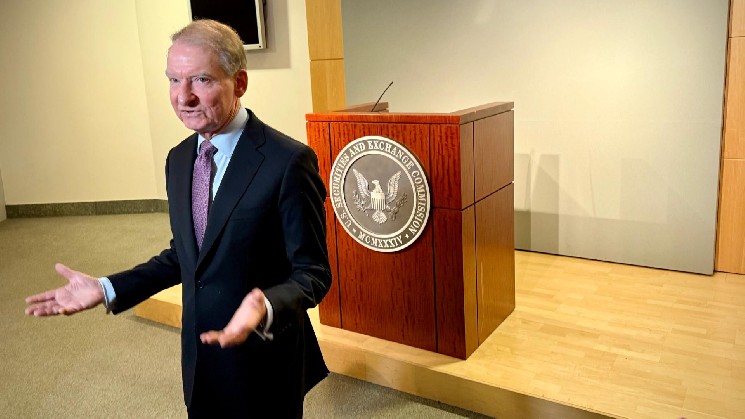
U.S. Securities and Exchange Commission (SEC) Chair Paul Atkins urged Congress to advance the crypto market structure bill best-known as Clarity Act, while making clear the agency’s crypto agenda will move forward regardless of the bill’s fate.
“Congress should vote to advance the Clarity Act and send it to the president’s desk as soon as possible,” Atkins said Monday during a keynote at a Solana Policy Institute event in Washington. “But let me be equally clear: with or without that legislation, this administration will deliver for American investors and technological innovators.”
The Senate is set to hold a cloture vote Tuesday afternoon U.S. Eastern time on a motion to proceed to the Digital Asset Market Clarity Act, a procedural test of whether the sweeping crypto market structure legislation has enough support to advance.
SEC to advance crypto agenda regardless of Clarity Act vote
Atkins used much of his speech to lay out the SEC’s parallel regulatory push under “Project Crypto,” highlighting three areas that he said would form the foundation for how digital assets are issued, transferred and held in the U.S.
The first is the SEC’s proposed Regulation Crypto Assets, which Atkins described as one of the commission’s most significant efforts to modernize securities regulation for crypto.
If adopted, he said, the framework would give entrepreneurs greater certainty to raise capital in the U.S. using digital assets rather than having to “guess what the law is as they go.”
The second is an overhaul of transfer agent rules to include blockchains for digital ownership ledgers. Atkins said the rules have not been seriously updated in roughly four decades and were built for paper stock certificates, while transfer agents are already adapting to a market that increasingly incorporates tokenized assets.
Moreover, Atkins said he has asked SEC staff to develop a proposal clarifying crypto custody for investment advisers and regulated funds. That proposal would seek to allow advisers, under certain conditions, to custody crypto themselves and to use state trust companies as custodians.
Atkins said self-custody may be necessary because qualified third-party custodians do not yet exist for some assets, while state trust companies already provide a pathway that “works in practice.”
He described the three initiatives together as “three pillars of a single, rational, and comprehensive regulatory architecture.”
“The SEC should not be the last institution to notice that the world actually has changed,” he said.
The push for the Clarity Act vote landed as the bill already faces an uphill battle, with several key disputes still unresolved ahead of Tuesday’s procedural vote.