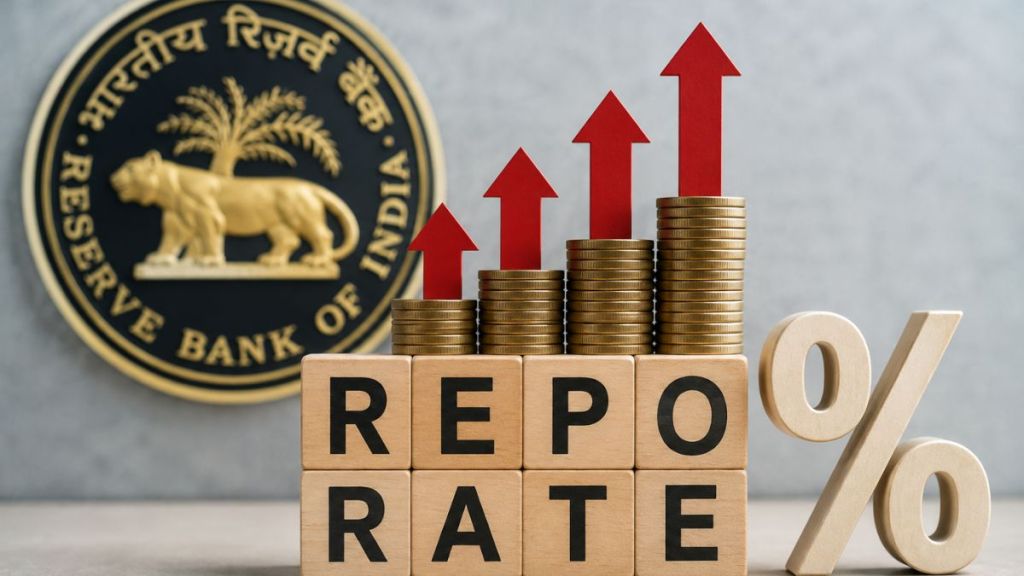
The Reserve Bank of India (RBI) may begin raising interest rates from December, according to a report by Morgan Stanley. Earlier the global brokerage was expecting the rate hike to begin from April 2027.
“We bring forward our expected rate hike cycle to December 2026 (from April 2027 previously), reflecting firmer inflation and growth trends. We expect the RBI to deliver a cumulative 75 bp rate hike cycle and peg the terminal rate at 6%,” Morgan Stanley.
This change in prediction came after the RBI kept the repo rate unchanged at 5.25% for the fourth consecutive policy meeting in August. RBI also retained its policy stance at ‘neutral’.
Morgan Stanley expects domestic demand to remain resilient, while headline inflation is expected to climb above 5% and remain elevated until June 2027.
Inflation likely to remain above 5% until June 2027
India’s headline retail inflation is expected to stay above the 5% mark in FY27.
ALSO READRBI MPC Highlights: ‘Neither dovish nor hawkish- this is the right policy rate,’ says RBI Governor
Morgan Stanley believes headline retail inflation may rise to around 5% by September and peak at 5.8% in the December quarter (Q3).
The brokerage said that inflation may stay above the 5% mark until June 2027, supported by higher food prices and a gradual rise in underlying inflation. However, it does not expect inflation to breach the RBI’s upper tolerance limit of 6%.
The RBI also expects headline CPI to average 5.0% YoY and core CPI 4.3% YoY in FY27.
In terms of core inflation, Morgan Stanlry believes, excluding jewellery, it will move above 4% from November 2026 and remain at or above that level through December 2027.
Growth momentum remains strong
The Indian economy, on the other hand, continues to show resilience despite global uncertainties.
Morgan Stanley expects GDP growth of 6.7% in FY27 and 7% in FY28. It said strong vehicle registrations, healthy consumer demand, faster industrial production and robust credit growth indicate that domestic demand remains firm. It also expects improving exports and sustained investment activity to support growth over the coming quarters.
The RBI has also marginally raised its FY27 GDP growth forecast to 6.7% from 6.6%, citing stronger high-frequency indicators.
Capital inflows to support liquidity, rupee
The RBI’s recent measures are also expected to attract overseas capital to improve liquidity and support financial conditions.
Morgan Stanley estimates additional capital inflows of $70-80 billion in FY27, which could help generate a balance of payments surplus of $35-40 billion. It believes these inflows will ease pressure on the rupee, improve liquidity in the banking system and support economic growth.
RBI likely to remain data-dependent
While expecting rate hikes later this year, Morgan Stanley believes the RBI will continue to closely monitor incoming data before changing policy.
RBI also said during its MPC announcement that policymakers need greater clarity on inflation before taking any action.
“There is a need for greater clarity to emerge, especially regarding inflation, its path and composition before taking any policy action. Any such action would also have to consider the need for recalibration of policy rates in line with the evolving growth-inflation dynamics, especially the normalisation of the underlying inflation from its benign levels seen hitherto,” the RBI said.
The brokerage will closely track high-frequency economic indicators, the inflation trajectory, weather conditions (EL Nino impact), capital flows, currency movements, commodity prices and global geopolitical developments before reassessing its policy outlook.
TOPICSRBIRBI Monetary Policy ReviewRepo RateReserve Bank of IndiaThe Reserve Bank of India + 0 MoreThis article was first uploaded on August six, twenty twenty-six, at three minutes past six in the evening. © IE Online Media Services (P) Ltd