
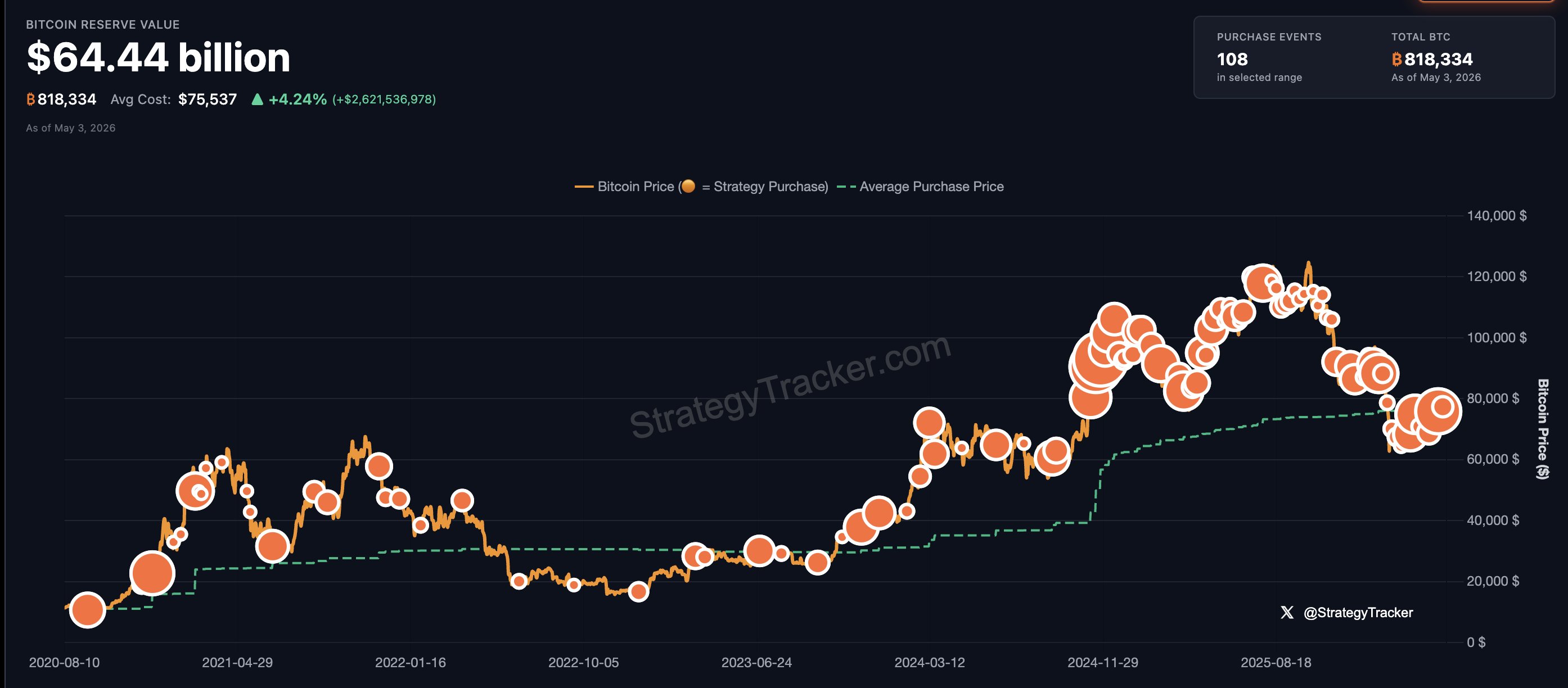
This past Sunday marked a notable moment for the cryptocurrency community as they awaited Michael Saylor’s anticipated “orange dot.” However, this week brought an unexpected twist with the head of Strategy announcing, “No buys this week.” For the first time in quite a while, the company’s aggressive accumulation strategy for $BTC fell silent.
The cause behind this “dry week” stems from issues related to their financing instruments. The current strategy resembles a sophisticated financial mechanism operating on two primary “engines,” both of which failed to produce the necessary results this week:
STRC (Stretch Preferred Stock): This instrument, which boasts an 11.5% yield and is considered Saylor’s flagship offering, only functions effectively when it trades above its $100 par value. Unfortunately, over the last fortnight, STRC has lingered in what can be termed as the “red zone,” remaining below $100 and rendering capital raising through this avenue less appealing.
MSTR ATM (At-the-Market equity sales): Following their acquisition of 3,273 $BTC at April’s end, Strategy opted not to inflate its stock price ahead of its critical Q1 2026 earnings call scheduled for May 5.
This technical friction coupled with an inability to leverage STRC effectively provided critics with ample opportunity to scrutinize the framework surrounding Strategy’s Bitcoin acquisition approach.
Peter Schiff Critiques Strategy as ‘Ponzi’
The most vocal critic emerged in Peter Schiff who hastily branded STRC as “the most obvious Ponzi scheme in history,” citing that its transparency actually highlights potential flaws.
Schiff argues that betting mathematically on $BTC‘s annual growth exceeding 11.5% merely serves as gambling masquerading under corporate strategy.
“Strategy CEO @phongle refuted my claim that $STRC is a Ponzi scheme by arguing it’s ‘transparent’ and ‘very clear what we’re doing.’ But I never accused Strategy of hiding anything. In fact, I labeled STRC as such precisely because $MSTR is so open about it.”
— Peter Schiff (@PeterSchiff) May 3rd, 2026
Counters from Phong Le suggest that transparency acts against any allegations; unlike traditional Ponzi schemes where gaps are hidden from view—here assets are recorded on-chain and capital raised comes from institutions aware they are buying leveraged exposure to Bitcoin. Schiff counters that simply declaring one is constructing a pyramid does not negate its nature.
As we enter early May 2024, Strategy holds onto approximately 818,334 $BTC. Despite halting purchases recently, their average acquisition cost stands at $75,537 , still below market rates ensuring profitability within their portfolio.
FAQ:
- What does Michael Saylor mean by “orange dot”?
- The term refers to updates or announcements regarding Bitcoin purchases made by his company during specific intervals.
- <strongWhy did there were no purchases announced?
- This was due primarily to unfavorable conditions affecting key financial instruments like STRC and MSTR ATM sales strategies used for acquiring more BTC.
- <StrongWhat criticisms have been leveled against Strategies’ methods?
- Peters Schiff criticized them labeling their approach akin too gambling rather than sound corporate practice due mainly too reliance upon BTC appreciation exceeding dividend payouts consistently over time.
.