
On Tuesday, Stafford Masie, the executive chairman of Africa Bitcoin Corporation, shared insights about Bitcoin’s role in various parts of Africa. He emphasized that in some regions, Bitcoin is utilized as a form of everyday currency rather than merely being viewed as a store of value.
During his conversation with Natalie Brunell on the Coin Stories podcast, Masie highlighted how perceptions of Bitcoin (BTC) vary significantly across different areas.
“In my region, we see Bitcoin as money,” he explained to Brunell. He noted that within certain circular economies in Africa, merchants prefer accepting satoshis over traditional dollars.
While many investors from developed nations often regard Bitcoin primarily as a hedge against inflation, Masie pointed out communities where satoshis are actively used within local economies. He contrasted this with the differing inflation rates experienced between Western countries and parts of Africa.
“When you discuss debasement at 4% to 5% annually in your context — we experience similar rates within just an afternoon,” he remarked.

Source: Coin Stories
Masie drew parallels between this trend and the rapid adoption of mobile technology across the continent. He argued that younger demographics are skipping over outdated financial systems entirely. Instead of gradually transitioning from stable fiat currencies, they are moving away from what he described as “broken money,” opting for digital assets instead.
The youthful population dynamics in Africa play a crucial role here; more than 25% of its inhabitants are under 20 years old. According to Masie, these younger generations not only embrace emerging technologies like artificial intelligence but also have a strong affinity for Bitcoin.
In this environment, Masie suggested that Bitcoin transcends its traditional role as merely a storehouse for value; it becomes “pristine capital.” This means it serves as foundational financial support upon which individuals and businesses can build their futures. As he stated:
“In Africa, we recognize life before and after 2008 — before and after the release of the Bitcoin white paper. Our existence transformed because suddenly we had access to something immune to debasement — immutable and decentralized assets that cannot be confiscated. For many Africans today—this represents life or death.”
A seasoned technology executive with extensive experience leading major tech initiatives in South Africa priorly leads Masie’s efforts at African BTC Corporation.
Related: Africrypt founders return to South Africa years post-platform collapse: Report
The Rise Of Cryptocurrency In Africa
The shift described by Masie appears supported by data from blockchain analytics firm Chainalysis regarding cryptocurrency adoption on the continent.
Btw July 2024 and June 2025 alone Sub-Saharan African nations received upwards of $205 billion worth on-chain transactions—a staggering increase by 52% year-on-year—making it one among globally fastest-growing crypto regions! March alone saw monthly volumes surge nearly $25 billion due largely towards activities originating out Nigeria following significant currency devaluation events!
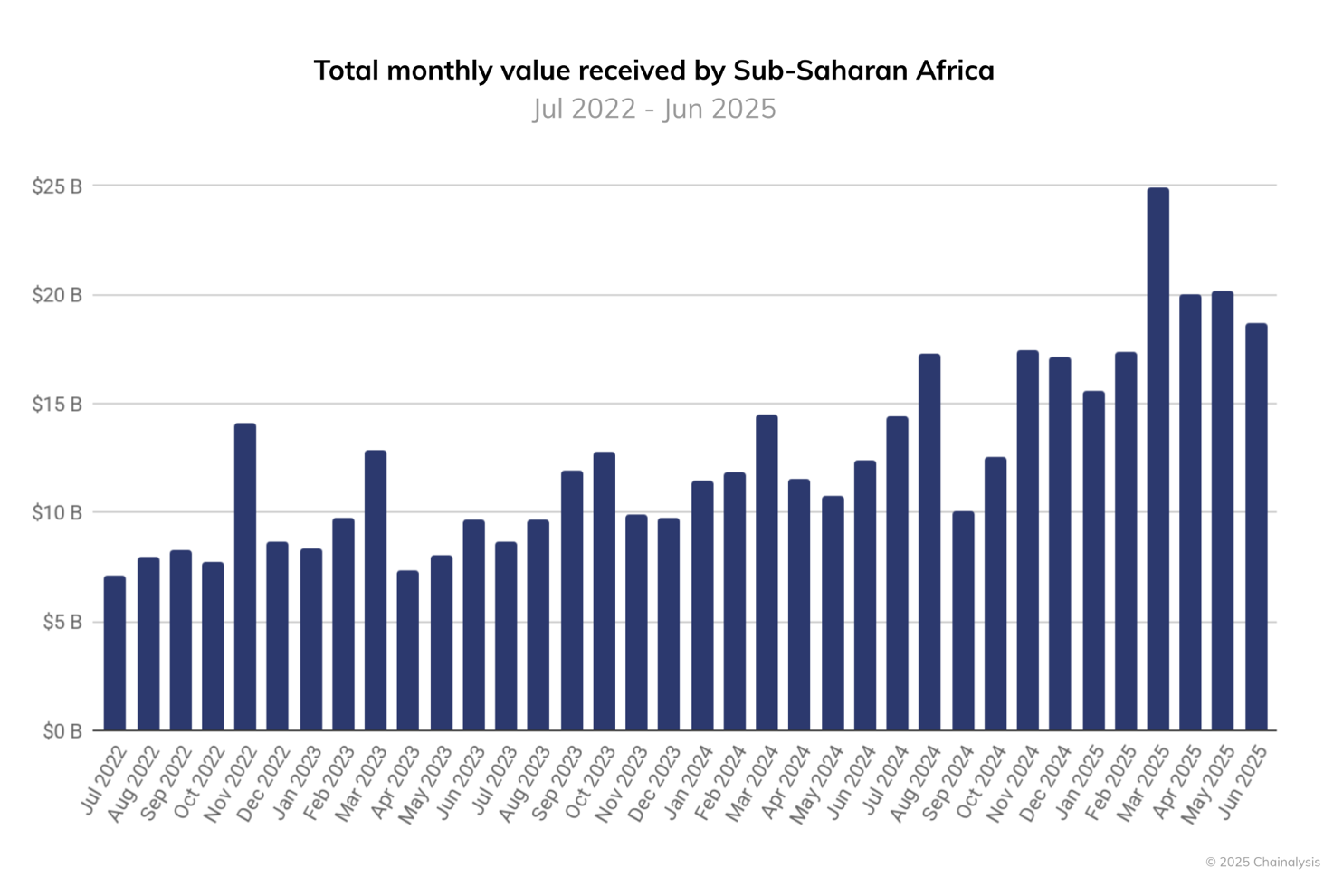
Source: Chainalysis
This area has also emerged prominently characterized through retail-driven market behaviors where transfers below $10k constituted over eight percent total value exchanged during same timeframe compared around six percent globally according reports released September earlier!
.
Nigeria alongside South African counterparts exhibited notable institutional activity reflected via recurring multimillion-dollar stablecoin transfers linked cross-border trades involving connections between both continents plus Middle East Asia respectively!
.
This January while addressing attendees World Economic Forum former UN Under-Secretary-General Vera Songwe elaborated further explaining how stablecoins increasingly regarded cheaper remittance settlement tools specifically tailored toward unique challenges faced throughout entire region’s economic landscape! She mentioned remittances have grown “more vital than aid” numerous African economies wherein conventional transfer methods typically incur costs averaging roughly six dollars per hundred sent despite existing high inflation exceeding twenty percent affecting around dozen countries additionally estimated six hundred fifty million unbanked individuals thus presenting opportunity utilizing such innovative solutions offering dual benefits acting both payment rails stores values amidst ongoing pressures placed respective currencies overall !
.
<Em Magazine : Would bitcoin really be at two hundred thousand if not Jane Street? Trade Secrets . .