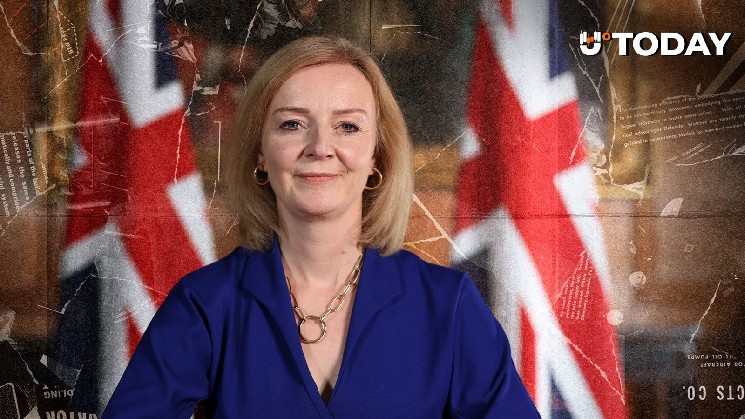
Liz Truss, the former Prime Minister of the United Kingdom, has publicly endorsed cryptocurrency as an essential mechanism for challenging the existing financial order.
She believes that Bitcoin can act as a crucial “balance” against the unchecked power wielded by central banks and entrenched bureaucracies.
A vital balance
For Truss, what makes cryptocurrency appealing is its potential to circumvent conventional financial systems.
She remarked that an increasing number of individuals are “discontent… with how money operates in our nation and how fiat currency functions here.”
“What draws me to it is its role as a counterbalance to the overwhelming influence held by central banks, which we’ve observed at both global and national levels—be it through institutions like the Bank of England or the European Central Bank,” she elaborated.
Truss highlighted that various world leaders are already utilizing digital currencies to navigate around failing traditional frameworks: “We appear to be witnessing disruptive political figures… employing it as a means to challenge established norms and confront outdated financial systems that have fundamentally failed their nations.”
The call for a ‘counter-revolution’
Truss has connected the embrace of decentralized finance with broader issues concerning civil liberties.
“It seems clear to me that unless we address Britain’s monetary system, we will not realize the kind of counter-revolution necessary for restoring people’s fundamental freedoms,” she cautioned. She further stated that “ownership of Bitcoin and belief in economic liberty are intertwined with other rights such as freedom of expression.”
“The majority of authority resides within permanent bureaucracies,” Truss asserted. “To advance within these structures, one must remain entrenched for years while navigating through them. There exist incentives promoting risk aversion and discouraging decisions likely to provoke backlash later on.”
Truss also acknowledged a significant gap between public perception regarding Britain’s economy versus its stark reality.
“Recent research indicated that average Britons perceive our wealth status akin either to being among America’s seventh poorest state or seventh richest state. In truth, we rank 51st; we’re poorer than Mississippi. Yet there seems little recognition among people about this serious issue facing our economy,” she explained.
In conclusion, Truss urged members from both Bitcoin circles and pro-business advocates alike to take action against institutional stagnation she experienced firsthand during her tenure in office.
“My time at Number 10 revealed just how formidable maintaining status quo can be,” Truss concluded.